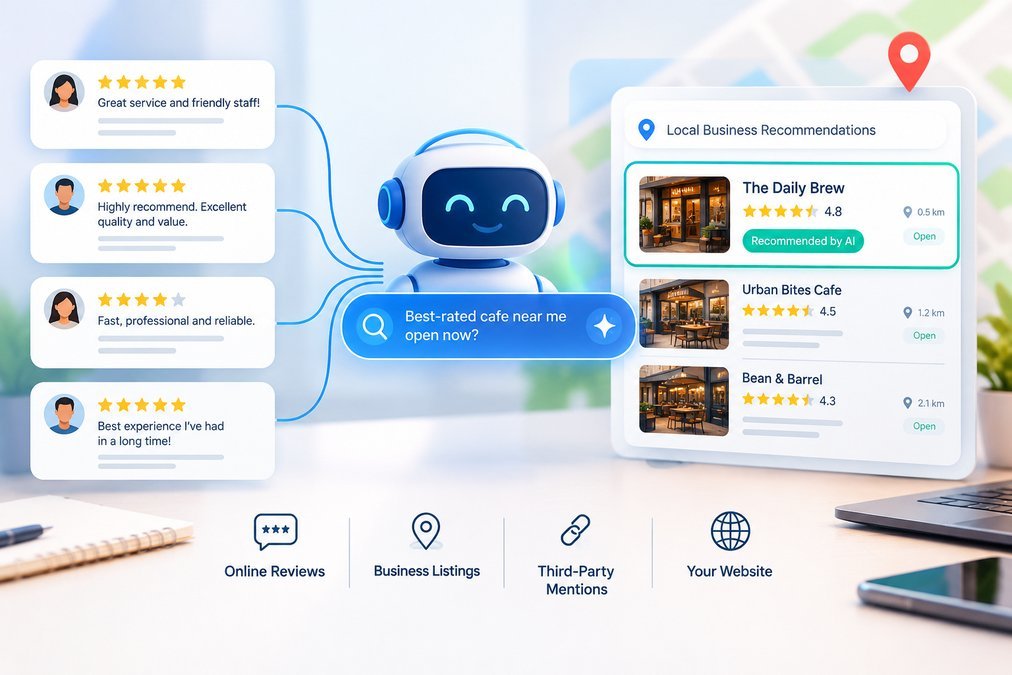
Not long ago, finding a good dentist, plumber, or restaurant meant searching Google and scrolling through local listings. Today, consumers can ask an AI assistant a more specific question: “Which is the best-rated dentist near me that is open on Saturdays?”
This shift is changing how people discover local businesses. BrightLocal's Local Consumer Review Survey 2026 reported that 45% of consumers had used AI tools for local business recommendations in the previous year, compared with 6% in 2025.
But here is what many business owners overlook: AI-generated recommendations depend on information available beyond a business's own website. Customer reviews, business listings, directories, and third-party references can all help establish what a business offers and how customers perceive it.
Online reviews now serve two purposes. They influence the people who read them directly, and they can contribute to the information AI tools use when answering questions about local businesses.
Key Takeaways
- AI tools are becoming an increasingly common starting point for local business discovery.
- Review quality, recency, ratings, and customer feedback help people evaluate businesses and may inform AI-generated recommendations.
- Consistent business information and credible third-party mentions make it easier for customers to verify a business's reputation.
- Consumers continue to check AI recommendations against reviews and other sources before making decisions.
- Agencies managing local SEO across multiple clients need repeatable processes for review management, listing accuracy, and AI visibility monitoring.
How AI Assistants Decide Which Local Businesses to Recommend
AI assistants do not all use the same sources or recommendation methods. Their responses can vary depending on the platform, location, query, and available information. However, several types of public information can influence how a local business is represented.
1. Business Profile Information
Business name, address, phone number, opening hours, service categories, and location details help establish what a business offers and where it operates. Google Business Profile, Bing Places, and other relevant directories can contribute to this information.
When details differ across platforms, customers may struggle to determine which information is accurate. Maintaining consistent listings helps create a clearer picture of the business.
2. Customer Reviews and Ratings
Reviews provide evidence of customer experiences. Ratings offer a quick quality signal, while written feedback explains why people recommend a business.
For example, several recent reviews mentioning punctuality, emergency callouts, and transparent pricing may help prospective customers understand a plumber's strengths. These details can also provide useful context when AI tools compile local recommendations.
3. Third-Party Mentions
Local directories, industry-specific review platforms, community discussions, and reputable publications can provide additional context about a business.
When information appears consistently across credible sources, customers have more opportunities to verify a business's reputation. However, simply appearing on more websites does not guarantee an AI recommendation; relevance and the quality of the available information matter.
4. The Business Website
A clear website helps people understand the services offered, locations served, business credentials, and contact information. Dedicated service pages and accurate location details make this information easier to interpret.
Reviews are particularly useful because they describe customer experiences in language that prospective customers recognise. Still, no universal review count or rating guarantees an AI recommendation. Reviews work alongside other information, and each platform may handle available sources differently.
What the 2026 Review Data Tells Us
BrightLocal's 2026 research highlights changing consumer expectations around online reviews. People increasingly look beyond the overall star rating to assess the quality, consistency, and freshness of customer feedback.
The survey reported that 74% of consumers look for reviews written within the last three months. It also found that 31% of consumers only use businesses rated 4.5 stars or higher.
These findings point to two important developments.
First, reputation is not simply about accumulating reviews. Consumers want recent feedback that reflects current service quality. A business with hundreds of reviews from several years ago may still need to demonstrate that customers continue to have positive experiences.
Second, AI has added another discovery stage rather than eliminated the need for independent verification. A consumer might ask ChatGPT for a shortlist of local dentists, visit the recommended businesses' review profiles, compare recent experiences, and then make an appointment.
Reviews therefore influence both initial discovery and the decision that follows it.
Expert Insight: Why Trust Signals Matter in AI Search
“AI assistants don't invent their opinion of a local business. They borrow it from reviews, listings and what other sites say about you. If those signals are thin, outdated or inconsistent, the AI simply recommends someone else. The businesses winning in AI answers aren't gaming anything. They're just earning reviews every month and answering every one of them.”
— Darshan Modi, Director – Digital Growth & AI Search, Mavlers Agency
This perspective highlights an important distinction for businesses and the agencies supporting them. Appearing in an AI-generated answer is not the same as securing a high position in a traditional search result. A business may rank well for a local keyword but remain absent from a particular AI response.
Review management, accurate listings, relevant third-party references, and a sound SEO foundation should therefore be treated as complementary activities rather than competing priorities.
A Seven-Step Review Playbook for Local Businesses
Businesses do not need complicated systems to establish better review-management habits. They need a consistent process that makes it easy for customers to share genuine feedback and helps maintain accurate information online.
1. Correct Your Business Listings
Check that your business name, address, phone number, opening hours, categories, and service details are accurate across Google Business Profile, Bing Places, Apple Business Connect, and relevant industry directories.
Update outdated details whenever your business moves, changes its hours, or adds a service. Consistency helps customers identify the correct business and reduces confusion.
2. Request Reviews at the Right Moment
Invite customers to leave honest feedback after a completed job, appointment, purchase, or other meaningful interaction. A polite email or text message with a direct review link can make the process convenient.
Keep requests neutral. Avoid pressuring customers to leave positive reviews, offering prohibited incentives, or selectively asking only customers expected to provide favourable feedback.
3. Build a Steady Flow of Genuine Reviews
A regular stream of authentic reviews gives prospective customers a more current picture of the business than a sudden burst followed by months of silence.
Make review requests part of the normal customer follow-up process. The goal is not to chase an arbitrary monthly number but to consistently collect honest feedback from genuine customers.
4. Respond to Positive and Negative Feedback
Thank customers for positive reviews and acknowledge the specific experience they describe when appropriate. For negative reviews, respond calmly, address the concern, and offer a suitable route to resolve the issue.
Avoid repetitive, generic replies. Personal and professional responses demonstrate that the business takes feedback seriously. Never disclose private customer information in a public response.
5. Encourage Specific, Honest Feedback
Customers may naturally mention the service they used, the problem they needed solved, or what they appreciated about the experience. These details are more informative than identical, one-line ratings.
Ask customers to describe their experience in their own words. Do not dictate review wording or attempt to manipulate what customers say.
6. Maintain a Presence on Relevant Review Platforms
Google is important for many local businesses, but it is not the only place customers look for reassurance. Depending on the industry, specialist healthcare directories, home-service marketplaces, travel review sites, and local business directories may also matter.
Choose platforms based on where customers genuinely research businesses. A well-maintained profile on a relevant review site is more useful than creating inactive profiles everywhere.
7. Monitor What AI Tools Say About Your Business
Test relevant questions in ChatGPT, Gemini, Perplexity, and Google's AI search experiences. Use queries that reflect actual customer needs, such as “Which family dentists in [location] have strong recent reviews?” or “Which plumbers near [location] offer emergency services?”
Record whether your business appears, which sources are cited, and whether the description is accurate. Repeat the checks periodically, using the same prompts where possible.
AI answers can change between sessions, so a single result should not be treated as a definitive visibility score. A repeatable monitoring process can help identify patterns and gaps worth investigating.
One rule should never be compromised: do not buy, fabricate, or manipulate reviews. Fake feedback undermines trust and may violate platform policies or applicable consumer-protection laws.
What This Means for Agencies Managing Local Clients
For digital marketing agencies, the shift creates a practical delivery challenge. Clients who previously asked about Google Maps rankings and website traffic may now want to know why ChatGPT does not recommend their business.
Answering that question requires more than checking a single ranking report. Agencies may need to review business profiles, citation consistency, review patterns, third-party references, local SEO performance, and AI-generated responses across multiple platforms.
The workload grows quickly when an agency manages several clients, each with different services, locations, competitors, and review profiles. Every account needs accurate records, recurring checks, and clear reporting. Adding this work without changing delivery processes can put pressure on existing teams.
When agencies want to scale beyond what their internal teams can deliver, white-label outsourcing can turn specialist capacity into an extension of the agency itself. Digital agencies partner with Mavlers Agency to deliver specialized services under their own brand while retaining ownership of client relationships.
An offshore delivery model can give agencies access to additional execution capacity without requiring them to recruit every specialist in-house. This is particularly useful when recurring tasks such as listing management, review monitoring, citation building, and reporting need to be handled across multiple accounts.
Through its white-label local SEO services, Mavlers Agency supports agencies with local SEO execution under their own brand, including business profile optimization, citation management, review management, and reporting.
The objective is not to promise that a particular review count will secure an AI recommendation. It is to build a consistent delivery process that improves the accuracy, quality, and visibil
Tags : .....