Understanding Human S9 Fraction: From Isolation to Drug Metabolism Analysis
By Kosheeka Primary Cells for Research 21-10-2026 3
Introduction
A drug candidate can look promising in early experiments, but what happens when it encounters the enzymes responsible for breaking down compounds in the human body? Understanding this process is an important part of drug development. Researchers need to know how quickly a compound is metabolised, which pathways are involved, and whether new metabolites appear during the process.
The human S9 fraction offers a practical way to investigate these questions in the laboratory. It contains a range of metabolic enzymes and supports the study of different biochemical reactions within a single preparation. For researchers working in drug discovery, it provides useful early insights into how a compound might be transformed by human liver enzymes.
What Is Human S9 Fraction?
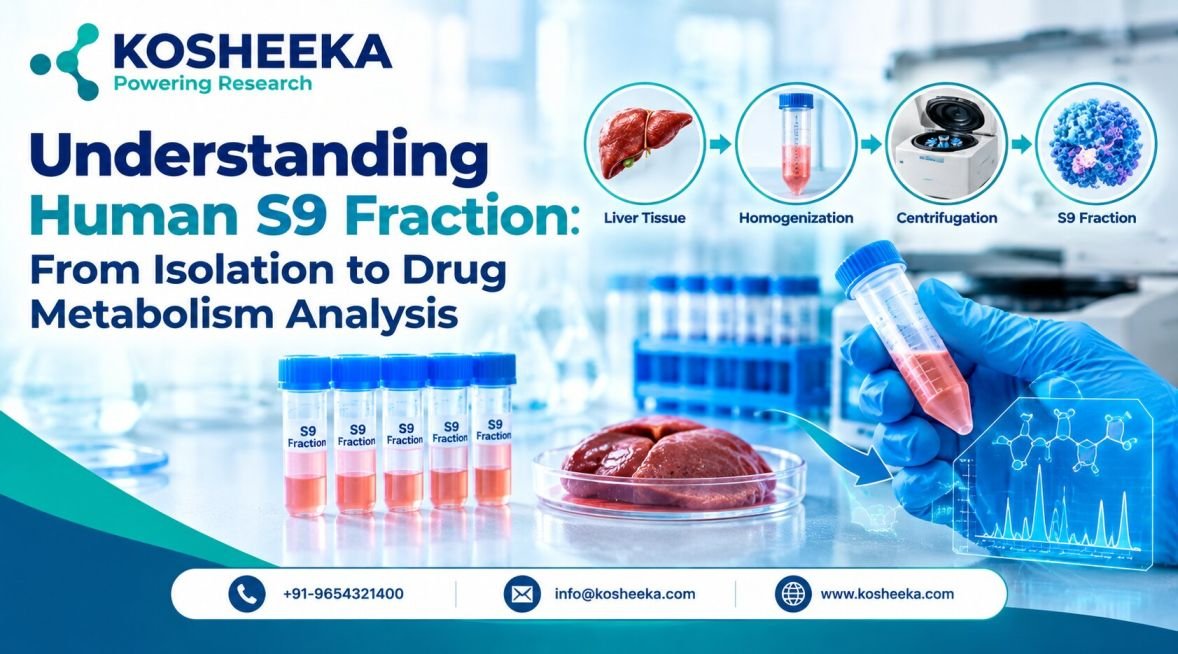
Human S9 fraction involves preparation of tissue homogenates from human liver tissue. It is collected from the supernatant remaining after centrifugation at approximately 9,000 × g under defined conditions.
What makes this preparation useful is its combination of microsomal and cytosolic components. The microsomal portion contains enzymes such as cytochrome P450s, which play an important role in the metabolism of many drugs. The cytosolic portion contributes other enzymes involved in reactions such as reduction, hydrolysis, and conjugation. The combination enables researchers to investigate multiple metabolic pathways. The enzyme content and activities vary depending on the tissue source and preparation method.
Human S9 Fraction Preparation and Isolation
Human S9 fraction preparation involves multi-step process:
- Tissue is homogenised in a suitable buffer, it releases the cellular components and preserves enzymatic activities
- Cellular homogenate undergoes differential centrifugation, this removes the larger cellular structures and debris
- Supernatants are collected after the appropriate centrifugation step contains the components needed for the S9 fraction. Depending on the intended application, additional processing may be used to clarify the preparation or meet specific quality requirements.
- Certain consideration factors include tissue condition, source, centrifugation settings, environmental conditions like temperature, or pH and storage condition. Poor handling or repeated freeze–thaw cycles potentially compromises the S9 fraction quality.
- Researchers require reliable information about the tissue origin, protein concentration, preparation conditions, storage, and relevant enzyme activities.
Human S9 Fraction Assay: How Is Metabolic Activity Evaluated?
Once the preparation is ready, researchers can use a human S9 fraction assay to examine how a test compound behaves in the presence of metabolic enzymes. The steps involves:
- The compound is incubated with the S9 fraction under controlled conditions
- Researchers measure how much of the original compound remains or identify the metabolites formed during incubation
- The requirements depend on the reactions. For instance, oxidative metabolism indicates NADPH-generating system, while certain conjugation reactions requires cofactors (UDP-glucuronic acid, glutathione). Incubation time, temperature, protein concentration, and substrate concentration must also be considered.
- Controls are equally important. They help researchers distinguish enzyme-driven metabolism from chemical degradation or other changes that occur independently of enzymatic activity.
- Analytical methods (LC-MS/MS) are used to measure compounds and their metabolites. The resulting data can help establish metabolic stability, identify possible pathways, and determine whether further investigation is needed.
Human S9 Fraction Metabolism: The Enzymes Behind the Process
Human S9 fraction supports investigation of multiple reactions involved in drug metabolism. During phase I metabolism, enzymes such as cytochrome P450s modify compounds through oxidation, reduction, or hydrolysis. These reactions can change a compound's chemical structure and sometimes produce metabolites that undergo further processing.
Phase II metabolism involves conjugation, in which enzymes attach groups such as glucuronic acid or glutathione to suitable compounds or their metabolites. These changes can influence their biological activity, solubility, and elimination.
Human S9 fraction consist of both microsomal and cytosolic components. They support both Phase I and Phase II reactions. However, not every pathway will be adequately represented under all assay conditions. Some reactions depend on specific cofactors, while enzyme activity can differ considerably between human liver samples.
Applications of Human S9 Fraction in Drug Metabolism Research
Human S9 fraction drug metabolism studies help researchers investigate how experimental compounds behave before moving into more advanced stages of development. The applications include:
- Metabolic stability: Measuring the rate at which a parent compound disappears during incubation.
- Metabolite profiling: Identifying products formed as enzymes transform a compound.
- Drug interaction studies: Investigating selected enzyme-mediated interactions between compounds.
- Early-stage screening: Identifying metabolic liabilities that may influence the selection or optimisation of drug candidates.
- Biotransformation research: Examining how structural changes affect the way a compound is metabolised.
- Such findings enable researchers to unveil further testing of compounds and metabolic pathways. They serve as crucial useful starting points for studies using other experimental models.
Limitations and Experimental Considerations
Lacks normal tissue architecture, blood flow, and the interactions between different cell types
Differences between tissue donors affect enzyme activity and experimental outcomes
Absence of a particular metabolite in an assay does not necessarily mean that the compound cannot produce under other biological conditions Results can interpret alongside the assay design, analytical data, and limitations of the model. Complementary systems might enable development of more complete picture of a compound's metabolic behaviour
Conclusion
Human S9 fractions give researchers a useful starting point for understanding how compounds are transformed by human metabolic enzymes. Careful preparation and isolation, appropriate assay conditions, and reliable analytical methods all contribute to meaningful results. When used alongside complementary models, the human S9 fraction can support early drug development by helping researchers investigate metabolic stability, identify metabolites, and assess potential challenges before progressing to more advanced studies.