
Introduction
Businesses today prefer faster and more convenient ways to manage certification. As a result, many organizations now choose ISO registration online instead of relying only on paperwork and face-to-face meetings. Digital registration saves time, simplifies communication, and makes document sharing much easier.
Whether you run a start-up, a manufacturing company, a healthcare organization, or an IT business, online registration offers a practical starting point for your ISO certification journey. It allows your team to organize documents, communicate with certification professionals, and track progress from almost anywhere.
However, many businesses still wonder how the online process actually works. They also want to know what information they need before getting started. Understanding each stage helps avoid delays and improves the overall experience.
This guide explains the complete process of ISO registration online, its benefits, and the best practices that help organizations prepare for successful certification.

Why Businesses Choose ISO Registration Online
Technology has changed how companies manage business operations. Certification is no exception. Online registration makes the process faster, more transparent, and easier to manage.
Instead of mailing documents or scheduling multiple office visits, organizations can upload files securely through digital platforms. They can also communicate with certification teams through email, video meetings, and online portals.
Moreover, digital registration allows businesses to monitor their progress from one location. This approach reduces administrative work and keeps everyone informed throughout the process.
What Is ISO Registration Online?
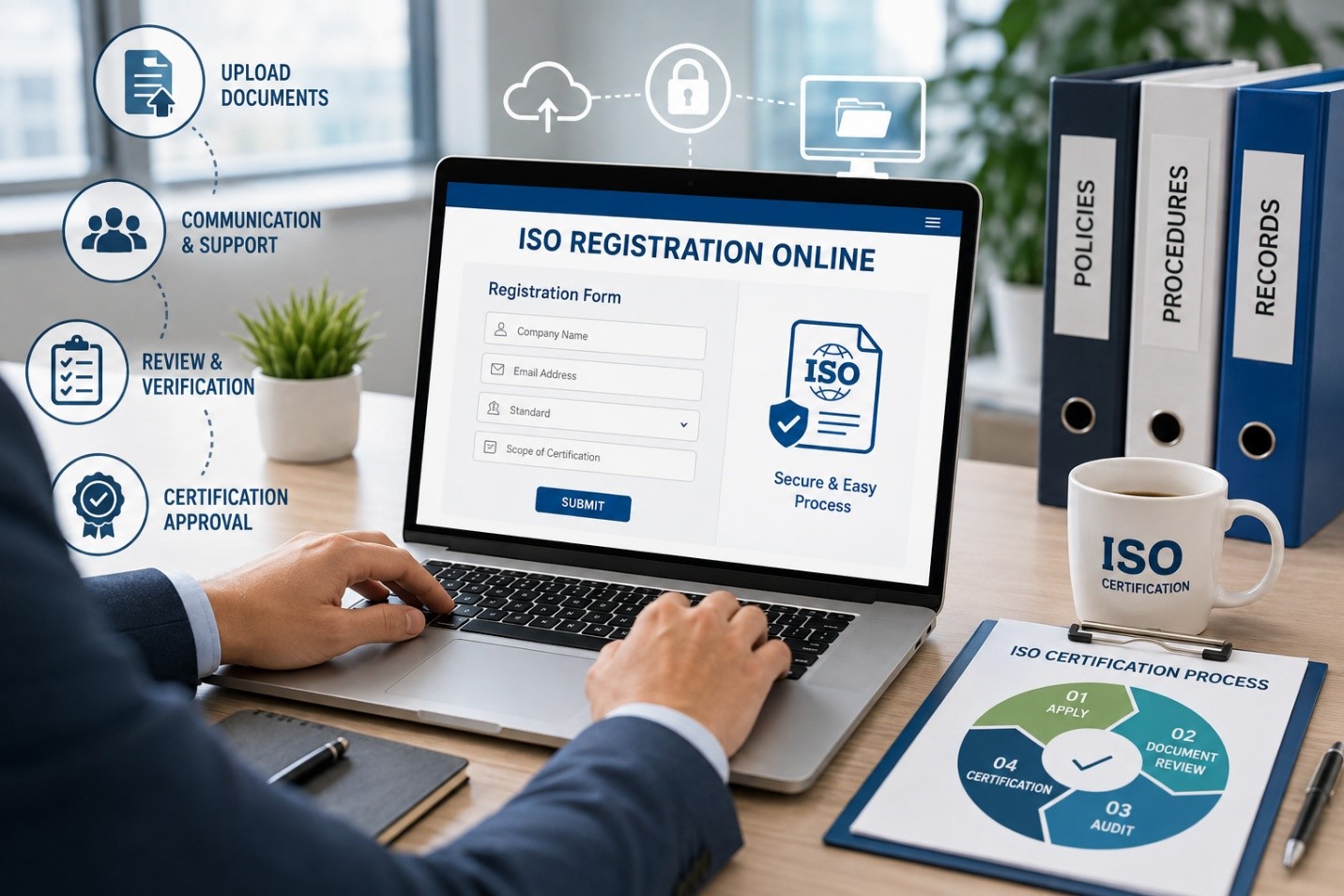
ISO registration online is the digital process of applying for ISO certification through online communication and document management systems.
Organizations submit basic business information electronically. They also upload required documents and communicate with certification professionals through secure online platforms.
Although many activities happen online, certification still requires proper implementation of the management system. Organizations must demonstrate that their processes work effectively before certification is granted.
Therefore, online registration improves convenience without changing the technical requirements of ISO certification.
Step 1: Identify the Right ISO Standard
The first step is selecting the ISO standard that best supports your business objectives.
Different standards address different management systems. For example, organizations may choose standards related to quality, environmental management, occupational health and safety, food safety, information security, or energy management.
Selecting the appropriate standard helps ensure that the certification aligns with business goals and customer expectations.
Step 2: Submit Basic Business Information
After selecting the standard, organizations complete an online registration form.
This form usually requests information such as:
- Company name
- Business location
- Number of employees
- Industry sector
- Scope of operations
- Desired ISO standard
- Contact information
Providing accurate information helps certification providers understand your organization and recommend the appropriate certification process.
Step 3: Prepare Digital Documentation
Documentation plays an important role throughout the certification process.
Organizations should gather existing policies, procedures, work instructions, process maps, and operational records before submitting their application.
Well-organized documents reduce unnecessary questions and speed up the initial review.
Digital document management also allows quick updates whenever changes occur.
Step 4: Initial Documentation Review
After receiving your documents, the certification team performs an initial review.
They check whether the submitted information appears complete and relevant. They may also request additional documents or clarification if necessary.
This early review helps identify missing information before the formal audit begins.
Consequently, organizations can address issues early instead of facing delays later.
Step 5: Communication and Planning
Once the documentation review is complete, planning begins.
The certification provider works with your organization to discuss timelines, audit arrangements, and project expectations.
Most communication now happens through online meetings, emails, or digital collaboration platforms.
This approach improves flexibility, especially for organizations with multiple offices or remote teams.
Step 6: Prepare for the Certification Audit
Successful certification depends on preparation.
Organizations should ensure employees understand documented procedures and follow established processes consistently.
Internal reviews also help identify improvement opportunities before the certification audit takes place.
Many companies conduct internal audits to verify readiness and correct any gaps before the external assessment.
Benefits of ISO Registration Online
Digital registration provides several advantages for businesses of every size.
Faster Communication
Online communication reduces waiting time.
Questions receive quicker responses, and document exchange becomes much more efficient.
Better Document Management
Digital files remain organized and accessible.
Teams can update documents without printing multiple copies or maintaining large paper archives.
Improved Collaboration
Remote teams can participate easily.
Employees from different locations can review documents, attend meetings, and contribute throughout the certification process.
Greater Flexibility
Organizations can complete many administrative tasks from their office or even while working remotely.
This flexibility saves valuable time and reduces travel requirements.
Common Challenges
Although online registration offers many benefits, organizations should remain aware of potential challenges.
Incomplete documentation often creates unnecessary delays.
Similarly, poor communication between departments can slow progress.
Businesses should also avoid submitting outdated procedures that no longer reflect daily operations.
Finally, assigning responsibility to multiple people without coordination may create confusion.
A dedicated project coordinator usually helps keep the process organized.
Best Practices for Success
Businesses can improve their certification experience by following several simple practices.
First, organize documentation before beginning registration.
Next, assign one person to coordinate communication with the certification provider.
Additionally, review procedures carefully before uploading documents.
Regular communication also helps resolve questions quickly.
Finally, treat certification as an opportunity for continual improvement rather than simply completing an administrative requirement.
Common Mistakes to Avoid During Online Registration
Many businesses begin the registration process with good intentions. However, a few common mistakes can slow down progress.
Submitting Incomplete Information
Always complete every section of the registration form carefully. Missing details often lead to follow-up questions and unnecessary delays.
Uploading Outdated Documents
Review your procedures before uploading them. Ensure every document reflects your current business practices. Updated records make the review process smoother.
Poor Internal Coordination
Assign one person or a small team to manage the registration process. This approach improves communication and prevents duplicate work.
Delaying Responses
Certification providers may request additional information during the review. Respond promptly to keep the project moving forward.
How Online Registration Supports Remote and Multi-Site Businesses
Many organizations now operate from multiple locations. Some also have remote employees working from different cities or countries.
Online registration makes collaboration much easier in these situations.
Employees can upload documents from any location. Managers can review files without waiting for printed copies. Virtual meetings also allow project teams to discuss certification progress efficiently.
As a result, businesses save time while maintaining better communication throughout the certification journey.
Choosing the Right Certification Provider
Selecting the right certification provider is an important decision. A reliable provider should offer clear communication, structured guidance, and professional support throughout the process.
When comparing providers, consider the following factors:
- Experience in your industry
- Clear registration process
- Responsive customer support
- Transparent communication
- Digital document management
- Practical guidance throughout certification
Instead of choosing only based on price, compare the overall value offered by each provider.
A professional and responsive team often makes the certification journey much smoother.
How ISO Registration Supports Business Growth
ISO certification offers benefits that extend beyond compliance.
A structured management system helps organizations improve consistency, reduce errors, and strengthen customer confidence.
In addition, documented processes improve communication across departments. Employees understand their responsibilities more clearly, and managers can monitor performance more effectively.
Many organizations also discover opportunities to improve efficiency while preparing for certification.
Therefore, ISO registration becomes part of a broader business improvement strategy instead of a one-time project.
Tips for a Smooth Registration Experience
You can simplify the process by following a few practical recommendations.
Start by collecting important business documents before beginning registration.
Next, review your existing procedures to ensure they match current operations.
Maintain regular communication with your certification provider throughout the project.
Furthermore, encourage department managers to participate during document preparation and internal reviews.
Finally, keep digital records organized so they remain easy to locate whenever additional information is requested.
Frequently Asked Questions
Can small businesses complete ISO registration online?
Yes. Small businesses often benefit the most from online registration because it reduces administrative work and simplifies communication.
Is online registration secure?
Most certification providers use secure digital platforms for document sharing and communication. Nevertheless, businesses should always follow good cybersecurity practices when uploading confidential information.
Does online registration guarantee certification?
No. Online registration only begins the certification process. Organizations must still implement an effective management system and successfully complete the required assessments.
Can documents be updated after submission?
Yes. Organizations often update documents during the review process if improvements or corrections become necessary.
Is online registration suitable for large organizations?
Absolutely. Large organizations with multiple locations often prefer online registration because it improves coordination and simplifies document management across different sites.
Future Trends in ISO Registration
Digital transformation continues to reshape certification processes.
Many organizations now use cloud-based document management systems to organize policies, procedures, and operational records.
Artificial intelligence and workflow automation are also improving document reviews and administrative tasks. Although human expertise remains essential, technology helps reduce repetitive work and improve efficiency.
In the coming years, businesses can expect online registration platforms to become even more user-friendly, secure, and collaborative.
Conclusion
ISO registration online offers organizations a faster, simpler, and more organized way to begin their certification journey. Digital registration improves communication, simplifies document management, and supports collaboration across multiple teams and locations.
However, successful certification depends on more than completing an online application. Organizations must prepare accurate documentation, implement effective management systems, and maintain continual improvement throughout their operations.
By understanding each stage of the process and following best practices, businesses can avoid common challenges and move toward certification with greater confidence. Whether you represent a startup, a growing enterprise, or a large multinational company, online registration provides a practical foundation for achieving internationally recognized ISO certification.
Gallery
ISO Registration Online: A Complete Guide for Businesses Seeking ISO Certification
Chennai-
0.0Ratings
- 0+Reviews
- 0 + Followers
Opening Hours
| Monday | 6:00 am - 6:00 am |
|---|---|
| Tuesday | 9:00 am - 6:00 am |
| Wednesday | 9:00 am - 6:00 am |
| Thursday | 9:00 am - 6:00 am |
| Friday | 9:00 am - 6:00 am |
| Saturday | 9:00 am - 6:00 am |
| Sunday | Closed |
Recent Questions and Answers
Have a question? Ask away!