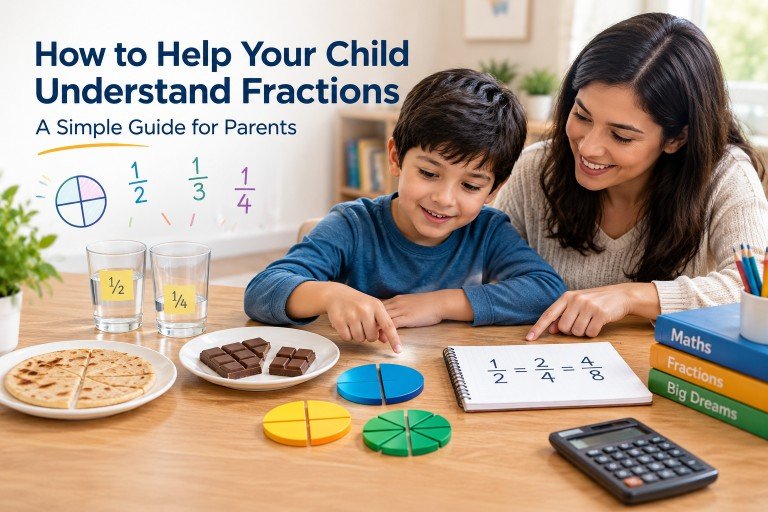
Fractions are one of the first topics where many children start to struggle with maths. Up to that point, numbers feel simple: 3 is bigger than 2, and adding means getting more. Then fractions arrive, and suddenly 1/4 is smaller than 1/3, even though 4 is bigger than 3.
If your child finds fractions confusing, they’re not alone. The good news is that fractions become much easier once the basic idea clicks. This guide explains how parents can help at home, step by step, without needing to be maths experts themselves.
Why Fractions Feel Hard
Most children learn numbers as counting: one, two, three. Fractions break that habit, because a fraction is not a count but a part of a whole. The bottom number (the denominator) tells you how many equal parts the whole is cut into, and the top number (the numerator) tells you how many of those parts you have.
That’s why 1/4 is smaller than 1/3. Cutting a roti into four pieces gives smaller pieces than cutting it into three. Once a child understands this, most of the confusion disappears.
Step 1: Start With Real Objects
Before worksheets, use things your child already knows:
• Roti or chapati: fold or cut it into halves, then quarters. Ask, “Which piece is bigger, one half or one quarter?”
• A chocolate bar: break it into equal squares and ask what fraction three squares out of twelve make.
• Glasses of water: fill one glass halfway and another a quarter of the way.
Children remember what they can see and touch. A few minutes with real objects builds stronger understanding than an hour of copying sums.
Step 2: Teach Equivalent Fractions
Next, show that different fractions can mean the same amount. Half a roti is the same as two quarters, which is the same as four eighths:
1/2 = 2/4 = 4/8
The rule is simple: multiply or divide the top and bottom by the same number, and the value doesn’t change. This idea is the key to almost everything else in fractions, especially simplifying and adding.
Step 3: Simplifying Fractions
A fraction is in its simplest form when no number other than 1 divides both the top and the bottom. To simplify, divide both by their highest common factor.
For example, take 18/24. Both 18 and 24 can be divided by 6:
18 ÷ 6 = 3 and 24 ÷ 6 = 4, so 18/24 = 3/4
Encourage your child to always ask, “Can I make this smaller?” before writing a final answer. Many marks are lost in exams simply because answers are left unsimplified.
Step 4: Adding and Subtracting Fractions
This is where most mistakes happen. Children often add the tops and the bottoms, writing 1/4 + 1/3 = 2/7, which is wrong.
You can only add fractions when the bottom numbers are the same. So first, find a common denominator, usually the lowest common multiple (LCM) of the two bottoms:
1/4 + 1/3 = 3/12 + 4/12 = 7/12
A quick check helps: 1/4 + 1/3 should be a bit more than half. Since 7/12 is just over 6/12, the answer makes sense. Teaching children to estimate like this helps them catch their own mistakes.
Step 5: Multiplying and Dividing Fractions
Multiplication is actually easier than addition. Multiply the tops together and the bottoms together, then simplify:
2/3 × 3/4 = 6/12 = 1/2
For division, use the “keep, change, flip” trick. Keep the first fraction, change ÷ to ×, and flip the second fraction:
3/4 ÷ 1/2 = 3/4 × 2/1 = 6/4 = 3/2, or 1½
Common Mistakes to Watch For
How to Check Homework Without Doing It for Them
Many parents want to help but aren’t confident with fractions themselves, or don’t remember the methods taught at school today. Instead of giving the answer, ask your child to explain each step out loud. If they get stuck, ask what the bottom numbers need to be before adding.
To check the working, you can use a fraction calculator that shows every step, not just the final answer. Your child can compare their own working line by line and see exactly where a mistake happened. That turns a wrong answer into a lesson instead of a frustration.
When to Consider Extra Support
Some children need more help than parents can give at home, and that’s perfectly normal. Consider a tutor, coaching class or abacus programme if your child:
• Still struggles with basic equivalent fractions after several weeks of practice
• Feels anxious or avoids maths homework
• Is falling behind in class tests on fractions and decimals
When choosing a coaching centre, read reviews from other parents, ask about batch sizes, and check whether the teacher focuses on understanding or only on memorising methods.
Conclusion
Fractions don’t have to be a struggle. Start with real objects, build understanding of equivalent fractions, and then move step by step through simplifying, adding, multiplying and dividing. Keep practice sessions short and regular, praise effort over speed, and let your child explain their thinking. With a little patience at home, fractions can become one of the topics your child feels most confident about.