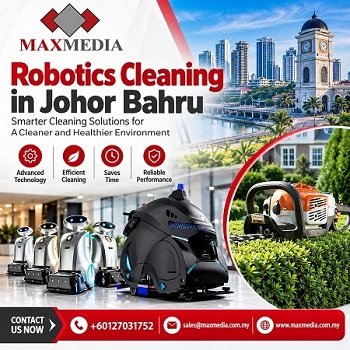
Robotic cleaners improve cleaning efficiency in large spaces by operating autonomously across wide floor areas without fatigue, supervision, or shift breaks. They use sensors and mapping technology to navigate complex layouts, cover more ground per hour than manual teams, reduce labour dependency, and maintain consistent cleaning quality — making them highly effective for facilities exceeding 5,000 square feet.
Managing cleanliness across a large commercial or industrial facility is not a simple task. For facility managers and building managers, the challenge is not just about keeping floors clean — it is about doing so consistently, cost-effectively, and without disrupting daily operations. That is where robotics cleaning in Johor Bahru is changing the game. Robotic floor cleaning technology has moved well beyond novelty. It is now a practical operational tool for large-scale facilities.
Why Large Spaces Are Difficult to Clean Manually
Large spaces — warehouses, shopping malls, airports, hospitals, logistics hubs, and corporate campuses — present unique cleaning challenges that manual teams often struggle to address consistently.
The core problems are straightforward:
- High labour turnover in the cleaning industry leads to inconsistent standards
- Manual cleaning teams cannot realistically cover thousands of square metres per shift at peak quality
- Repeat cleaning runs during peak hours cause disruption to building occupants
- Supervisory overhead increases as the facility footprint grows
In Malaysia, the facilities management sector has been growing steadily. According to the Malaysian Facilities Management Association (MFMA), demand for professional facilities services — including cleaning — continues to rise in line with commercial real estate expansion, particularly in Johor Bahru where large-scale developments and logistics parks have expanded significantly over the past decade.
How Robotic Floor Cleaning Technology Works
Modern robotic floor cleaning units are not remote-controlled machines. They are autonomous systems equipped with LiDAR sensors, simultaneous localisation and mapping (SLAM) technology, and AI-driven path planning. This allows them to create a digital map of the facility, identify obstacles in real time, and calculate the most efficient cleaning route.
Key Technical Features That Drive Efficiency
- SLAM Navigation: The robot builds and updates a live map of the space. It adapts to changes such as parked trolleys, temporary partitions, or foot traffic patterns.
- Multi-surface capability: Advanced units handle polished concrete, vinyl, ceramic tiles, and epoxy floors — all common in Malaysian commercial buildings.
- Automatic docking and recharging: When battery levels drop, the robot returns to its docking station, recharges, and resumes where it left off.
- Real-time reporting: Cleaning logs, coverage maps, and missed zones are transmitted to facility management dashboards for review.
This level of operational transparency is something manual teams simply cannot provide at the same granularity.
Robotics Cleaning in Johor Bahru: What Facility Managers Are Seeing
Johor Bahru has become a focal point for automated floor cleaning adoption in Malaysia. The city's rapid industrial and commercial growth — including logistics warehouses, e-commerce fulfilment centres, and large retail developments — makes it a natural testing ground for large area cleaning automation.
Facility managers in these environments are reporting several measurable improvements after deploying robotic systems:
- Labour reallocation: Cleaning staff are redeployed to detail tasks — washrooms, glass surfaces, and high-touch areas — while robots handle floor coverage autonomously.
- Extended operating hours: Robots can run during off-peak hours, overnight, or during low-traffic periods without requiring overtime pay or additional supervision.
- Reduced water and chemical consumption: Automated systems apply precise amounts of cleaning solution, reducing waste compared to manual mopping methods.
- Consistent output quality: Unlike human performance, which can vary depending on staffing levels or fatigue, robots deliver the same cleaning pass quality every cycle.
Comparing Manual vs. Automated Floor Cleaning in Large Facilities
The numbers alone make a compelling case. For a facility exceeding 10,000 sqm, a single robotic unit can replace multiple manual cleaning passes daily while reducing operational costs over a 12-month period.
Practical Use Cases: Where Robotic Cleaners Deliver the Most Value
Warehouses and Logistics Facilities
These spaces often run around the clock. Robotic units can clean between shifts, during loading bay downtimes, or alongside ongoing operations — without interrupting workflow. Consistent floor cleanliness also reduces slip hazards, which matters for workplace safety compliance in Malaysia under the Occupational Safety and Health Act (OSHA) 1994.
Retail Malls and Commercial Complexes
High footfall environments require frequent cleaning throughout the day. Automated units can run during early morning hours before tenant opening, during low-traffic midday periods, and after closing. This improves hygiene standards without creating disruption for shoppers or tenants.
Hospitals and Healthcare Facilities
Infection control is a non-negotiable priority. Robotic cleaners with UV disinfection add-ons can systematically sanitise large ward corridors and public areas to a repeatable standard — reducing cross-contamination risk better than variable manual methods.
What to Look for When Evaluating a Robotic Cleaning Solution
Not every robotic cleaning system is built for large area cleaning at scale. When evaluating options, facility managers should prioritise the following:
- Mapping accuracy: Can the unit reliably navigate your specific floor layout, including narrow aisles and irregular zones?
- Tank capacity: Larger clean water and dirty water tanks mean fewer interruptions per cleaning cycle.
- Fleet management software: If you are deploying multiple units across different zones, centralised monitoring is essential.
- After-sales support: Local technical support in Johor Bahru ensures minimal downtime if maintenance is required.
- Integration with FM systems: The best systems feed data into existing building management platforms.
Vendor reliability and local service capability often matter more than headline specifications. A robot with premium specs but no local support infrastructure will cost more in downtime than it saves in labour.
The Shift Toward Smarter Facility Management
Large area cleaning is one of the most immediate, high-ROI applications of automation in facilities management. The technology is mature, the operational benefits are measurable, and the labour market pressures in Malaysia make the business case increasingly clear. Robotic systems are not replacing cleaning teams — they are restructuring how cleaning teams work, focusing human effort where it matters most.
For facilities across Johor Bahru and broader Johor, the transition to automated cleaning is less a question of "if" and more a question of "when" and "which system." Maxmedia offers robotics cleaning services designed specifically for large commercial and industrial spaces, with local deployment support that ensures your investment operates at full capacity from day one. Explore what a robotic cleaning deployment could look like for your facility.
Frequently Asked Questions
What types of large facilities benefit most from robotic floor cleaning?
Warehouses, shopping malls, hospitals, airports, and logistics centres benefit most. These facilities have large, open floor areas that robotic units can navigate efficiently. The consistent high-traffic demand in these environments makes automated floor cleaning a cost-effective and practical solution for maintaining hygiene standards without excessive labour costs.
How does a robotic cleaner navigate a large, complex floor layout?
Robotic cleaners use LiDAR sensors and SLAM technology to build a real-time map of the facility. They identify obstacles, calculate efficient cleaning paths, and adapt to layout changes automatically. This allows them to cover large areas systematically without manual guidance, while logging coverage data for facility manager review.
Can robotic cleaners operate alongside people during working hours?
Yes. Modern robotic units are equipped with obstacle detection and safety sensors that allow them to operate safely in occupied spaces. Many facilities in Malaysia deploy them during low-traffic periods for maximum efficiency, but the systems are designed to pause or reroute when people are detected nearby.
Is robotics cleaning suitable for facilities in Johor Bahru specifically?
Absolutely. Johor Bahru's rapid commercial and industrial growth — including large warehouses and retail complexes — makes it one of the most relevant markets for robotic cleaning adoption in Malaysia. Local service support from providers in the region also ensures faster maintenance response and reduced operational downtime.
How does automated cleaning reduce costs compared to manual cleaning teams?
Automated systems reduce costs by covering more floor area per hour than manual workers, operating outside standard shift hours without overtime costs, and using cleaning chemicals more precisely. Over a 12-month period, facilities typically see significant reductions in labour expenditure and consumable costs when deploying robotic units for primary floor coverage.
What data does a robotic cleaning system provide to facility managers?
Most robotic systems generate digital cleaning logs that record coverage area, time taken, missed zones, and battery usage per cycle. This data integrates with facility management dashboards, giving building managers verifiable proof of cleaning completion and the ability to identify recurring problem areas that may need additional attention.