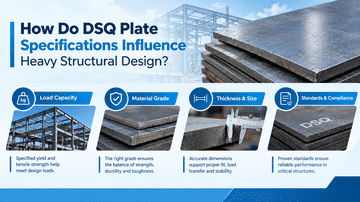
Once engineers have specified thickness, strength, toughness, tolerances and quality of the plate in a DSQ plate specification, these values determine the limits of the entire design. Calculations, connections, and fabrication are based on them.
Thickness determines the load a section can carry. Strength and toughness determine its behavior under stress and cold.
Which DSQ Plate Specifications Matter Most in Structural Design?
Plate Thickness, Length, Width, and Dimensional Tolerances
Nominal thickness, length, and width feed straight into the section properties of the design model. When rolled thickness lands at the lower tolerance limit, member capacity drops with it. EN 10029 and ASTM A6/A6M define those limits.
Yield Strength and Tensile Strength Requirements
Design checks keep working stress below yield strength, so this value sets the allowable stress in a member. Tensile strength governs net section and connection checks, where stress approaches the ultimate limit.
Chemical Composition and Weldability
When carbon and alloy content rise, carbon equivalent rises with them, and so do preheat needs and cracking risk. Limits on sulphur and phosphorus protect ductility and toughness.
Impact Toughness, Testing, and Quality Requirements
If a structure faces cold or sudden loading, Charpy V-notch results at the specified test temperature show how much energy the plate absorbs before fracture. Tensile, bend, and ultrasonic tests confirm the remaining quality requirements.
How Do DSQ Plate Properties Affect Structural Calculations?
Load-Bearing Capacity and Stress Distribution
When designers know thickness and yield strength, they calculate member capacity from section area and permitted stress. Thicker bearing plates also spread concentrated loads, which lowers local stress at supports.
Plate Thickness, Buckling Resistance, and Structural Stability
If a plate panel carries compression, its elastic critical buckling stress rises with the square of its thickness-to-width ratio. Doubling the thickness therefore multiplies that stress by four.
Deflection Control and Stiffness Under Load
Because steel grades share an elastic modulus near 200 GPa, a stronger plate does not deflect less. Only added thickness raises stiffness, and it does so with the cube of thickness.
The Importance of Design Codes and Safety Factors
When a project follows IS 800 or Eurocode 3, the code converts material properties into design resistance through partial safety factors. IS 800 applies a factor of 1.10 to yielding, so the specified minimum yield strength sets the design resistance.
Why Do DSQ Plate Specifications Matter for Connections?
Bolted Connections, Hole Placement, and Edge Distances
Where bolts pass through a plate, edge distance and thickness govern bearing and tearing capacity. Eurocode 3 sets a minimum end distance of 1.2 times the hole diameter.
Welded Connections and Joint Design
When a joint requires fully absorbed welds, plate thickness sets the groove size, filler volume, and the number of passes. Thicker sections also cool faster, which raises hardening risk in the weld zone.
Dimensional Accuracy During Assembly
If plates arrive within tolerance, bolt holes align and joint gaps stay small. Plates outside tolerance force rework on site, delay erection, and can add residual stress.
How Do Fabrication Requirements Influence Plate Selection?
Cutting, Machining, and Dimensional Control
When fabricators cut a plate by plasma, laser, or flame, the heat alters the cut edge and can distort the plate. Machining allowances and edge preparation rules therefore belong in the specification.
Welding Procedures and Heat-Affected Areas
If the plate carries a higher carbon equivalent, the welding procedure needs preheat and controlled heat input to protect the heat-affected zone. Procedure qualification then confirms joint performance.
Material Traceability and Inspection Before Fabrication
Before cutting begins, fabricators match each plate's heat number to its test certificate and verify thickness and surface condition. A plate without traceable records stays out of the project.
Where Are DSQ Plates Used in Heavy Structural Projects?
Industrial Frames and Load-Bearing Assemblies
Base plates, gusset plates, and stiffeners in industrial frames take column loads and pass them into foundations and beams. Each part relies on verified thickness and strength.
Heavy Equipment and Structural Components
On heavy equipment, plates form chassis members, support brackets, and machine bases that face repeated loading. Fatigue behaviour, toughness, and flatness are as important there as static strength.
Infrastructure and Other Engineered Applications
Bridge components, storage structures, and supports for plant equipment use plates of thicknesses set by project loads. Each project sets it exposure and inspection needs.
Where a project considers a DSQ plate for any of these uses, suitability depends on the actual grade, certified properties, design requirements, and applicable standards. A plate that suits one frame may fail the checks for another.
What Should Engineers Verify Before Specifying DSQ Plate?
Required Grade, Thickness, and Mechanical Properties
The ordered grade, thickness range, yield strength, tensile strength and elongation must be verified against the design calculations. Check certified values against the minimum specified.
Applicable Standards and Inspection Documentation
When the project names a standard, request a certificate that cites it. An EN 10204 type 3.1 certificate lists the chemical analysis and mechanical test results.
Compatibility With Fabrication and Site Conditions
If the site involves low temperatures or repeated loading, check toughness and fatigue needs. Confirm that the shop can cut, weld, and handle the plate size and weight.
Conclusion
DSQ plate specifications directly influence structural performance, fabrication planning, and compliance. When designers select material on verified properties and project calculations, the structure meets its design intent and passes inspection. Thickness or strength alone cannot deliver that result. Engineers who check the certificate, standard, and fabrication route before ordering avoid rework.
FAQs
Why is plate thickness important in heavy structural design?
Thickness controls how much load a plate carries and how well it resists buckling and deflection. It also sets weld size and bolt bearing capacity.
Does a higher yield strength always make a plate more suitable?
No, elastic modulus does not change with grade, and higher strength can tighten welding and toughness requirements. Suitability depends on the full specification.
Which tests should be checked before using DSQ plate?
Check the tensile test for yield strength, tensile strength and elongation, plus the chemical analysis. Add Charpy values for cold service and ultrasonic results for through-thickness soundness.
How can DSQ plate specifications affect weldability?
Carbon equivalent and alloy content in a DSQ plate specification decide preheat, heat input, and cracking risk. Higher values demand tighter welding control.
Why is a material test certificate important for structural plates?
It links each plate's heat number to its measured chemistry and mechanical properties. Inspectors and designers use it to prove compliance with the specified standard.
Tags : DSQ plate