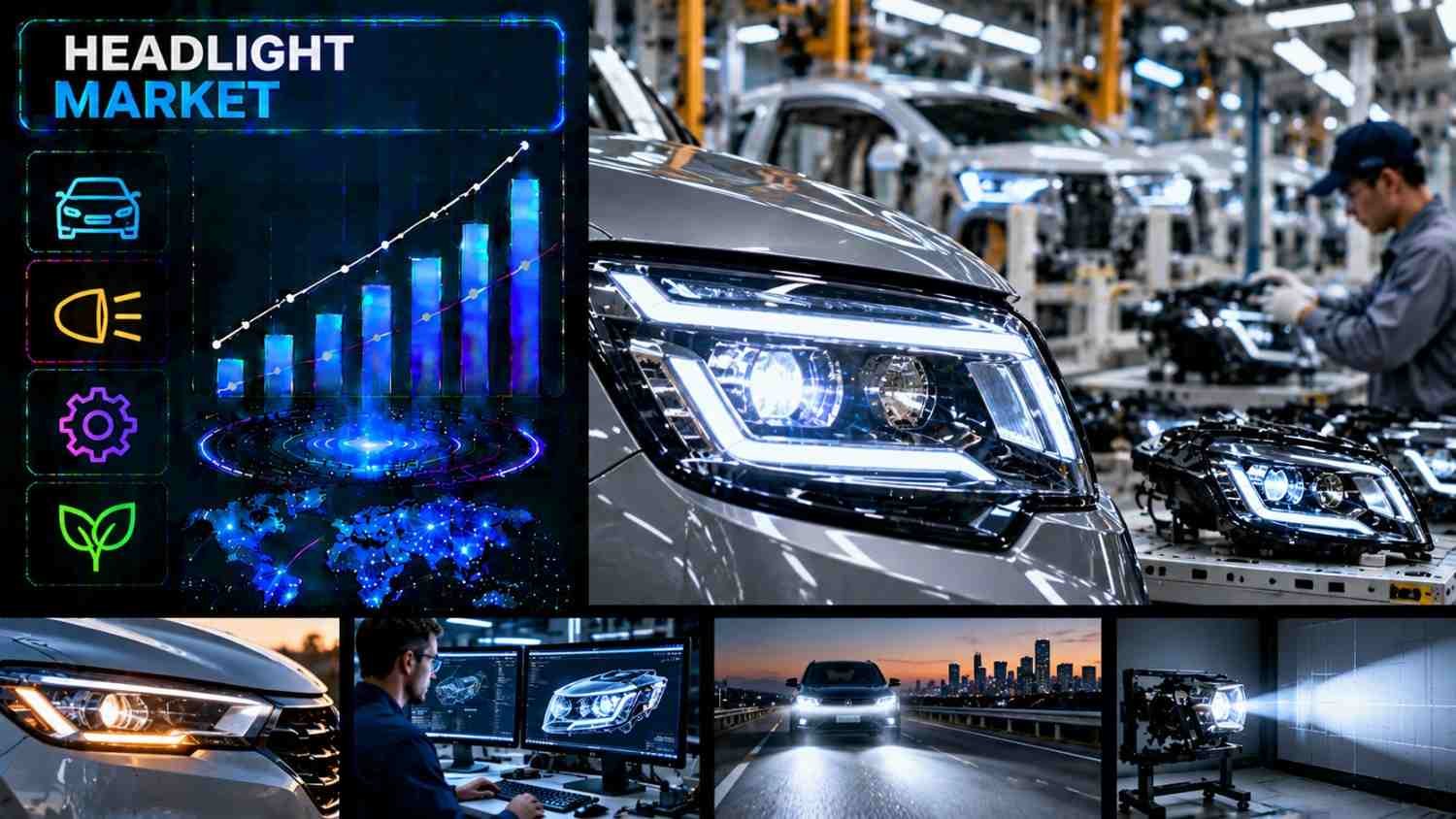
Now let me fetch the report page.IMARC Group, a leading global market research and management consulting firm, has published its latest market intelligence report on the headlight market. The global headlight market grew from USD 8.8 Billion in 2025 to USD 9.2 Billion in 2026. Looking forward, IMARC Group estimates the market to reach USD 13.6 Billion by 2034, exhibiting a CAGR of 4.95% from 2026-2034. Growth is driven by the growing emphasis on road safety, a global surge in vehicle production, stringent vehicle lighting and environmental regulations, rising demand for customized headlights, the incorporation of advanced technology such as adaptive and pixel-level lighting, and the introduction of eco-friendly, energy-efficient headlights. Asia Pacific currently dominates the market.
The market is experiencing steady growth momentum as the headlight evolves from a basic safety component into a technology-rich system that shapes both night-time visibility and vehicle identity. Automakers increasingly treat lighting signatures as brand differentiators, while regulators and independent rating bodies reward vehicles that deliver stronger road illumination without dazzling other drivers. The shift away from halogen toward LED and pixelated light sources is lifting the value of each vehicle set, because every new vehicle needs at least a pair of headlights and premium trims now carry far more complex modules. An aging vehicle parc is also expanding replacement and upgrade demand through the aftermarket, supported by easy online access to a wide range of designs, technologies, and price points.
How AI is Reshaping the Future of the Headlight Market
AI-Enhanced Object Detection Cutting False Positives in Adaptive Driving Beam Systems: Koito Group has worked with Reality AI to apply machine learning to its next-generation adaptive driving beam headlights. Conventional adaptive beams rely on template-matching vision techniques that are prone to false positives in dynamic real-world traffic. The AI-based approach targets higher beam resolution and more accurate dimming around oncoming vehicles. It also runs on cost-effective edge hardware that fits automaker price points, which supports wider adoption beyond luxury models.
High-Resolution Pixel Lighting Managed by Software-Defined Control: ams OSRAM's EVIYOS HD 25 packs 25,600 individually controllable LEDs into a single light source. It selectively illuminates the road in high-beam mode without glare and can project warning symbols onto the road surface. Developed with Marelli and integrated into the NIO ET9 electric sedan, it shows how headlamps are becoming sensor-linked computing devices. A conventional LED headlamp uses roughly 80 to 120 LEDs, so managing this pixel density depends on software, camera inputs, and real-time scene interpretation rather than simple mechanical switching.
Sensor Fusion and Over-the-Air Upgrades Extending Lighting Intelligence: Hyundai Mobis developed an advanced adaptive driving beam that combines camera, radar, navigation, and steering angle data. The system runs through software without additional hardware, which protects price competitiveness. Tesla has also moved to enable matrix headlight functionality on existing Model Y and first-generation Model 3 vehicles through a software update. Together these examples show lighting performance increasingly being upgraded after the sale, which opens recurring value for automakers and suppliers.
Headlight Market Trends and Drivers:
The global headlight market is expanding as road safety shifts from a compliance topic to a core purchase criterion for buyers, fleet operators, and regulators. According to the World Health Organization, road traffic crashes cause approximately 1.19 Million deaths globally each year, and poor visibility after dark is a recurring contributor. The Insurance Institute for Highway Safety notes that about half of all traffic deaths occur in darkness or at dawn and dusk. It also finds that vehicles with good-rated headlights have 19% fewer nighttime single-vehicle crashes and 23% fewer nighttime pedestrian crashes than vehicles with poor-rated headlights. The industry has responded: 46% of headlight systems tested on the latest model year vehicles earned a good rating, compared with just one good rating among more than 80 systems when the ratings began. In the United States, NHTSA amended Federal Motor Vehicle Safety Standard No. 108 to permit adaptive driving beam systems, which dim only the portions of the beam directed at other road users while keeping full illumination elsewhere. Europe has allowed such systems for far longer, so US certification opens a large new pool of demand for advanced modules.
Rising vehicle production, particularly of electric and hybrid models, is a structural volume driver, and government programs are anchoring local supply chains. The International Energy Agency reported that electric cars accounted for 18% of all vehicles sold in a recent annual assessment, up from 14% a year earlier. In India, the Production Linked Incentive Scheme for Automobiles and Auto Components carries an outlay of ₹25,938 crore. It offers incentives of 13% to 18% on electric vehicle and hydrogen fuel cell components and 8% to 13% on other advanced automotive technology components, subject to at least 50% domestic value addition. Approved applicants have reported cumulative investment of ₹44,326 crore against a target of ₹42,500 crore. The scheme has 82 approved applicants, 225 manufacturing units, and 67,820 jobs, and the latest Union Budget raised its annual allocation to ₹5,939.87 crore from ₹2,091.26 crore. The PM E-DRIVE scheme adds a ₹10,900 crore outlay for electric mobility. In China, RMB 62.5 billion (about USD 8.9 Billion) of ultra-long special treasury bond funds was allocated in advance for the current vehicle trade-in program. New energy vehicle buyers receive 8% of the vehicle price, capped at RMB 15,000, and the program has supported more than 21 million car buyers at an average subsidy of about RMB 14,000. New energy vehicles reached 65.4% of subsidized auto trade-ins in the latest monthly data, and every one of these vehicles requires a new headlight set.
Stringent regulation, aftermarket demand, and technology innovation complete the growth picture. In the European Union, the General Safety Regulation applies to all new vehicles and is expected to save over 25,000 lives and avoid at least 140,000 serious injuries over its horizon. By mandating advanced driver assistance features, it raises the importance of lighting that supports camera-based safety systems. Many countries are also phasing out halogen in favor of more energy-efficient LED and high-intensity discharge options, which pushes manufacturers toward compliant, higher-value products. In the aftermarket, the US light-duty automotive aftermarket expanded by 8.6% to USD 392 Billion in its most recent reported full year, within a total US automotive aftermarket estimated at USD 534 Billion. A rising average vehicle age, growing interest in LED and adaptive upgrades, and the reach of e-commerce all support replacement headlight sales. Meanwhile, matrix LED designs use 12 to 100 LED dies per headlight, and micro LED pixel arrays are pushing control to 10,000 to 30,000 pixels, steadily raising content value per vehicle.
Headlight Industry Segmentation:
The report has segmented the market into the following categories:
Breakup By Technology:
- Xenon
- LED
- Halogen
LED is the leading technology segment. LEDs consume far less power than conventional halogen bulbs, which aligns with global energy conservation goals. Their life span can approach that of the vehicle itself, cutting replacement frequency and delivering long-term savings. They also reach full brightness instantly, which improves reaction time on the road. Their compact size gives designers freedom to create distinctive, slim lighting signatures, and this flexibility is why LED matrix and pixel architectures are becoming standard on premium and increasingly on mainstream models.
Breakup By Vehicle Type:
- Passenger Cars
- Commercial Vehicles
Passenger cars account for the larger share of the market. High production volumes of passenger cars directly translate into high headlight demand. Individual buyers also actively choose advanced safety features and distinctive styling. Adaptive headlights, LED systems, and smart illumination are now fitted as standard on many new passenger car models, which pushes the category toward more technology-intensive and higher-value lighting content.
Breakup By Vehicle Propulsion:
- ICE Vehicle
- Electric Vehicle
Internal combustion engine vehicles continue to anchor headlight demand. They are generally more affordable than electric or hybrid alternatives, which supports high sales volumes. A mature network of fueling stations and repair shops sustains the installed base, and these vehicles operate across a wide range of terrains and conditions worldwide. Electric vehicles are the fastest-moving opportunity, as manufacturers pair energy-efficient LED and micro LED headlights with design-led front ends.
Breakup By Sales Channel:
- OEM
- Aftermarket
The aftermarket channel is a major demand contributor, driven by the growing number of aging vehicles whose headlights wear out or fail. Aftermarket headlights are often priced below manufacturer parts, are easy to find through online platforms, local stores, and repair shops, and offer a wider choice of designs, technologies, and price points. Many are also designed for simple replacement, which lets vehicle owners avoid professional installation costs.
Breakup By Region:
- North America (United States, Canada)
- Europe (Germany, France, United Kingdom, Italy, Spain, Others)
- Asia Pacific (China, Japan, India, South Korea, Australia, Indonesia, Others)
- Latin America (Brazil, Mexico, Others)
- Middle East and Africa
Asia Pacific dominates the global headlight market, supported by a large population, dense vehicle ownership, and rising disposable incomes. China and India act as major bases for manufacturing both vehicles and auto parts such as headlights, which supports local supply and export volumes. China's new energy vehicle penetration reached a record 62.4% in a recent quarter, while India's incentive programs are deepening domestic component production. Strict regional vehicle safety rules and growing manufacturer investment in research and innovation further strengthen the region's lead.
Competitive Landscape:
The report provides a comprehensive analysis of the competitive landscape in the headlight market with detailed profiles of all major companies, including:
- Continental Aktiengesellschaft
- De Amertek Corporation
- HELLA GmbH & Co KGaA (Faurecia SE)
- Hyundai Mobis Co. Ltd. (Hyundai Motor Group)
- J.W. Speaker Corporation
- Koito Manufacturing Co. Ltd.
- Koninklijke Philips N.V.
- OSRAM GmbH (ams-OSRAM AG)
- Robert Bosch GmbH (Robert Bosch Stiftung GmbH)
- Stanley Electric Co. Ltd.
- Valeo
- ZKW Group GmbH (LG Electronics Inc.)
Competition centers on smart LED and laser-based headlights with adaptive beam technology, sustainability initiatives, and partnerships with automakers. Scale matters: Koito reported record consolidated net sales of ¥947.6 billion (about USD 5.9 Billion) in its latest fiscal year, with Toyota alone accounting for 13.6% of sales. Valeo posted first-half sales of EUR 10.4 billion with order intake of EUR 12.1 billion, about 1.4 times its original equipment sales. Hyundai Mobis' lighting business generated about KRW 2.5 trillion (roughly USD 1.8 Billion) in revenue in its last full year and operates five plants. The structure is concentrated yet consolidating. Yole Group analysis shows the top five lighting suppliers, Koito, Marelli, Valeo, HELLA under Forvia, and Stanley, hold roughly two thirds of the automotive lighting market. Koito alone holds about 21%, and Koito and Stanley together hold about 44% of the Asian market. Headlamps represent about two thirds of lighting value. Deal activity is reshaping the field: Forvia acquired HELLA for about USD 6 Billion, OPmobility bought Varroc's lighting business for EUR 600 million, and OPmobility has now agreed to acquire Hyundai Mobis' lighting unit.
What Does The Full Report Cover?
If you are tracking the headlight market for investment decisions, market entry planning, competitive benchmarking, or strategic advisory, IMARC Group's report gives you everything in one place:
- Complete market sizing with revenue forecasts covering the full projection period
- Quantified growth driver analysis across technology, vehicle type, vehicle propulsion, sales channel, and regional markets
- Sub-segment breakdowns for xenon, LED, halogen, passenger cars, commercial vehicles, ICE vehicles, electric vehicles, OEM, and aftermarket with individual share data
- Country-level data for the United States, Canada, Germany, France, the United Kingdom, Italy, Spain, China, Japan, India, South Korea, Australia, Indonesia, Brazil, and Mexico
- Competitive profiles of 12 leading companies with strategic landscape assessment
- Porter's Five Forces analysis assessing the impact of new entrants, competitive rivalry, supplier power, buyer power, and the threat of substitution
- Latest product innovation trends covering adaptive and matrix LED headlights, micro LED pixel lighting, laser light sources, and eco-friendly lighting developments shaping competition and consumer preference across key regional markets
Recent News and Developments in Headlight Market
September: OPmobility signed a final agreement to acquire 100% of Hyundai Mobis' lighting business for an enterprise value of KRW 600 billion (about USD 443 Million). The unit generated about KRW 2.5 trillion in revenue with a positive operating margin in its last full year and runs five plants across South Korea, China, Mexico, and the Czech Republic. The deal substantially scales up OPmobility's lighting activity and deepens its partnership with Hyundai and Kia, with completion subject to antitrust and regulatory approvals.
July: Valeo reported first-half sales of EUR 10.4 billion, with original equipment sales of EUR 8.5 billion and order intake of EUR 12.1 billion. Its LIGHT Division outperformed global automotive production in the period. The company reaffirmed its full-year sales target of EUR 20 billion to EUR 21 billion.
May: Koito Manufacturing reported record consolidated net sales of ¥947.6 billion for its fiscal year ended March, supported by new orders and hybrid vehicle demand in the Americas. Profit attributable to owners fell 64.2% to ¥16.5 billion after ¥20.0 billion of impairment charges, including ¥14.3 billion tied to LiDAR. The company is shifting its mix toward higher-value products such as adaptive driving beam systems.
March: ams OSRAM made its debut at the Shanghai International Auto Lamp Exhibition, showcasing its EVIYOS HD 25 intelligent headlight light source with 25,600 individually controllable elements. The technology is already installed in two premium NIO models, the ET9 and ES8, marking its growing traction with Chinese electric vehicle makers.
October: FORVIA HELLA won an order to supply the first fully customized headlamp for VDL Bus & Coach's new Futura 3 series. The headlamp integrates five front lighting functions: low beam, high beam, position light, daytime running lights, and direction indicator. It is designed in Lippstadt, Germany, and produced in Lugoj, Romania, extending the supplier's commercial vehicle lighting presence.
Note: If you require specific details, data, or insights that are not currently included in the scope of this report, we are happy to accommodate your request. As part of our customization service, we will gather and provide the additional information you need, tailored to your specific requirements. Please let us know your exact needs, and we will ensure the report is updated accordingly to meet your expectations.
Key Questions This Report Answers
- What is the current global headlight market size and what is its projected value?
- Which technology segment holds the largest share in the global headlight market?
- What are the key drivers of global headlight market growth?
- Which region dominates the global headlight market and why?
- How are road safety regulations, adaptive driving beam approvals, and the shift to LED and pixel lighting reshaping product development and competitive strategies in the headlight industry?
- Who are the top companies in the global headlight market and what are their competitive strategies?
- What are the investment and market entry opportunities across LED, electric vehicle, passenger car, and aftermarket headlight segments?
About Us:
IMARC Group is a global management consulting firm that helps the world's most ambitious changemakers to create a lasting impact. The company provides a comprehensive suite of market entry and expansion services. IMARC offerings include thorough market assessment, feasibility studies, company incorporation assistance, factory setup support, regulatory approvals and licensing navigation, branding, marketing and sales strategies, competitive landscape and benchmarking analyses, pricing and cost research, and procurement research.
Media and Sales Contact
IMARC Group
Email: sales@imarcgroup.com
United States: +1-201-971-6302
India: +91-120-433-0800
United Kingdom: +44-753-714-6104
Tags : Headlight Market