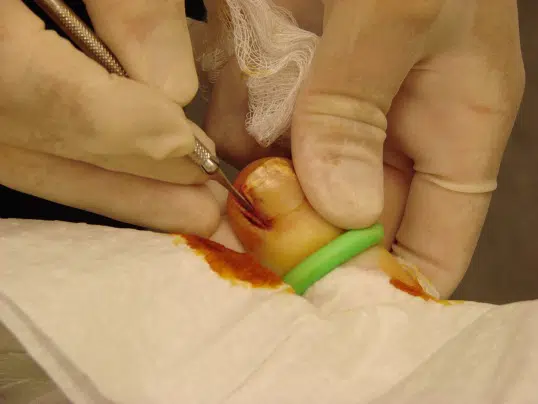
Short answer, not usually, at least not as the first thing they'd try. If you've been dealing with a thick, discoloured, crumbly nail and you're picturing the whole thing getting pulled off in one go, that's not really how fungal nail treatment tends to work. There's more to it than that, and it's worth understanding before you go in expecting something that probably isn't on the cards.
What's actually going on with a fungal nail
Fungal nail infections, sometimes called onychomycosis if you want the proper term, happen when fungus gets underneath the nail and settles in. It tends to cause yellow or brownish discolouration, thickening, and a crumbly texture that's hard to miss once you notice it. Left alone, it can spread to other nails, and in some cases the skin underneath becomes inflamed or sore too.
It's genuinely common, and there's no reason to feel self-conscious about it. But it also doesn't tend to improve on its own, so it's worth actually addressing rather than just covering it up with nail polish and hoping.
So what does treatment usually look like
Most fungal nail treatment starts well short of removing anything. Thinning or filing down the thickened nail is often part of it, partly for comfort, and partly because it helps any treatment applied actually reach where the fungus is sitting. Topical antifungal treatments are commonly used, though they generally need to be applied consistently over a long stretch, months rather than weeks, since nails grow slowly and the fungus needs to be out-grown as much as treated.
Oral antifungal medication is another option in some cases, generally tends to work faster than topical treatment alone, though it's a conversation to have with a GP, since it needs to be prescribed and isn't suitable for everyone.
A podiatrist's role through all of this is largely about proper diagnosis in the first place, since not everything that looks like a fungal nail actually is one, trauma and other nail conditions can look fairly similar, ongoing management of the nail itself, and advice on what's actually going to help versus what won't.
When does nail removal actually come into it
Removal, whether that's partial or full, isn't generally the default treatment for a fungal infection. It tends to come up in more specific situations. If the nail's become so thick it's genuinely painful, particularly in shoes, removing or significantly reducing it can bring relief while other treatment continues. If the infection's severe and not responding to other approaches, removal sometimes gives topical treatment better access to the nail bed underneath. And if there's a secondary issue going on, like the nail also causing problems with an adjacent nail or significant discomfort day to day, that can factor into the decision too.
Even then, it's a conversation between you and your podiatrist about what's actually appropriate for your specific nail, not a standard next step for every fungal infection that walks through the door.
Why self-treatment usually doesn't get far
It's tempting to just file it down yourself or try whatever's on the pharmacy shelf, and sometimes that's a reasonable starting point for a mild case. But fungal nails can be stubborn, and treating them properly often means sticking with something consistently for months, which is a lot easier to actually follow through on with a proper plan behind it. There's also the diagnosis question, if it's not actually fungal, treating it as though it is won't do much good at all.
Preventing it coming back
Fungal infections have a habit of returning if the conditions that caused them in the first place don't change. Good foot hygiene genuinely matters here, keeping feet clean and dry, not sharing nail clippers or footwear with others, and keeping nails trimmed with clean edges. None of this guarantees anything, but it meaningfully reduces the odds of a repeat infection once the current one's been dealt with.
Getting it looked at properly
If you're dealing with a nail that's changed colour, thickened, or started crumbling, it's worth having it properly assessed rather than guessing at the cause or assuming removal is inevitable. Foot Focus Podiatry, based in Wilson, has been providing podiatry care in Perth since 2000, with a team able to properly diagnose what's going on and talk through genuine treatment options for your specific nail.
If you've been putting it off out of embarrassment or because you assumed the only option was having the nail removed, it's worth getting proper nail fungus treatment in Perth and finding out what's actually involved for your case, rather than letting it sit there getting worse.