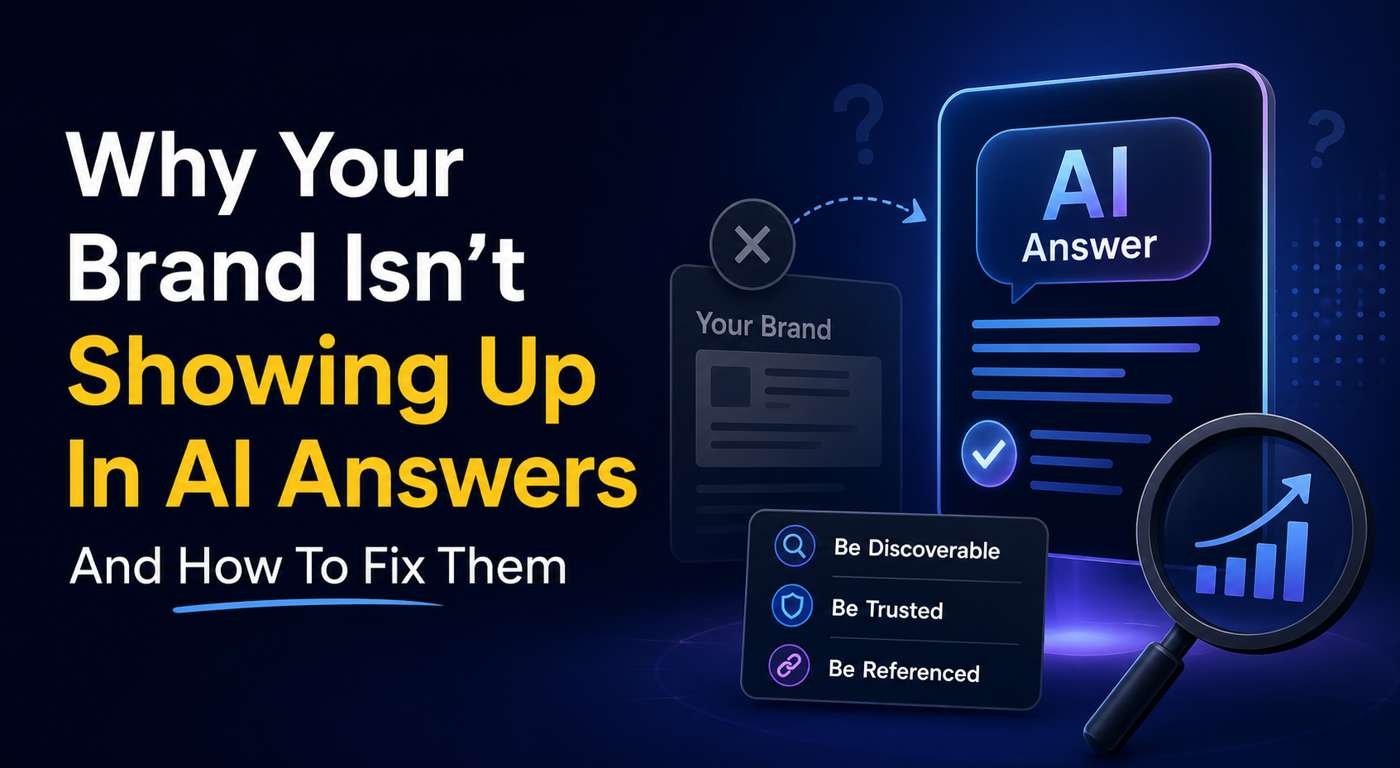
You put serious money into your website, curated good content, and you're ranking decently. But when you type a question about your industry into a generative search tool, your brand is totally MIA. Instead, the AI confidently recommends a competitor whose product isn't even half as good as yours.
If you're an entrepreneur watching your business get ghosted by the internet's new gatekeepers, it’s beyond frustrating. The shift from standard search to answer engines is throwing a curveball at everyone right now. But instead of worrying, it's time to adapt. Here is a breakdown of why you're flying under the radar and exactly how you can fix it.
Why Your Brand Isn’t Showing Up In AI Answers
No mentions on other websites
Models need proof that you exist. They scour forums, review sites, and industry hubs to figure out who the heavy hitters are. If the only place hyping you up is your own blog, you lack third-party validation. AI search optimization wants consensus. If no one else is talking about you, the bots won't stick their necks out to recommend you.
Your brand identity is inconsistent
These tools look for "entities" real-world organizations that they can easily verify. If you go by an abbreviation on social media, have an outdated address on a directory, and use a completely different name on your homepage, the system gets confused. When it gets confused, it drops you and moves on to a brand with a cleaner digital footprint.
AI bots are blocked from reading your site
Sometimes the problem is just bad plumbing. A lot of websites have firewalls or server settings that accidentally block AI bots from crawling their pages. If a bot gets hit with an error code because your content is trapped behind complex code or a strict security filter, it obviously can't read your stuff. You miss the cut by default.
Your content is too hard to scan
Traditional SEO taught us to write 500 words of backstory before getting to the point. Answer engines hate that. They want fast, scannable facts. If your content buries the real answer under a mountain of fluff, the system will simply scrape the info from a competitor who gave a straight answer.
What To Do If Your Brand Is Not Appearing In Ai Answers
First, check your technical setup. Make sure your developer hasn't accidentally blocked crawler bots. If they can't get in, nothing else matters.
Next, clean up your content structure. Stop hiding the goods. Use clear headings, bullet points, and numbered lists. When a bot scans your page, it should be able to yank out a statistic or a solution in milliseconds.
You also need to build some street cred off-site. Jump into industry discussions, push for genuine customer reviews, and get your name out there on reputable platforms. The more the web agrees on who you are and what you do, the faster these models will trust you. For a lot of teams, bringing in AI-led digital marketing companies is a smart play here. They know the exact technical tweaks and distribution tactics needed to get you noticed in this new ecosystem.
How to check if your brand appears in AI answers
You don't need an expensive software subscription for this. Just act like your customer. Open up the major generative search platforms and start typing in the problems your business solves.
Don't just search for your company name, search for the solutions. Ask things like, "What are the best tools for [your niche]?" or "Who handles [your service] for startups?" If your name doesn't pop up in those conversational responses, pay close attention to who does. Look at how their pages are structured and where they are getting mentioned online. That is your new blueprint.
Conclusion
The internet is shifting gears, but the core rule hasn't changed: you have to provide genuine, accessible value. Throwing away your entire traditional strategy isn't the move, because standard search still drives plenty of traffic.
Honestly, by combining solid technical foundations with the direct, entity-building tactics that answer engines love, you cover all your bases. Adjust your playbook, get your name out there, and make sure your brand is the one getting the recommendation.
FAQs
Why is my site ranking high but missing from AI answers?
Traditional search relies heavily on backlinks and keywords. Answer engines look for consensus, clean data, and scannable facts. If your content is a headache to extract or lacks third-party mentions, you get skipped entirely.
How fast can I fix my brand's invisibility in AI search results?
It is not an overnight fix. Unblocking bots helps immediately, but building entity trust and external validation takes time. Expect to see real shifts after a few months of consistent effort.
Do AI-led digital marketing companies guarantee I will appear in AI answers?
Nobody can guarantee exact placements since the algorithms are always changing. However, these specialized agencies know how to structure your data and improve the odds of you being cited as a top source.
What type of content do generative models actually prefer to cite?
They love direct, organized information. Think bulleted lists, clear definitions, data points, and tight FAQ sections. If your page gives a straight answer without the fluff, it has a much higher chance of being pulled.
Should I stop focusing on traditional search engine traffic now?
Definitely not. Traditional search still drives massive volume for most businesses. A hybrid of both could be the best way to go, ensuring you capture users who browse links while also getting recommended by conversational platforms.
Tags : .....