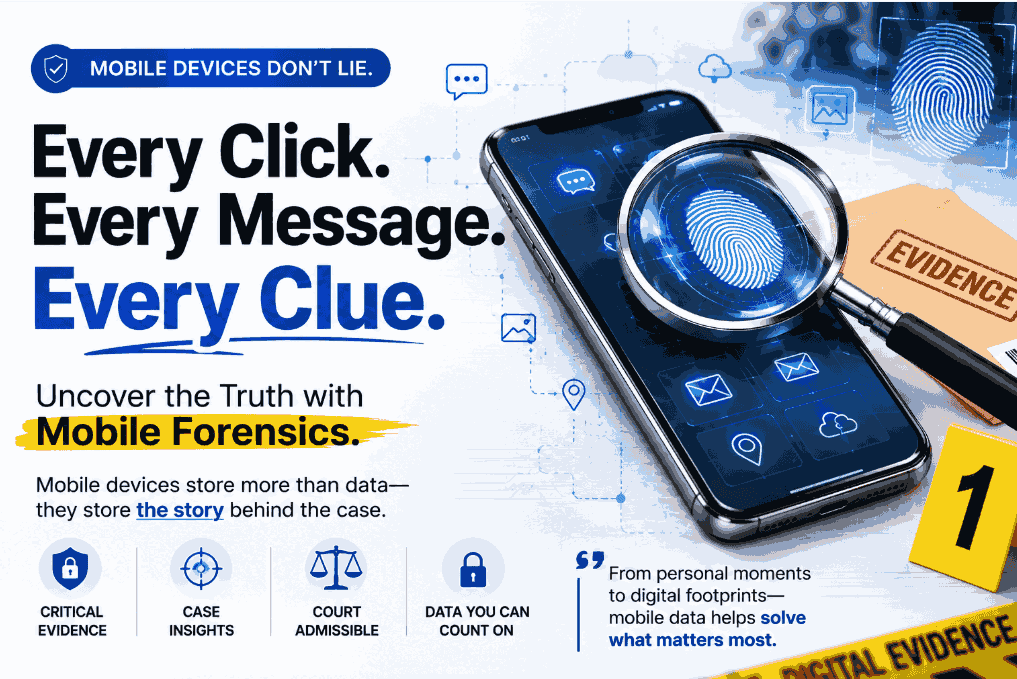
Picture a detective walking into a crime scene in 1995. The first thing they'd look for is a filing cabinet, a diary, maybe an answering machine. Walk into that same scene today, and the first thing anyone reaches for is a phone.
That single shift explains almost everything about modern investigations. A phone isn't just a communication device anymore. It's a black box recorder for a person's entire life, and it rarely stops recording.
This piece breaks down exactly why that little rectangle has become the single most valuable piece of evidence in a digital forensics investigation, how professionals actually get data out of it, and what happens once they do.
A Phone Never Clocks Out
A desktop computer only knows what happened while it was switched on and sitting on a desk. A phone doesn't get that luxury. It's in a pocket at a crime scene, on a nightstand during a phone call, in a car during a drive it never meant to log.
That constant presence is exactly why mobile devices now anchor most digital forensics investigation work. Consider the numbers: there are more smartphones in the world today than there are people who don't own one. The FBI has pointed out that close to 90% of the crimes it investigates now involve some form of digital evidence, and phones are usually where that evidence starts.
Here's a simple way to think about it. A laptop is a diary someone writes in occasionally. A phone is a diary that writes itself.
Everything Your Phone Quietly Keeps
Most people don't realize how much detail a single device holds until it becomes relevant to a case. A few examples:
- Messages and chats across every app installed, often the clearest window into what someone was planning
- Call history, which proves a relationship or connection existed even when the conversation itself is gone
- Location data, pulled from GPS, Wi-Fi networks, and cell towers, often accurate enough to place someone at a specific address
- Photo metadata, hidden inside every image, recording the exact time and coordinates a picture was taken
- Synced email accounts, frequently the most formal and detailed written record on the entire device
- Search and browser history, showing intent before an action was ever taken
- App activity, from fitness trackers to food delivery, each one an unintentional logbook of daily movement
Individually, none of these prove much. Stitched together, they build a timeline that's difficult to argue with.
Getting the Data Out Without Breaking the Case
Here's where things get technical, so let's use an analogy first. Extracting data from a phone is a lot like getting into a house that's locked in different ways depending on how nervous the owner was.
Sometimes the front door is unlocked, and investigators can simply copy what the operating system hands over. That's called a logical extraction — quick, but limited to whatever the phone chooses to show.
When that's not enough, examiners move to a physical extraction, essentially copying the device's entire memory bit by bit, deleted files included. This is where most real investigations do their heaviest work.
In the rare case where a device is damaged or won't power on at all, specialists go further still, connecting directly to the memory chip itself, or in extreme cases, reading individual memory cells under a microscope. Think of it as the difference between using a spare key, picking a lock, and finally just removing a wall panel to get inside. Investigators always try the least invasive option first, and only escalate when they have to.
Why Phones Fight Back Harder Than You'd Think
Modern security features exist to protect regular people from thieves. Unfortunately, they also stand directly in an investigator's way.
Encryption is the biggest wall. Apple's Secure Enclave, for instance, functions like a diary with a lock that self-destructs the pages if you guess the combination wrong too many times. Even physically removing the memory chip won't help without the correct key.
Remote wipe is another real threat. A phone still connected to a network can be wiped from anywhere the moment someone realizes it's been seized, which is exactly why the first thing investigators do is isolate a device inside a signal-blocking bag before it ever reaches a lab.
Then there's simple inconsistency. Every manufacturer, every operating system version, sometimes every phone model, stores data slightly differently. A method that works perfectly on one device can fail completely on the next.
This isn't a hypothetical problem. When investigators seized the iPhone used in the 2015 San Bernardino attack, Apple's own encryption became the central obstacle in the case, sparking a public legal standoff between the company and federal investigators over whether a backdoor should even exist. Encryption built to protect ordinary users ended up protecting a locked phone from the people trying to solve a crime.
Proving It Actually Happened This Way
None of this evidence matters if a courtroom doesn't trust it. That trust comes from something called chain of custody, which works a lot like stamps in a passport. Every person who handles that phone, from the officer who seized it to the analyst who examined it, has to log exactly when they had it and what they did with it. Miss a stamp, and the whole document looks suspicious.
This isn't informal practice. Standards like ISO/IEC 27037 define how digital evidence should be handled internationally, while U.S. courts lean on Federal Rules of Evidence 901 and 902 to decide whether that evidence gets accepted at all. Examiners also generate hash values, a kind of digital fingerprint, to mathematically prove that not a single bit of data changed between the moment of seizure and the moment it's shown in court.
When the Data Alone Isn't the Whole Story
Here's the part that rarely gets discussed. A single phone extraction can produce tens of thousands of messages and images, spread across formats that don't naturally connect to one another. Handed to an investigator as a raw export, it looks less like evidence and more like an entire filing room dumped onto one desk.
That's the real bottleneck in most modern cases. Getting the data off the phone is a solved problem. Making sense of it fast enough to matter is where things slow down, especially with one specific category: email.
A synced mail account on a phone isn't a handful of messages. It's often an entire mailbox, complete with attachments, headers, and years of correspondence that most people forget their phone is even holding onto. In corporate and financial investigations particularly, that inbox is frequently where the real story lives, buried under thousands of unrelated messages.
General extraction tools are built to pull that mailbox off the device. They aren't built to help an investigator search, filter, or connect what's inside it. That's a different job entirely, and it's exactly the gap a dedicated email forensics platform like MailXaminer is built to close, taking that exported mailbox and turning it into something searchable, connected, and ready for a courtroom rather than a spreadsheet nobody has time to read.
The Bottom Line
A phone doesn't just witness a person's life anymore. It documents it, second by second, whether anyone intended it to or not. Understanding how that documentation gets extracted, protected, and proven is what separates a modern digital forensics investigation from guesswork.
The evidence was never really hiding. It was just waiting for someone who knew exactly where, and how, to look.
Tags : mobile forensics