Why FORTIFY FLOWABLE® ECM May Be Useful for Irregular Surgical Wound Sites
By Alexa Smith 14-09-2026 1
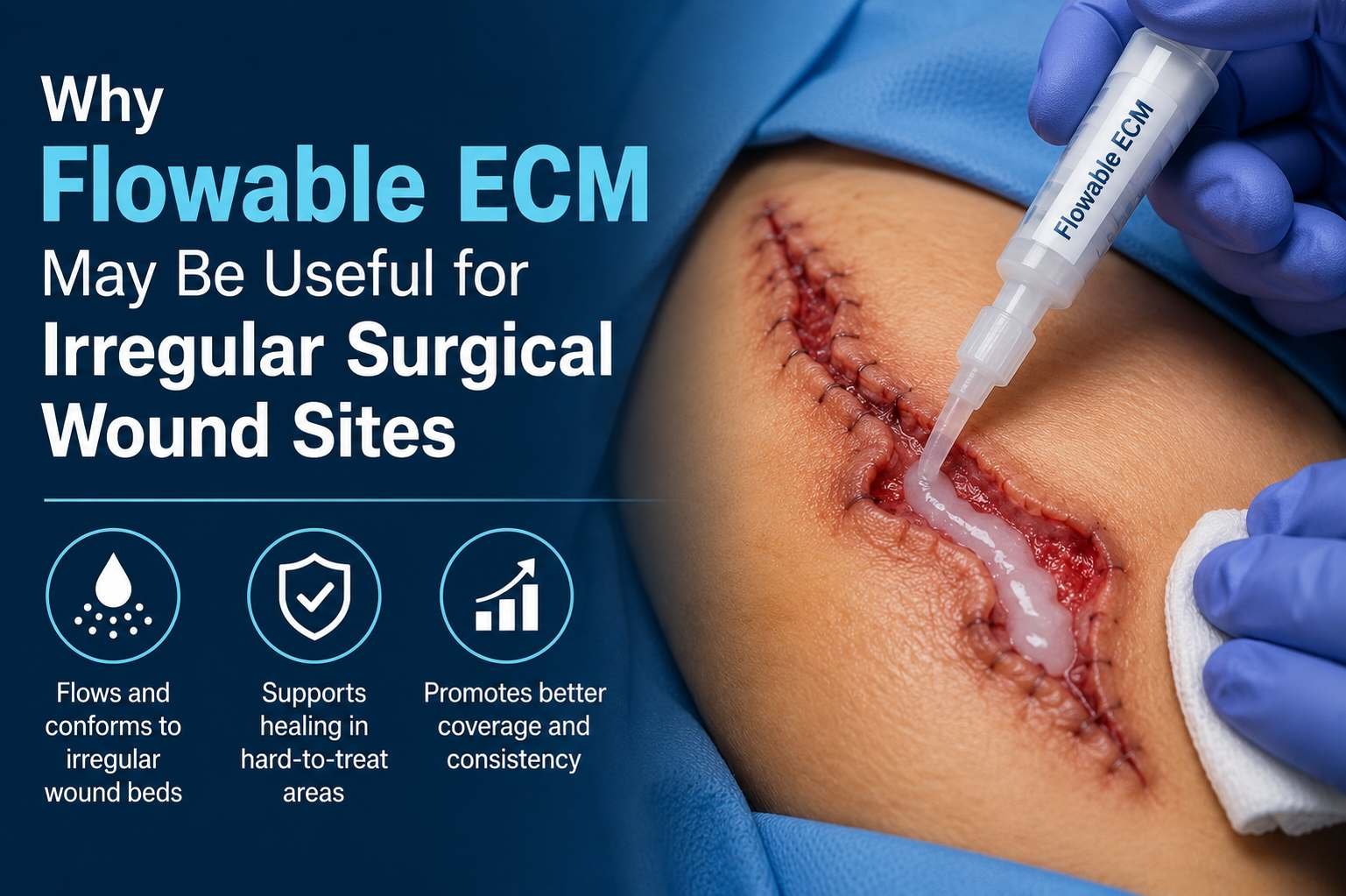
Surgical wounds can vary considerably in shape, depth, and accessibility. Some wound sites have uneven surfaces, variable depth, tunneling, or undermining that can make placement of a traditional sheet-style graft or powder more challenging. In these situations, healthcare professionals may consider advanced wound management products designed to conform to the characteristics of the wound site.
FORTIFY FLOWABLE® Extracellular Matrix is part of Sanara MedTech’s surgical product portfolio. Sanara MedTech develops and commercializes products for surgical care, wound management, and tissue repair. Its technologies are intended for use by healthcare professionals in hospitals, surgery centers, wound care facilities, physician practices, and other clinical settings.
FORTIFY FLOWABLE® Extracellular Matrix provides a micronized extracellular matrix (ECM) in a flowable format. According to Sanara MedTech, the product is designed for use in areas that may be difficult to access with sheet or powder formats. Its flowable formulation can help fill deep or irregularly shaped surgical wounds and conform to the contours of the wound site.
What Is an Extracellular Matrix?
The extracellular matrix is a structural network found naturally within tissue. It provides physical support for cells and contributes to the environment involved in tissue repair and remodeling. ECM-based products are used in wound management to provide a scaffold that can support the body's natural healing processes.
An ECM scaffold does not replace the body's healing response. Instead, it provides a structural framework within the wound environment. The role and suitability of an ECM product can depend on several factors, including wound characteristics, tissue condition, blood supply, patient health, infection control, surgical technique, and postoperative management.
FORTIFY FLOWABLE® Extracellular Matrix uses small intestinal submucosa (SIS) extracellular matrix technology in a flowable format. Sanara MedTech describes the product as an advanced wound care device designed to help address wounds with irregular shapes and varying depths.
Why Irregular Surgical Wound Sites Can Be Challenging
Some surgical wounds have a relatively accessible and uniform surface. Others may present additional challenges because the wound site has an uneven shape or varying depth.
Examples of characteristics that may require additional consideration include:
- Deeper areas within the surgical wound
- Tunneling or undermining
- Narrow or difficult-to-access areas
- Uneven wound margins
- Anatomically contoured wound surfaces
- Areas where placement of a sheet may be difficult
- Wounds requiring precise placement of a wound management material
When a wound has an irregular configuration, the selected product should be capable of reaching the areas that require coverage or support. A sheet-style graft can be appropriate for certain clinical applications, but its physical format may make placement more challenging in deeper, narrow, or irregular areas.
A flowable ECM provides another product format that healthcare professionals may consider when wound configuration and accessibility are important factors.
How Flowable ECM Supports Wound Conformability
One potential advantage of FORTIFY FLOWABLE® Extracellular Matrix is its flowable format.
Unlike a preformed sheet, a flowable ECM can be placed within wound areas that have varying contours or depths. This may be particularly relevant when the wound site is irregular or contains areas that are difficult to reach using a sheet-based product.
Sanara MedTech describes FORTIFY FLOWABLE® as a product that can fill deep, irregularly shaped, tunneling, and undermined wounds while conforming to the wound site.
Conformability can be an important consideration when selecting a wound management product. A product that can adapt to the configuration of a surgical wound may allow healthcare professionals to address areas that are difficult to cover using a conventional sheet format.
FORTIFY FLOWABLE® therefore provides another ECM delivery option for healthcare professionals managing surgical wounds where wound shape, depth, or accessibility may present challenges.
Applying ECM Where Sheet and Powder Formats May Be Limited
Different wound management products are designed for different clinical applications.
A sheet-based graft may be appropriate when a wound has a broad, accessible surface. Powder-based products may be useful in other situations where that format is clinically appropriate. However, wounds with deeper areas, tunneling, undermining, or irregular contours may require a product format that can be placed within less accessible areas.
FORTIFY FLOWABLE® is designed for application in areas that may be inaccessible to sheets and powders.
This does not mean that a flowable ECM is appropriate for every surgical wound. Product selection should be based on the characteristics of the wound, the patient's clinical circumstances, the treatment objectives, and the product's current Instructions for Use.
Healthcare professionals should use their clinical judgment and follow applicable facility protocols and manufacturer instructions when determining whether FORTIFY FLOWABLE® is appropriate for a particular procedure.
Wound Types Identified for FORTIFY FLOWABLE®
Sanara MedTech identifies FORTIFY FLOWABLE® for use in the management of several wound categories, including surgical wounds, donor sites and grafts, post-Mohs surgery wounds, partial- and full-thickness wounds, post-laser surgery wounds, tunneled or undermined wounds, second-degree burns, and trauma wounds.
These applications illustrate why a flowable ECM format may be considered in different wound management situations. For example, a surgical wound with an uneven configuration or a wound with tunneling or variable depth may require a different product format from a simple, shallow wound.
The treating healthcare professional is responsible for determining whether FORTIFY FLOWABLE® is appropriate for the clinical situation. Product use should be based on current labeling, the applicable Instructions for Use, professional judgment, facility protocols, and the individual patient's needs.
Supporting a Comprehensive Wound Management Approach
Managing an irregular surgical wound requires consideration of the entire wound environment. When an ECM product can conform to the wound configuration, it may help healthcare professionals place the material within areas that require coverage or structural support.
A flowable ECM may offer several potential advantages, including:
- Filling irregular wound spaces
- Reaching deeper areas of a wound
- Conforming to wound contours
- Supporting contact with the wound bed
- Providing an ECM-based structural scaffold
- Providing an option for tunneled or undermined wounds
However, an ECM product is only one component of a broader wound management strategy.
Depending on the clinical situation, surgical wound management may also involve wound assessment, cleansing, appropriate removal of nonviable tissue, infection prevention and management, drainage management, closure techniques, dressing selection, and follow-up evaluation.
Patient-related factors can also influence healing. Blood supply, nutrition, underlying medical conditions, tissue condition, surgical technique, and postoperative care can all contribute to clinical outcomes.
Practical Considerations for Surgical Teams
Before using a flowable ECM product, surgical teams should understand the appropriate preparation, delivery, documentation, and procedural requirements associated with the product.
Important considerations may include:
- The type, location, and characteristics of the surgical wound
- Whether the wound has tunneling, undermining, depth variation, or an irregular configuration
- How the product will be prepared and delivered
- Whether the wound bed has been appropriately prepared
- Which dressing or covering protocol will be used
- How product application will be documented
- Whether members of the clinical team are familiar with the current Instructions for Use
Establishing a consistent workflow can help surgical teams incorporate wound management products into established clinical procedures. This can be particularly important in surgical environments where multiple healthcare professionals participate in treatment and documentation.
How FORTIFY FLOWABLE® Fits Into Sanara MedTech's Surgical Portfolio
Sanara MedTech's surgical portfolio includes products intended for different aspects of surgical care, wound management, tissue repair, and related clinical applications. These include technologies involving surgical wound management, surgical irrigation, extracellular matrix support, tissue repair grafting, amniotic membrane allografts, and bone matrix applications.
FORTIFY FLOWABLE® fits within this portfolio as a micronized ECM product designed for surgical wound management.
Wound management is not a one-size-fits-all process. Different wound characteristics may require different product formats and treatment approaches. Depending on the clinical situation, healthcare professionals may consider collagen-based products, irrigation technologies, tissue repair products, amniotic allografts, ECM products, or other wound management options.
Understanding the intended role and application of each product can help healthcare professionals evaluate which option may be appropriate for a particular clinical situation.
Learn More About FORTIFY FLOWABLE® Extracellular Matrix
FORTIFY FLOWABLE® Extracellular Matrix may be considered for irregular surgical wound sites because its flowable format is designed to conform to wound contours, address varying wound depths, and reach areas that may be difficult to access with sheet or powder formats.
For surgical wounds involving irregular configurations, tunneling, undermining, or variable depth, a flowable ECM can provide healthcare professionals with an additional wound management option when clinically appropriate.
Sanara MedTech develops and commercializes products for surgical care, wound management, and tissue repair. Through products such as FORTIFY FLOWABLE® Extracellular Matrix, the company provides healthcare professionals with technologies designed for different clinical and surgical applications.
Healthcare professionals should consult current product labeling and the applicable Instructions for Use when evaluating FORTIFY FLOWABLE® for a specific patient or procedure.
Tags : .....