Why AI Video Production Is Moving Beyond Single-Prompt Generators
The first generation of AI video tools made a powerful promise: type a prompt and receive a video.
That idea helped introduce generative video to millions of people. It also made for impressive demonstrations. A user could describe a cinematic landscape, a character walking through a city, or an unusual visual effect and receive a few seconds of moving imagery without a camera crew, 3D pipeline, or traditional animation process.
But producing an impressive clip and producing a finished video are two very different problems.
As AI video matures, the focus is beginning to shift. The important question is no longer simply, “Can AI generate this shot?” It is increasingly, “Can we turn dozens or hundreds of generated shots into a coherent production?”
That change has major implications for filmmakers, agencies, animation teams, content creators, and the software they use.
A Good Clip Is Not Yet a Production
A single AI-generated shot can be surprisingly convincing.
The difficulty becomes obvious when you need a second shot.
The character needs to look like the same person. Their clothes should remain consistent. The location needs to retain its architecture. The camera angle must make sense in relation to the previous shot. Objects should not suddenly move or disappear. Lighting, mood, production design, and visual style should still belong to the same world.
Then there is a third shot, a fourth, and a fiftieth.
Traditional filmmaking already has systems for solving these problems. Scripts, shot lists, storyboards, production design, continuity records, editing, approvals, and asset management all exist because filmmaking is fundamentally about coordinating many individual decisions.
Generative AI does not remove that requirement.
In some cases, it makes structure even more important because every new generation introduces another opportunity for the result to drift away from the original creative intention.
The Single-Prompt Model Has Natural Limits
The prompt box is an excellent interface for experimentation.
You describe an idea, generate a result, adjust the description, and try again. For concept exploration or a short standalone clip, that can be all you need.
The problem is that a prompt contains very little production context.
Imagine a filmmaker needs a close-up of a protagonist entering an apartment. The prompt might describe the character, environment, lighting, lens, and action.
For the next shot, much of that information has to be communicated again.
Now imagine doing the same thing throughout a ten-minute film.
The creative team gradually becomes responsible for manually reconstructing the context of the production every time a new asset is generated. Character references live in one place, storyboards in another, scripts in another, generated videos somewhere else, and the final edit in yet another application.
The generation itself may be fast. Managing everything around it becomes the bottleneck.
Continuity Is Becoming One of AI Video's Biggest Challenges
The more ambitious the production, the more important continuity becomes.
A viewer may forgive a strange detail in a five-second social media clip. In a narrative sequence, inconsistencies become much more noticeable.
Character continuity is the obvious example, but it is only one layer.
A production may need to preserve:
Character appearance and wardrobe
Locations and production design
Props
Lighting
Time of day
Camera direction
Screen position
Visual style
Story chronology
Performance
Scene geography
These decisions are interconnected.
If a character leaves a room carrying a red folder, the next shot may need that same folder. If the establishing shot places a window on the left side of a room, subsequent coverage should respect the geography. If a scene is set at sunset, later shots should not suddenly appear to take place at midday.
No single prompt can reliably manage the complete history of those decisions across an entire film.
That is why AI video production is gradually becoming less about prompting individual outputs and more about maintaining production context.
Storyboarding Becomes More Important, Not Less
It would be easy to assume that generative video makes storyboards unnecessary. Why create a still image when you can simply generate the video?
In practice, the opposite can be true.
Generating video is relatively expensive and unpredictable compared with deciding what a shot should contain beforehand. Storyboards allow filmmakers to make decisions before committing to full video generation.
They can establish framing, camera position, character placement, action, and sequence structure while changes are still comparatively inexpensive.
A director can look at ten storyboard frames and recognize that a scene does not cut together properly before generating ten video shots.
That matters because faster generation does not automatically mean more efficient production.
Generating the wrong shot faster is still generating the wrong shot.
Pre-production therefore remains valuable in an AI workflow. The tools may change, but the underlying principle does not: make inexpensive decisions early so fewer expensive decisions need to be corrected later.
Editing Needs to Become Part of the Generation Loop
Traditional editing mostly happens after footage has been captured.
AI makes the boundary between production and post-production much less clear.
A filmmaker might generate several shots, place them into an edit, discover that the sequence needs a reaction shot, generate that shot, adjust its timing, replace another shot, and then create a new transition.
The timeline becomes part of the production process itself.
This is an important difference from the idea of an AI video generator as a machine that simply exports finished clips.
The edit tells the filmmaker what needs to be generated next.
A shot that looks excellent by itself may be too slow when placed between two other shots. Another might have the wrong eyeline. A scene may need an additional establishing shot. Dialogue timing may require a longer close-up.
The production therefore becomes iterative:
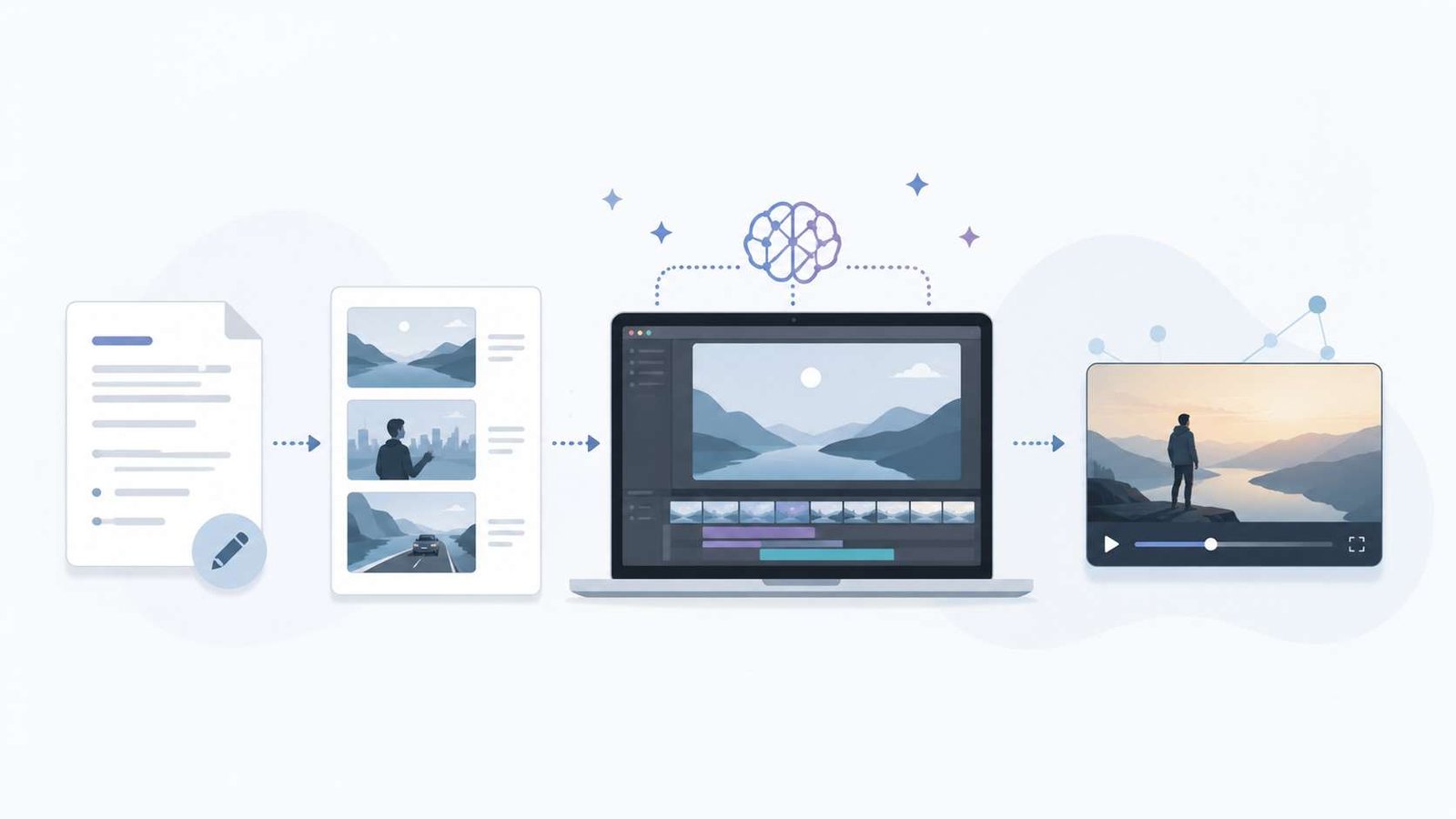
Plan. Generate. Edit. Review. Regenerate.
Rather than being the last stage, editing increasingly becomes the environment in which AI production decisions are tested.
The Best Model Is Only Part of the Equation
Much of the current discussion around AI video concentrates on model quality.
Which model has the best motion? Which produces the most realistic humans? Which follows prompts most accurately? Which creates the most cinematic images?
These are useful questions, but they can obscure another issue.
A professional production is unlikely to depend on one model forever.
Different models may be better at different tasks. A filmmaker might prefer one system for realistic footage, another for stylized animation, another for image generation, and another for voices.
Model capabilities also change rapidly.
A workflow built entirely around whichever generator happens to be strongest today can therefore become obsolete surprisingly quickly.
The more durable layer is the production itself: the script, shots, characters, references, storyboards, generated takes, approvals, and edit.
This is why the next generation of AI video production software is increasingly concerned with connecting the entire process rather than treating generation as an isolated event.
The generator is important, but it sits inside a much larger system.
What a Structured AI Video Workflow Looks Like
There is no single correct workflow for every production, but a structured process might look something like this.
1. Start With the Story
Define what the video actually needs to communicate.
For narrative work, that may begin with a screenplay. For advertising, it might be a treatment or creative concept. For educational content, it could begin with a written outline.
The important point is that generation should serve an intention rather than determine it.
2. Break the Story Into Scenes and Shots
Instead of asking AI to invent the finished movie, determine what individual shots are required.
This creates a production plan.
A scene may require an establishing shot, medium coverage, close-ups, inserts, transitions, or visual effects. Thinking in shots makes it easier to determine exactly what needs to be generated.
3. Establish Visual References
Characters, locations, props, wardrobe, and visual style should be established before hundreds of assets are created.
Reference images become a visual source of truth for the production.
4. Build the Storyboard
Use storyboard frames to test composition and sequencing.
The objective is not necessarily to create beautiful images. It is to make visual decisions.
5. Generate Shots With Context
Once a shot has a clear purpose, framing, references, and surrounding sequence, video generation becomes much more directed.
Instead of asking the model to solve everything, the filmmaker is asking it to execute a specific part of an existing plan.
6. Assemble the Edit Early
Generated shots should enter a timeline as soon as possible.
Seeing the material in sequence reveals problems that cannot be identified by reviewing clips individually.
7. Iterate at the Shot Level
When something does not work, replace or regenerate the problematic shot instead of reconsidering the entire production.
This is similar to traditional filmmaking and animation, where individual elements move through review and approval.
Where Single-Prompt Generators Still Make Sense
None of this means simple AI video generators are becoming irrelevant.
Quite the opposite.
They are excellent for experimentation, ideation, social media, visual effects concepts, mood pieces, and standalone shots. A creator who needs a six-second surreal visual may have no reason to build an elaborate production workflow.
The difference is scale and intent.
If the desired output is one independent clip, the prompt can effectively be the production plan.
If the desired output is a commercial, music video, short film, episode, animated sequence, or other multi-shot piece, additional structure becomes increasingly valuable.
This mirrors the history of many creative technologies.
A camera can record a shot, but a camera is not a film production system. A synthesizer can create music, but it does not replace the entire recording workflow. A 3D renderer creates frames, but professional animation requires much more than rendering.
AI video generation is beginning to undergo the same transition.
AI Filmmaking Will Become More About Direction
One of the more interesting consequences of this shift is that AI filmmaking may gradually become less prompt-centric.
Prompt writing will remain useful, but much of the creative work will happen elsewhere.
Which shot should exist?
What should the audience understand at this moment?
Which character is on screen?
What should remain consistent?
How should the camera move?
Which take works best?
Where should the cut happen?
What needs to change?
These are directing and production questions rather than prompting questions.
AI can make individual stages dramatically faster, but somebody still needs to make the decisions that connect those stages into a finished piece.
That is why production-oriented AI tools are likely to become increasingly important as creators attempt longer and more ambitious work.
From Generating Video to Making Video
AI video has already passed an important milestone: generating moving images from text is no longer surprising.
The next challenge is considerably harder.
Creators need to turn those images into coherent scenes, and those scenes into finished productions.
That requires continuity, planning, visual references, storyboards, shot management, iteration, editing, and creative judgment.
The future of AI video therefore may not be defined by a single magical prompt that creates an entire film.
It may instead look much more familiar to filmmakers: a structured production process in which new technology makes each stage faster, more accessible, and more flexible.
The biggest change is not that production disappears.
It is that far more people may soon have access to it.
Tags : ai filmmaking ai video ai storytelling