A website redesign is often viewed as an exciting milestone for a business. Companies redesign websites to improve branding, modernize user experiences, increase conversions, and stay competitive in an increasingly digital marketplace.
However, while redesigns can deliver significant benefits, they also carry substantial risks.
Many businesses focus heavily on visual improvements while overlooking one of the most critical aspects of a successful redesign: preserving and enhancing SEO performance.
Without proper planning, a website redesign can result in:
- Significant traffic losses
- Ranking declines
- Broken pages
- Lost backlinks
- Reduced lead generation
- Poor user experiences
These issues often occur because businesses begin redesign projects without first understanding the current state of their website.
This is where a free website audit tool can provide valuable insights.
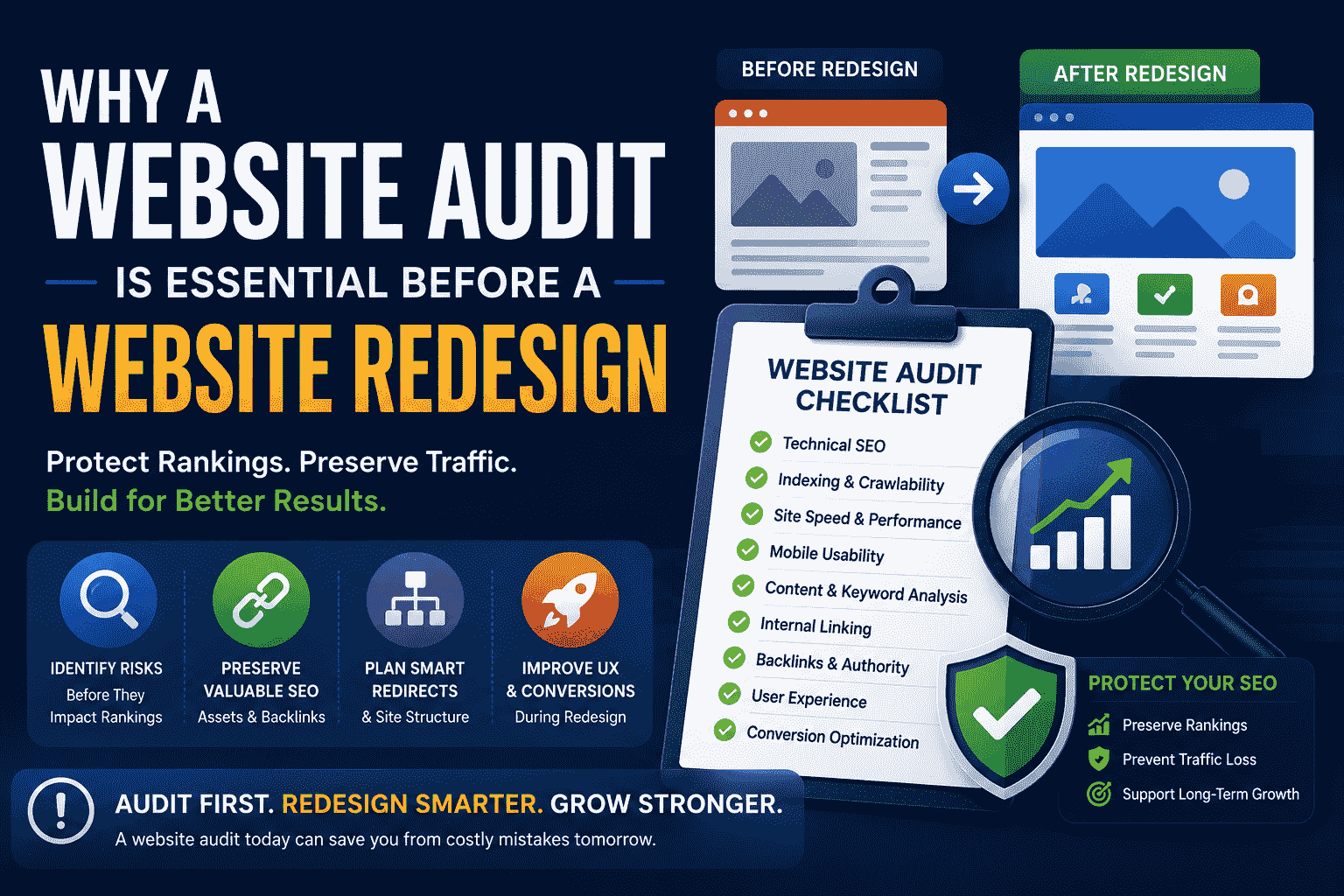
Before making significant design, structural, or content changes, businesses need a clear picture of their website's current performance. An audit helps uncover technical SEO issues, content weaknesses, indexing problems, user experience challenges, and conversion barriers that could negatively impact rankings and traffic after launch. By identifying these strengths and weaknesses early, organizations can approach a redesign strategically, protect valuable SEO assets, and build a stronger foundation for long-term growth.
Why Website Redesigns Often Cause SEO Problems
Many organizations assume that redesigning a website will automatically improve performance.
Unfortunately, this is not always true.
In fact, some businesses experience immediate traffic declines following a redesign.
Common reasons include:
- URL changes without redirects
- Missing content
- Technical SEO errors
- Broken internal links
- Mobile usability issues
- Poor site architecture
Because search engines rely on consistency and accessibility, even small mistakes can affect rankings.
A website audit helps identify these risks before development begins.
The Hidden Value of Existing SEO Assets
Before redesigning a website, businesses must understand what is already working.
Many websites contain valuable assets such as:
- High-ranking pages
- Strong backlinks
- Indexed content
- Established keyword visibility
- High-converting landing pages
Without an audit, these assets may be accidentally removed or weakened during the redesign process.
A website audit helps ensure that successful elements are preserved and incorporated into the new website structure.
Why Traffic Preservation Should Be a Priority
Organic traffic often represents years of SEO effort.
Businesses invest heavily in:
- Content creation
- Technical optimization
- Link building
- User experience improvements
A poorly planned redesign can undermine these investments.
Website audits identify:
- Top-performing pages
- High-value keywords
- Strong backlink destinations
- Important traffic sources
This information allows teams to prioritize traffic preservation throughout the redesign process.
Understanding Technical SEO Before a Redesign
Technical SEO serves as the foundation of search visibility.
A website audit evaluates critical technical elements including:
Crawlability
Can search engines access important pages?
Indexation
Are valuable pages appearing in search results?
Site Speed
How efficiently does the website load?
Mobile Performance
Does the website function well on mobile devices?
Structured Data
Are search engines receiving useful content signals?
Understanding these factors before a redesign helps businesses avoid introducing new technical issues.
Why URL Mapping Matters
One of the most common causes of SEO losses during redesigns is poor URL management.
Businesses often change:
- Page names
- Folder structures
- Navigation systems
When old URLs disappear without proper redirects, search engines and users encounter dead ends.
A website audit helps create a complete inventory of existing URLs and identifies pages that require preservation or redirection.
Proper URL mapping significantly reduces the risk of traffic loss.
Protecting Content During a Redesign
Content is often one of a website’s most valuable SEO assets.
Unfortunately, redesign projects frequently focus on aesthetics while reducing content depth.
Common mistakes include:
- Removing important pages
- Shortening valuable content
- Eliminating keyword-rich sections
- Consolidating pages improperly
A website audit identifies high-performing content that should be retained and optimized rather than removed.
This helps preserve rankings and search visibility.
How Website Audits Improve Site Architecture
Site architecture influences how both users and search engines navigate a website.
Poor architecture can create:
- Crawl inefficiencies
- User confusion
- Reduced authority distribution
- A website audit evaluates:
- Navigation structures
- Internal linking systems
- Content hierarchy
- URL organization
These insights help businesses build stronger website structures during redesign projects.
Why Internal Linking Should Be Reviewed Before Redesigns
Internal links play a critical role in SEO.
They help:
- Distribute authority
- Improve crawlability
- Guide users toward important pages
During redesigns, internal linking structures are often disrupted.
A website audit identifies:
- Existing link relationships
- Orphan pages
- Authority flow patterns
Maintaining strong internal linking helps protect rankings after launch.
Mobile Experience Must Be Evaluated
Modern websites must perform exceptionally well on mobile devices.
Before redesigning a website, businesses should understand how mobile users currently interact with the site.
A website audit evaluates:
- Mobile usability
- Loading speeds
- Navigation effectiveness
- Form functionality
These findings help ensure that redesign decisions improve rather than harm mobile experiences.
Conversion Performance Should Guide Redesign Decisions
Many redesign projects focus on aesthetics while overlooking business outcomes.
However, visual improvements mean little if lead generation declines.
A website audit helps identify:
- High-converting pages
- Effective calls to action
- Successful user journeys
- Conversion bottlenecks
These insights ensure that redesign efforts support business goals rather than simply creating a new appearance.
Why Competitor Analysis Matters Before Redesigns
A redesign presents an opportunity to strengthen competitive positioning.
Website audits often include competitor analysis that reveals:
- Content opportunities
- UX trends
- Technical advantages
- SEO strengths and weaknesses
Understanding competitor performance helps businesses make more strategic redesign decisions.
Enterprise Websites Face Greater Redesign Risks
Enterprise websites often contain thousands of pages and complex infrastructures.
As a result, redesign-related mistakes can affect large portions of the website.
Common enterprise challenges include:
- Multiple stakeholders
- International content
- Large content libraries
- Technical complexity
Many organizations work with an enterprise SEO agency to conduct pre-redesign audits and manage large-scale migrations.
Enterprise audits help reduce risk and improve long-term SEO performance.
Website Audits Improve Redesign Budget Planning
Redesign projects often involve significant investments.
Without understanding existing issues, businesses may underestimate:
- Development costs
- Content requirements
- Technical fixes
- SEO resources
A website audit provides visibility into project scope and helps organizations forecast budgets more accurately.
Many businesses use an SEO cost calculator after completing an audit to estimate optimization expenses and prioritize investments.
This approach improves financial planning and reduces unexpected costs.
Why Redirect Planning Is Critical
Redirects are essential during redesigns because they preserve search equity and guide users to the correct destinations.
- Without proper redirects:
- Rankings may decline
- Backlinks lose value
- Users encounter errors
A website audit helps identify pages that require redirect implementation and supports smoother transitions.
Preventing Traffic Loss After Launch
Many businesses assume that SEO work ends when the redesigned website launches.
In reality, post-launch monitoring is equally important.
Website audits establish benchmarks that allow businesses to compare:
- Rankings
- Traffic
- Conversions
- Indexation
before and after launch.
This visibility helps teams identify problems quickly and respond before significant losses occur.
Why Regular Audits Support Long-Term Success
A redesign should not mark the end of website evaluation.
Websites continue to evolve through:
- Content updates
- Feature additions
- Technical changes
- Marketing initiatives
Regular audits help maintain website health and ensure that redesign benefits continue over time.
Organizations that audit consistently are generally better positioned to sustain SEO growth.
Signs Your Website Needs an Audit Before Redesign
Several indicators suggest that a website audit should occur before redesign efforts begin:
Organic traffic is important to business growth.
The website contains hundreds or thousands of pages.
Rankings have fluctuated recently.
Major content changes are planned.
URL structures will change.
Lead generation depends heavily on search traffic.
In these situations, an audit can help prevent costly mistakes.
Conclusion
Website redesigns offer tremendous opportunities for growth, but they also carry significant SEO risks.
Businesses that redesign without understanding their current website often experience avoidable traffic losses, ranking declines, and conversion challenges.
A website audit provides the insights needed to protect valuable SEO assets, preserve organic visibility, improve user experiences, and support better decision-making throughout the redesign process.
Whether you're beginning with a free SEO website audit, partnering with an enterprise SEO agency, or forecasting investments using an SEO cost calculator, the audit should always be the first step before redesign planning begins.
The most successful redesign projects are not built solely around visual improvements. They are built on data, strategy, and a clear understanding of what must be protected and improved to achieve long-term SEO success.
Frequently Asked Questions
1. Why should a website audit be performed before a redesign?
A website audit identifies valuable SEO assets, technical issues, and content opportunities that should be preserved during the redesign process.
2. Can a website redesign hurt SEO rankings?
Yes. Without proper planning, redesigns can cause ranking losses through URL changes, content removal, broken links, and technical issues.
3. What does a pre-redesign website audit include?
It typically includes technical SEO analysis, content evaluation, site architecture review, internal linking assessment, and conversion analysis.
4. How does a website audit help protect organic traffic?
It identifies top-performing pages, keywords, backlinks, and technical factors that should be maintained during the redesign.
5. Do enterprise websites need special redesign audits?
Yes. Enterprise websites are more complex and often require specialized audits to manage large-scale SEO risks effectively.
Tags : .....