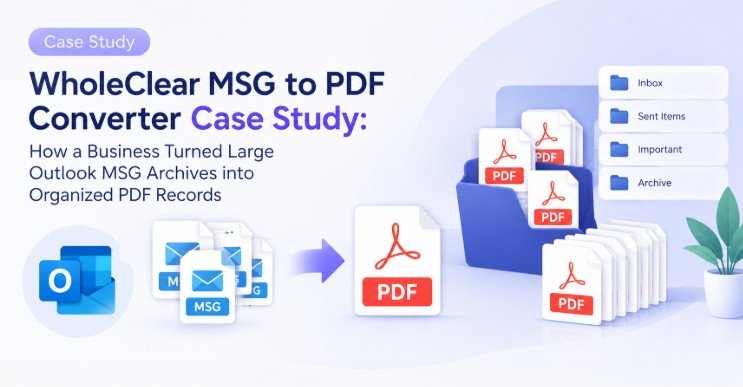
WholeClear MSG to PDF Converter Case Study: How a Business Turned Large Outlook MSG Archives into Organized PDF Records
By Casey Oliver 24-09-2026 6
Introduction
A medium-sized business had been collecting Outlook MSG files over the years from customer communication, vendor discussions, project correspondence, and internal operations. The files were spread out in different employee folders and departmental backup drives. The MSG format preserved the original Outlook messages, but it was getting hard to sort through thousands of individual files.
The company decided to develop a centralized PDF archive to allow authorized employees to access the email records without opening each MSG file. The challenge was how to process a large archive in a practical way, while retaining important email information, attachments, formatting and folder organization.
This case study covers the approach of the business to the problem and the way they organized the archive using WholeClear MSG to PDF Converter.
Data for Migration
The company was a regional professional services firm of approximately 140 employees. Employees had been saving important Outlook emails as individual MSG files over a number of years.
The IT team estimated the archive to be:
- 18,600 MSG Files
- Approximately 146 GB of email data
- Nearly 41,000 attachments
- 12 main folders per department
- 300+ subfolders
- MSG files of various versions of Outlook
- Individual messages of a few KB to several hundred MB
The archive included contracts, invoices, customer conversations, project approvals, meeting correspondence and technical discussions.
The management team wanted a PDF-based archive as PDF files were easier to distribute internally, review, print and store with other business documents.
Why Manual MSG to PDF Conversion is Difficult
At first, the IT team considered opening each MSG file in Outlook and printing to PDF.
This worked for a few messages, but soon became unfeasible.
Even if an employee spent just one minute on each of the 18,600 MSG files, the process would take over 310 hours to complete. The real time was probably much higher since the messages had to be opened, checked, printed, named and saved.
There were other concerns:
- Attachments must stay attached to the correct emails.
- Folder names had to be organized.
- Important email headers such as sender, recipient, subject and date.
- Manual processing of files increased the likelihood of missed messages.
- Some of the archived MSG files were from earlier versions of Outlook.
- The workflow would be complicated by the need to install or rely on several applications.
So the IT team was looking for a bulk conversion approach.
The Conversion Solution
The business tried the conversion process on a small sample of departmental MSG files, before working through the whole archive.
The software offers batch MSG conversion in the form of a folder mode that enables users to load multiple MSG files, instead of processing each message individually. It also retains email elements including To, CC, BCC, sender, subject, sent information and formatting. Attachments are exported to a separate folder.
It was also useful for the project that the conversion did not need Microsoft Outlook or Adobe Reader to be installed for the conversion itself. Only later was Adobe Reader required to view the resulting PDF documents.
Step-by-Step Process
The IT team then went through a controlled five step process.
Step 1: Backup your data
The original MSG archive has been copied to separate storage. Source files were kept as read-only throughout the project.
Step 2: Split the archive
The 18,600 MSG files were organized based on existing folder structures and departments. This also made it easier to check the output after conversion.
Step 3: Perform a trial conversion
The first converted sample was comprised of 250 MSG files. The team examined email headers, formatting, attachments, filenames and folder organization.
Step 4: Process the full archive
The IT team applied folder based processing to the remaining MSG files after the pilot produced the desired structure. The software is capable to convert in bulk; there are no limitations on the number and the size of MSG files.
Step 5: Check the PDF archive
The team randomly selected files from each department and cross-referenced them against the original MSG messages. They also verified that key attachments had been properly exported.
Performance Results
The whole conversion process, including the verification and file organization, took about three business days.
The company created a structured archival of customer correspondence, project-related emails, finance-related communications and administrative records in PDF format.
The biggest improvement wasn’t just the switch from MSG files to PDF. it was creating an archive that was easier for employees to use.
The team said:
- More accessible and reviewable email records
- Attachments were sent separately for reference.
- Departmental folders were still more readily identifiable.
- Some important email metadata still existed.
- Employees no longer needed to open Outlook just to check old correspondence.
- The original MSG files may continue to be archived as the source archive.
The conversion process maintains the MSG email structure and allows for both selective and bulk conversion, according to software documentation.
Key Findings
The project provided a number of practical lessons for businesses dealing with large MSG archives.
By migrating a small sample before you begin a large migration, you can identify naming, folder, and attachment problems early.
Second, keep the original MSG files until the converted archive has been thoroughly verified.
Third, bulk processing is much more practical than opening and printing thousands of messages manually.
Finally, check email metadata and attachments in addition to the PDF content. An archive is only useful if the information needed for later review is still accessible.
Frequently Asked Questions
1. Is it possible to batch convert MSG files to PDF?
Yes. The software has a folder mode conversion feature which allows batch conversion of several MSG files at a time.
2. Does the attachment of email get converted along with MSG files?
Yeah. You can export attachments from MSG emails to a separate output folder.
3. Is the email headers preserved during conversion?
Details (To, CC, BCC, sender, subject, sent etc.) Email format
4. Do I need Microsoft Outlook?
No. The software is designed to perform the conversion without Outlook being installed.
5. Can I convert older Outlook MSG files?
The software documentation states it supports valid MSG files from Outlook 2019, 2016, 2013, 2010, 2007, 2003 and earlier editions.
6. Can Users Choose Only Certain MSG Files?
Yes. The MSG conversion is selective, which can be handy if you only need to archive some folders or messages.
7. What should companies do before embarking on a large conversion?
Make a copy of the original MSG archive, run a pilot conversion, check attachments and metadata, and then process the rest of the folders in batches.
Conclusion
The main challenge for this business was not only to convert MSG to PDF. It was turning a huge pile of individually stored Outlook messages into an organized archive that employees could actually use.
The IT team devised a more manageable PDF record system without having to manually print thousands of emails by testing a representative sample, retaining the original files, processing folders in bulk and verifying the results later.