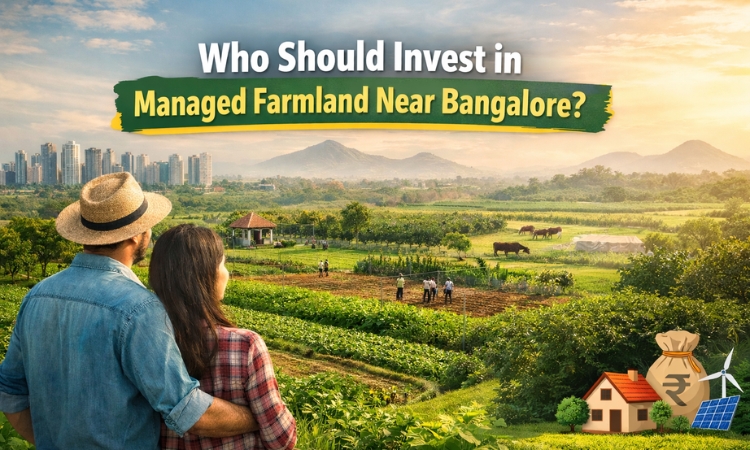
Investment philosophies are evolving. Conventional portfolios built purely on equities and real estate are gradually making room for tangible, productive assets. Among these, managed farmland near Bangalore is emerging as a compelling option for investors who seek both stability and long-term growth.
Land is finite. Food demand is not. This fundamental imbalance creates a powerful economic narrative that continues to attract attention toward farmland in Bangalore. With structured management models, professional cultivation, and organized agricultural planning, farmland investments are no longer restricted to seasoned agriculturists. They are now accessible, systematic, and strategically aligned with modern wealth-building goals.
But farmland is not a universal solution. It suits particular mindsets, financial goals, and life stages. Understanding who benefits the most from such investments is essential before entering this distinctive asset class.
High-Net-Worth Individuals Seeking Asset Diversification
Affluent investors often seek assets that operate independently of market turbulence. Stocks fluctuate. Currencies wobble. Even urban real estate experiences cyclical slowdowns. Agricultural land in Bangalore, however, follows a different rhythm — one tied to productivity, demand for natural resources, and intrinsic land value.
For high-net-worth individuals, managed farmland near Bangalore offers portfolio ballast. It acts as a counterweight to volatility-heavy instruments. The biological growth of crops and trees, particularly in long-term ventures like a sandalwood farmland project near Bangalore, creates a compounding effect that is not directly influenced by daily market sentiment.
Wealth preservation becomes equally important as wealth creation at this financial tier. Farmland delivers both. It provides tangible ownership, productive capacity, and capital appreciation potential over time, forming a resilient pillar within diversified holdings.
Working Professionals Looking for Passive Income Streams
Time scarcity defines modern careers. Many professionals possess investable capital but lack the bandwidth to manage complex ventures. Traditional farming requires oversight, expertise, and constant engagement. Managed farmland models eliminate these barriers.
With professional management handling cultivation, maintenance, and harvesting, investors gain exposure to farmland in Bangalore without operational involvement. Returns stem from structured agricultural outputs, often supported by crop planning and long-term cultivation strategies.
For salaried individuals aiming to create additional income sources beyond fixed wages, agricultural land for sale in Bangalore presents a distinctive path. It blends asset appreciation with potential yield generation, offering a dual-benefit structure. The investment works quietly in the background, while the investor focuses on career progression.
Non-Resident Indians (NRIs) Exploring Stable Indian Investments
For NRIs, investment decisions are often both emotional and financial. Land holds cultural significance. It represents permanence and roots. At the same time, overseas investors seek stable assets in India that do not demand frequent physical presence.
A managed farmland near Bangalore bridges this gap. Professional supervision ensures agricultural activities continue seamlessly. Structured projects, especially those involving long-cycle crops such as a sandalwood farmland project near Bangalore, offer long-term value creation without day-to-day involvement.
Additionally, agricultural investments reconnect NRIs with India’s growth story in a grounded, literal sense. Rather than abstract financial instruments, they hold an asset that grows from soil, season by season, year by year.
Retirees Planning Sustainable and Low-Risk Investments
Retirement planning shifts focus from aggressive growth to security and steady value preservation. Agricultural land in Bangalore appeals to retirees for both financial and lifestyle reasons.
Land historically retains value, particularly in regions near expanding urban centers. Managed farmland near Bangalore offers exposure to growth corridors while maintaining the inherent stability of agricultural property.
Beyond economics, there is a psychological dimension. Many retirees seek serenity. Green landscapes, periodic farm visits, and a connection to nature contribute to well-being. While the investment remains professionally managed, the option to engage with the land provides intangible satisfaction that purely financial assets cannot replicate.
First-Time Investors Seeking Entry into Alternative Assets
Young or new investors often begin with traditional instruments. Over time, curiosity expands toward alternatives. Farmland introduces them to asset classes beyond stocks and mutual funds.
Managed farmland near Bangalore offers structured entry into agriculture without overwhelming complexity. It serves as an educational bridge, helping investors understand crop cycles, land economics, and agricultural value chains.
Furthermore, farmland in Bangalore tends to exhibit low correlation with financial markets. This makes it an instructive diversification tool. First-time investors learn an important lesson early — wealth is strengthened when assets behave differently under the same economic conditions.
Entrepreneurs and Business Owners Seeking Tax-Efficient Avenues
Entrepreneurs frequently search for strategic financial channels that align with long-term planning. Agricultural investments occupy a unique position in India’s financial ecosystem. While regulations vary and professional advice is essential, agricultural income considerations can make farmland an attractive component of a broader financial blueprint.
Owning agricultural land for sale in Bangalore also diversifies entrepreneurial risk. Business revenues may fluctuate, but land-backed assets provide a stabilizing counterbalance. Managed models further reduce administrative load, allowing business owners to allocate attention where it is most needed.
Environmentally Conscious Investors
A new class of investors evaluates opportunities through an ecological lens. Profit alone is insufficient. Sustainability matters. Environmental impact matters.
Agriculture, when managed responsibly, becomes a green asset. Managed farmland near Bangalore often involves planned cultivation, soil stewardship, and long-term crop strategies that enhance land productivity. Projects centered around perennial crops, including sandalwood farmland project near Bangalore, promote long-duration ecological growth.
Such investments align wealth creation with environmental responsibility. Capital supports land use that remains productive rather than extractive, creating value while respecting natural systems.
Conclusion
Managed farmland near Bangalore is not merely a trend. It represents the intersection of land, productivity, and structured investment frameworks. Its suitability, however, depends on investor intent.
Those seeking diversification find stability. Professionals gain passive exposure. NRIs secure grounded assets. Retirees embrace security and tranquility. Entrepreneurs explore strategic allocation. Environmentally conscious investors align capital with sustainability.
The asset is simple in nature, yet sophisticated in impact. Soil. Growth. Time. When aligned with the right investor profile, agricultural land in Bangalore evolves from a piece of property into a long-term wealth companion.
Tags : .....