Rental businesses rely on accurate asset visibility to reduce losses, improve customer service, and maximize equipment utilization. The knowledge of RFID vs GPS for equipment tracking assist the companies to choose the appropriate technology to apply in various operations. An effective rental equipment tracking system would facilitate management of inventory, minimize errors in manual forms and enhance the overall business performance.
Regardless of the management of construction tools, event equipment, medical devices, or industrial machinery, it is crucial to select the appropriate tracking method. Quickdice offers high-tech solutions, which assist rental companies in enhancing the visibility of assets, streamlining the workflows, and making crucial decisions relying on real-time equipment data.
Why Equipment Tracking Matters for Rental Companies
Tracking of equipment enables rental companies to be aware of the location of all assets, when they last utilized them, and the person who is currently in possession of the asset. The visibility reduces theft, misplaced equipment, enhances scheduling of maintenance and has greater availability of assets. Customer satisfaction is also improved through better tracking as equipment is available, properly maintained and on time and unnecessary replacement costs are minimized.
Understanding RFID Technology
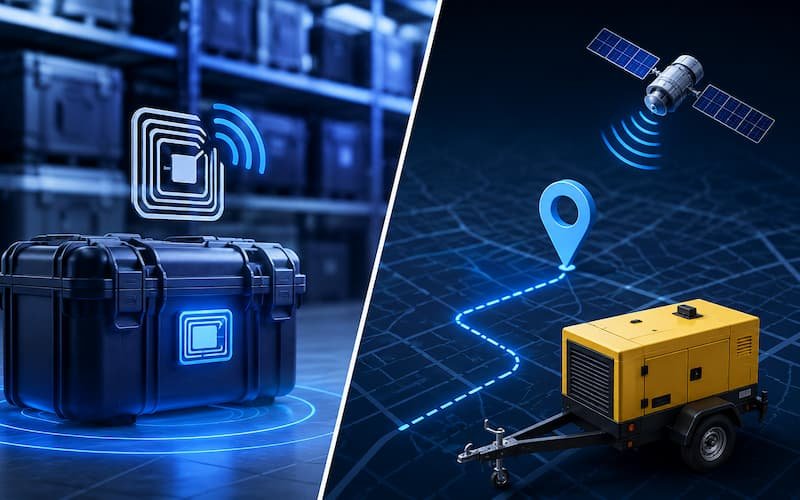
RFID (Radio Frequency Identification) is the electronic identification of equipments without the need of direct contacts through the use of electronic tags and readers. Inventory checks can be done more quickly and accurately as multiple tagged items can be scanned at the same time. RFID is very effective in warehouses, storage yards and rental facilities where companies require effective identification of assets as well as efficient management of inventory.
Understanding GPS Tracking
GPS tracking is a satellite technology that is used to identify the real time position of equipment over a large geographical region. It is suitable when the assets to be transported are of high value, and they move often between customer locations or remote areas. GPS offers real-time positioning, tracking of movements, the monitoring of the routes and recovering stolen equipment and is useful in equipment operating outside the company premises.
RFID vs GPS for Equipment Tracking: When Is RFID the Better Choice for Rental Companies?
1. Managing Equipment Inside Warehouses
In cases where equipment is mostly kept within warehouses or storage facilities, RFID vs GPS for equipment tracking will mostly lean towards RFID. Inside the house, GPS signals can be very inaccurate whereas RFID can be used to identify items in seconds, count inventory faster and efficiently check stock without having to scan a line of sight or maintain constant satellite connectivity.
2. Performing Fast Inventory Audits
Any rental company that has a regular inventory audit will find RFID useful since numerous assets can be scanned at a time. Employees can easily check hundreds of products that have tags attached to them instead of searching by individual products and this saves labor costs, enhances accuracy and minimal downtime is used during regular inventory checks.
3. Tracking Large Numbers of Small Assets
RFID is also more convenient than GPS to companies that rent hand tools, electronic equipment, safety equipment, or small machinery. GPS attachment of all low-cost products is a costly endeavor and RFID tags are affordable and offer an efficient identification of thousands of assets in different storage sites.
4. Reducing Equipment Identification Errors
RFID reduces human errors incurred in entering data manually or scanning barcodes. Automatic identification will make sure the equipment is in and out of the company properly, which will lessen improper records, lost equipment, and billing issues. This gives the smoothest rental processes, and reliable equipment histories to refer to in the future.
5. Improving Warehouse Productivity
Warehouses that have high traffic need rapid transportation of equipment in and out of the facility in the receiving, storage, maintenance, and dispatch areas. RFID automates most tracking procedures and the employees can process the equipment in a more efficient manner. Increased productivity and decreased delays during peak periods will be achieved through faster workflows.
6. Monitoring Equipment Maintenance Cycles
RFID assists maintenance staffs to determine equipment right away and retrieve service histories when carrying out inspections. Any tagged assets can be scanned upon entry to the maintenance areas and make sure that the scheduled servicing is done on time. Improved maintenance management will prolong the life of the equipment and prevent unwanted machine malfunction in the course of rentals.
7. Operating Within Limited Budgets
Companies that have thousands of items to be rented may be more concerned with price. In numerous comparisons between RFID vs GPS for equipment tracking, RFID will provide reduced implementation expenses in tracking inventory indoors. Organisations are able to label more assets, and keep accurate records without investing in costly GPS devices on all assets.
8. Managing Fixed Storage Locations
In cases where equipment is usually relocated within the branches of the company or in the areas where it is stored, RFID gives adequate visibility. RFID is an effective tool in an operational environment with controlled operation as businesses can have a record of accurate location within the facilities without paying to have a continuous real-time tracking.
9. Speeding Up Equipment Check-In and Check-Out
RFID is a big step in speeding up the rental process. A single scan will enable the staff to be able to identify several returned or rented items in real time thereby cutting down on the time spent by customers and enhancing efficiency of operations. The accelerated processing enables increased transactions at the same time maintaining the correct inventory records in a rental cycle.
10. Building a Scalable Asset Management System
The expanding rental companies require technology that can accommodate the increasing inventories. RFID enables businesses to include thousands of tagged objects without the need to make significant infrastructure modifications. RFID has kept bringing efficiency in identifying, visibility of inventory and ease in managing assets in various plants as equipment fleets keep increasing.
Conclusion
The decision to use RFID or GPS is based on the way in which the rental equipment is stored, moved and managed. Although GPS is excellent in operation with the large geographic coverage, RFID provides an excellent value in terms of indoor inventory, quicker audits, reduced operating expenses and effective management of warehouses. Assessment of the operational needs is important so that businesses invest in technology that can provide them with a long-term value.
Ultimately, understanding RFID vs GPS for equipment tracking enables rental companies to improve asset visibility, reduce losses, increase productivity, and enhance customer satisfaction. The appropriate choice of tracking solution assists in smarter operation, better inventory management, long-term business development since more and more equipment fleets may be expanded.
Tags : .....