When Should an Oil and Gas Company Consider Multi-Standard ISO Certification?
By sahana sana 05-10-2026 1
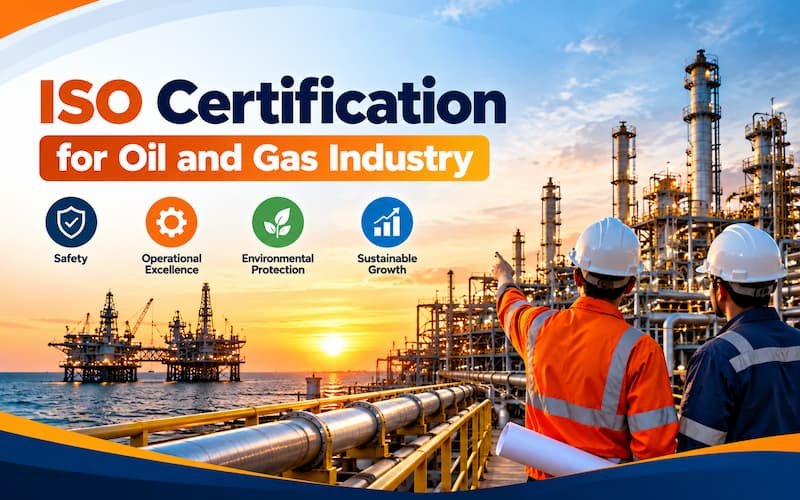
In an industry where quality, environmental responsibility, occupational safety and operational reliability are all tied together, oil and gas companies need to be mindful of the risks they can encounter. There are various kinds of risks that can be managed simultaneously by organizations engaged in exploration activities, drilling, production, refining, transport, equipment supply and oilfield services. This may mean that a businesses management system will eventually need to cover more business requirements than just a certification. Awareness of relevant iso oil and gas standards can assist organizations select management systems that are suitable for their business, customer, contractual needs and risk profile.
The multi-standard ISO certification may be of relevance for an oil and gas company that is required to exhibit control over quality, environmental performance, occupational health and safety, energy use, information security, and industry-specific requirements. ISO classifies ISO 29001:2020 as a quality management system standard for organizations that provide products and services in the petroleum, petrochemical and natural gas sectors. It adds to the requirements of ISO 9001:2015 and the requirements of sector-specific supply-chain risks and opportunities.
As the business grows, its operations become more complex
An ISO certification can be considered by an oil and gas company if its operations are going to be at multiple locations, on multiple projects, for multiple services and/or at different stages of the oil and gas industry value chain. If a small organization has limited activities, it may be able to use a single quality or safety system to handle its processes initially. With more complicated operations, however, management may require formal systems for quality, environmental controls, worker safety, energy management, and other areas.
The complexity can also be raised when an organization starts to work on several contracts at the same time. The client's expectations for QA, environmental controls, OS, documentation, supplier management and regulatory compliance may vary. The coordinated management system can aid the company to set up a consistent process throughout projects and eliminate redundant processes in the company's internal management system.
When Customers Require Multiple Certifications
Another more pragmatic reason for exploring further ISO certifications is customer and contractor needs. Oil and gas operators, EPC contractors, equipment manufacturers and service companies can include management-system requirements in tender documents, supplier qualification systems or contracts. It can be done by a company that wants to be certified, but it is better for the company to read the specific requirements that apply to their target customers and contracts and to obtain the standards because they are widely used, or because it is the one they are interested in.
The ISO 29001 is particularly targeted for product and/or service supply organisations in the petroleum, petrochemical and natural gas sectors. Depending on the scope of their contracts, ISO guidance indicates that organisations in this sector could have demands for standards including ISO 9001, ISO 29001, as well as other industry specifications. Thus, when deciding if a more comprehensive certification program is appropriate or not, it is important to consider customers' needs.
Where Quality and Industry-Specific Requirements Overlap
In the oil and gas industry, quality management is essential as it can impact both the timelines of projects and the reliability of their operations if there are problems with the equipment, processes that are inconsistent, or if the materials from the supplier are faulty or if there is a lack of controls. The ISO 9001 gives a general framework for quality management whereas ISO 29001 gives the sector-specific requirements for organisations providing products and services to the petroleum, petrochemical and natural gas industry. ISO states that ISO 29001:2020 is written as a supplement to ISO 9001:2015.
Those companies which already have a quality management system in place can then consider whether their activities and customer requirements warrant implementing the sector specific standard. This may be of special interest to manufacturers, service providers and suppliers whose products or services directly feed into the oil and gas industry. The decision should be made based on the size of the organization, the contractual requirements, the risk of operation and the expectations of the industry.
When the Environmental responsibilities increase, the Yeast reaction rate increases.
An additional factor for oil and gas companies is environmental management. Operations can include emissions, waste, chemicals, water usage, spills, energy usage and more environmental factors. ISO 14001 can be incorporated into a wider management-system approach, particularly for companies with a large environmental footprint.
ISO's management-system standards list calls ISO 14001 the international standard for environmental management systems. An environmental management system can offer a systematic way of determining the environmental aspects, setting goals, measuring performance, and driving continuous improvement.
In some situations the need for environmental certification may be more relevant when a business becomes involved in projects where the environmental performance is more closely monitored or when clients incorporate environmental management as part of their supplier qualification criteria. It can also support organisations on embedding environmental responsibility into the normal process of everyday planning rather than as individual events.
When Occupational Health and Safety Risks Are Significant
Heavy equipment, hazardous material, high pressure systems, confined spaces, working at height, transportation hazards, and other occupational hazards may be involved in oil and gas operations. ISO 45001 can be adopted by companies with significant workplace hazards to provide a systematic approach to occupational health and safety management.
According to ISO, ISO 45001 is a management-system standard for occupational health and safety. A formal safety management approach can assist organizations with systematic processes that share the objective of establishing consistent safety controls at different facilities and/or projects, including hazard identification, risk assessment, responsibilities, performance monitoring, and hazard control improvement.
A company may also want to take into account the relationship between certification and other legal, regulatory, contractual and operating obligations it has. Certification is not a substitute for compliance obligations, it is part of a structured management approach to the control of the occupational health and safety processes.
How to begin making energy management a business priority.
Many oil and gas activities are directly linked with energy consumption, especially for processing, refining, transportation, utilities, large industrial facilities, etc. ISO 50001 could be useful for companies looking for a systematic way to manage their energy performance.
ISO 50001:2018 is recognised by the management-system standards as the energy-management system standard by ISO. An energy management system is a way for an organisation to create a formal procedure to gain insight in the energy consumption, to develop an energy goal, to track progress, and to continuously improve.
Companies and their activities and goals determine the relevance of this certification. For organisations that have a significant amount of energy use, it can be beneficial to link energy management to quality, environmental and safety systems, to provide a more coordinated approach to operational performance.
When integrated management system is the Company's desire.
The most compelling practical motivation for seeking Multi-standard ISO certification is the chance to incorporate related management systems. Common characteristics that pertain to quality, environmental management, occupational health and safety, energy management, and sector-specific quality requirements include leadership, planning, documented information, risk management, internal audits, corrective actions, and continual improvement.
ISO's guidance on oil and gas management systems includes a range of oil and gas-specific management-system standards, including quality, environmental, occupational health and safety, asset management, and energy management. Organizations can look at how to coordinate common processes in each system, while keeping the requirements for each applicable standard intact, rather than each system being a completely separate program.
An integrated approach can also help clarify internal responsibilities. Where the standards allow, for example, audit planning, management review, corrective action management, document control and performance monitoring could be coordinated. But, don't neglect standard-specific requirements when integrating.
The need for a more comprehensive framework for Risk Management
In the oil and gas sector, there are special risks that can arise through interaction between operational, environmental, safety, quality, supply-chain, and business risks. As an organisation becomes exposed in these areas it may choose to determine that one management system is not enough to meet its needs.
A larger certification strategy can aid companies create documented processes to identify threats, assign duties, keep tabs on controls, and assess performance. The ISO guidance on ISO 29001 highlights risk-based thinking in oil and gas supply chains and clarifies that ISO 29001 provides a structure for matching requirements with other associated oil and gas industry standards.
When entering New Markets or Contracts
New areas of geographical expansion or new customer groups may generate new certification requirements. An organisation might find it necessary to have certain management system certifications for new customers, large contractors or international procurement processes. In these instances, the planning of certification should be linked to the company's commercial plans.
The management should not pursue all of the possible standards, but rather those that are appropriate for the services being provided and the customers being served. This way, the management system can be implemented without going overboard and without paying extra to certify costs.
What is a Company to do for Multiple Certifications?
An organization should first do a detailed gap assessment prior to starting the certification process against the standards they will be using. In the assessment, the following aspects of policies and procedures, operational controls, records, responsibilities, risk assessments, legal requirements, supplier controls, internal audits and performance-monitoring processes should be considered:
The company can then develop an implementation plan that prioritizes and schedules the plan. To minimise duplication of effort, common procedures can be developed if requirements overlap. There should also be an understanding on the part of the employees of how the various systems interrelate to their everyday functions. Training, internal audits, corrective actions and management reviews should be planned as a continuous management system process and not as a process that is used only before an external audit.
Choosing an appropriate certification body and specifying the scope of certification is also important. The scope should reflect the work of the organisation, the geographical scope and which processes will be involved. Certification should be based on the management system actually in place in the organisation, and not merely be a document generation exercise.
Conclusion
Multi-standard ISO certification is relevant in situations where an oil company's operations are complex, customer expectations are high, risks are present, environmental obligations are high, safety standards are important, or market goals are large, and consequently, a single management system is not sufficient. Other management-system areas are addressed by the following standards: ISO 14001, ISO 45001 and ISO 50001 are standards which apply to quality management—other requirements. Other requirements are addressed in the following standards: ISO 14001, ISO 45001 and ISO 50001 are standards which apply to quality management—other requirements.
The first step in making a decision should be a thoughtful evaluation of the business requirements, not the number of certificates that companies can be issued. An organization can do this by assessing contracts, customer needs, operational risks, current systems and intentions for the future, to decide which certifications are relevant and if an integrated approach is appropriate. A well-designed Multi-standard ISO certification program can then be designed to offer a coordinated management system framework that helps to support consistent processes, risk control, continuous improvement and the specific requirements of the oil and gas industry.