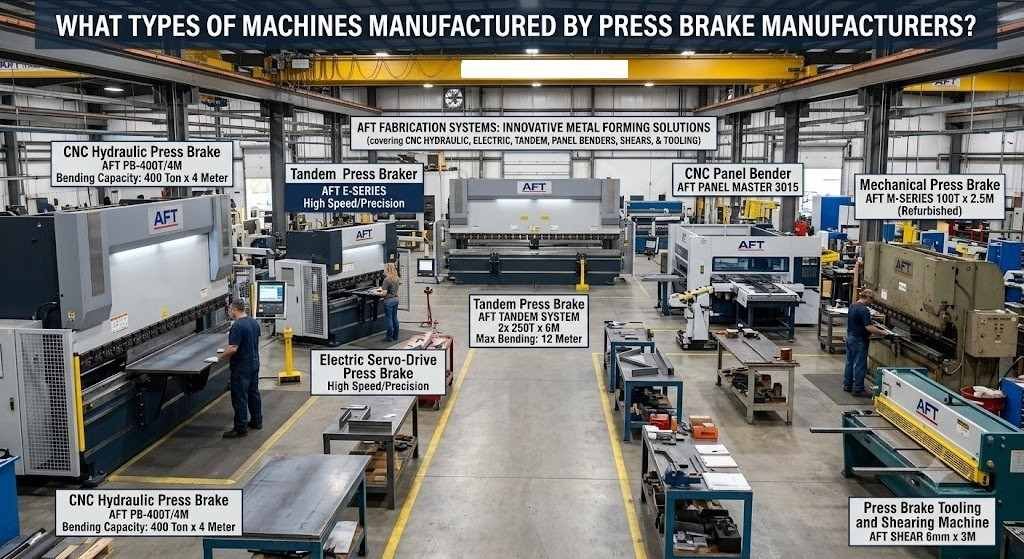
Several types of press brakes are made by press brake manufacturing companies to satisfy bending and fabrication requirements for different industries. Some of the options available include hydraulic press brakes, CNC press brakes, NC press brakes, mechanical press brakes, and electric press brakes. Hydraulic types are mostly used for heavy-duty applications while CNC press brakes are used to obtain precision and repeatability in bending for complex production work. Moreover, the manufacturing industry has the ability to develop machines with a variety of tonnage capacity, bending lengths, controls, and levels of automation. When choosing the appropriate machine for the requirements, it is important to consider the following: the thickness and gauge of the sheet, the type of material used, and the production volume as well as the application requirements will be considered.
Designing modern press brakes is a procedure of cooperation between the manufacturer and the customer.
The Modern press brake manufacturers create their machines by employing the rigid structures, advanced hydraulic or electric solutions, and computerized instruments. The process of designing begins with ascertaining several factors such as bending force, thickness of the material, length of workpiece, production volume, and accuracy specifications. Then the makers choose the components of a frame, hydraulics, motors, controls, backgauges, and tooling solution, which ensures proper bending performance. Alternatively, today’s CNC press brakes may feature programmable bending processes, automatic angle corrections, touchscreen control panels, and energy-efficient solutions.
Grasping the Concept of Press Brake Tonnage, Length of Bend, and Precision
When purchasing a press brake for sheet metal fabrication, it's wise to get familiar with some crucial terms like tonnage, length of bend, and precision. Tonnage represents maximum working ability of the press brake. It should correspond to the type and thickness of material it is expected to work with as well as to the bending process. Length of bend denotes the width of the sheet which can be bent by one stroke of the machine. Accuracy defines how accurately the machine bends metal and the requirement for angle and dimensions. Nowadays, modern decisions on CNC press brakes are able to ensure the repeatability of the process due to sophisticated control systems and back gauges. Therefore, if manufacturers choose the proper form factor of tonnage, length, and accuracy, they will achieve high-quality results without unnecessary excess costs due to too high machine power.
Choosing Press Brake Manufacturers for Small and Large Fabrication Businesses
Making a choice of suitable press brake manufacturers is an important step for any metalworking enterprise. It is necessary to mention that the specifications of equipment depend on the level of material thickness, production rate, precision, and the budget of the business. In this respect, small-sized companies have an opportunity to use well-constructed mini- or medium-sized machines that will ensure great efficiency and won’t necessitate high investments. Some big industrial enterprises require high-tonnage and press brake equipment with high bending lengths and effective automation systems. Nevertheless, aside from those points, it is worth examining the product’s quality, customization options, warranty, installation, training, spare components, and other services.
Conclusion
Awareness of the types of machines and their specifications is vital in making the right decision about the right type of press brake used for the task. The manufacturers provide various choices of press brakes, thus, allowing industries to pick the appropriate press brakes. These machines vary from small versions to highly efficient CNC systems. In order to make the necessary choice of the press brake, it is important to compare the technical specifications of the press brake, such as the quality of manufacturing, the degree of automation, specifications, and assistance provided to a purchaser.
Tags : .....