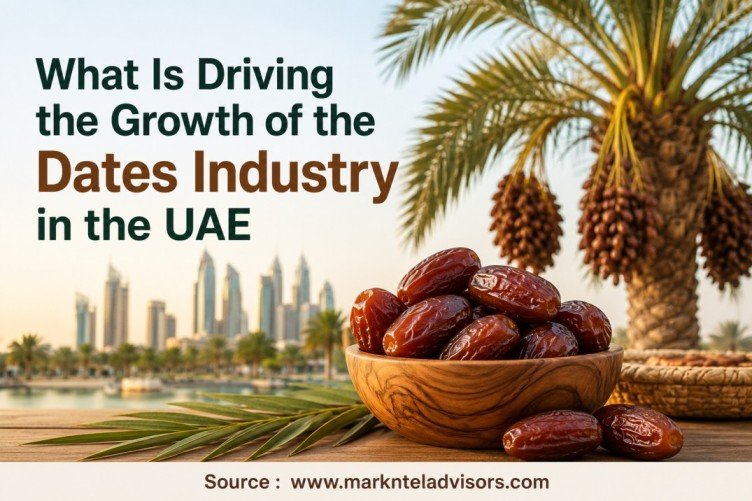
The dates industry in the UAE plays a significant role in the country’s agricultural landscape, supported by favourable climatic conditions, strong cultural demand, and expanding food processing applications. Dates are not only a staple food in the region but also a key export commodity, contributing to broader agri-food trade flows across the Middle East and North Africa. Global agricultural bodies such as the Food and Agriculture Organization (FAO) highlight the Middle East’s increasing role in date production and consumption, driven by both traditional usage and modern food innovation trends (FAO, United Nations).
According to a MarkNtel Advisors study on the UAE dates sector, the industry reflects steady structural growth supported by rising consumption in both domestic and international markets. The findings presented in the UAE Dates Industry Report indicate evolving demand patterns across retail, food processing, and export channels. As per the UAE Ministry of Climate Change and Environment (MoCCAE), national agricultural initiatives are also strengthening date palm cultivation through sustainability-focused farming practices and technological adoption.
Agricultural Foundations and Production Dynamics
Date cultivation in the UAE is closely tied to arid climate adaptability, where palm farming remains one of the most viable agricultural practices. Farmers increasingly rely on advanced irrigation systems, including drip irrigation and controlled-environment farming techniques, to improve yield efficiency. The FAO notes that sustainable water management remains a critical factor in arid-region agriculture, particularly for crops like date palms that require careful resource balancing (FAO).
The sector is also benefiting from research-led improvements in crop resilience and pest control, supported by regional agricultural institutions. Initiatives promoted by the UAE government aim to preserve palm biodiversity and enhance productivity through modern agritech solutions. Insights from the UAE Dates Industry Analysis suggest that production efficiency is increasingly tied to innovation-driven farming systems and value-chain integration.
Rising Domestic Consumption and Cultural Significance
Dates hold deep cultural and dietary importance in the UAE, commonly consumed during religious events, festivals, and daily nutrition. This strong cultural foundation ensures consistent domestic demand throughout the year. The Ministry of Climate Change and Environment (MoCCAE) emphasizes the role of date palms in food security strategies and their alignment with national agricultural sustainability goals.
Urbanization and changing dietary preferences have also led to diversified product usage, including packaged snacks, syrups, and energy bars derived from dates. This transformation is expanding the consumer base beyond traditional consumption patterns. A broader Middle East fruit supply analysis highlights how processed fruit derivatives are gaining traction in modern retail formats across the region.
Export Growth and International Trade Expansion
The UAE has developed a strong position in global date exports due to its strategic geographic location and established trade infrastructure. Export activities are supported by re-export hubs and logistics connectivity to Asia, Europe, and Africa. According to the International Trade Centre (ITC), agricultural commodities from the Middle East benefit from improved trade facilitation and global demand for natural sweeteners (ITC).
The increasing popularity of premium and organic date varieties has also contributed to higher international demand. Export-oriented packaging and quality certification systems are further enhancing competitiveness. The regional agricultural outlook study indicates that export channels remain a key growth driver for the UAE’s dates ecosystem, supported by government-led trade diversification initiatives.
Value Addition and Processing Industry Trends
Beyond raw production, the UAE dates industry is witnessing strong growth in value-added processing. Manufacturers are increasingly focusing on date-based syrups, powders, confectionery, and health-focused food products. This diversification aligns with global demand for natural sweeteners and clean-label ingredients.
Food innovation centers in the UAE are supporting product development, while private sector investments are enhancing processing capabilities. According to FAO dietary diversification insights, value-added fruit products are becoming central to agri-food industrialization in developing regions (FAO). This trend is reinforcing the UAE’s position as both a producer and processor in the global dates value chain.
Sustainability and Future Outlook
Sustainability remains a key focus in the UAE agricultural sector, particularly in water conservation and soil management. Government-led initiatives aim to reduce environmental impact while maintaining agricultural productivity. The UAE Ministry of Climate Change and Environment continues to promote sustainable farming techniques aligned with long-term food security strategies.
International organizations such as FAO and ITC emphasize the importance of sustainable supply chains in enhancing agricultural resilience. The UAE dates industry is expected to continue evolving through technological integration, export diversification, and product innovation. Overall, the sector reflects a balance between cultural heritage and modern agricultural transformation, positioning it as a resilient component of the regional agri-food economy.