What Customers Notice When A Business Handles A Medical Emergency Well
Reviews usually focus on price, product quality, and how fast the service was. But some of the stories customers tell come from the worst five minutes of a visit. Those are the stories people remember and post about. A shopper faints near the checkout. A diner starts choking. A delivery driver collapses at a loading dock. In those moments, people see what a business is really made of. Many teams in Etobicoke start by looking at Coast2Coast CPR Training Etobicoke to get frontline staff ready for exactly that kind of day.
Why Do Customers Remember How A Business Responds To An Emergency?
Customers remember emergencies because they reveal whether staff care and know what to do. A calm, quick response builds trust that no advertisement can buy.
Think about the last time you saw someone struggle in a public place. Did staff step in? Did they freeze, or hand the problem to someone else? Bystanders notice. They also talk about it, online and off.
A clear response doesn't need to look heroic. It looks organized. Someone calls 911. Someone clears space. Someone stays with the person. That quiet competence is what customers describe afterward.
Which Emergencies Happen Around Customers?
Most emergencies in customer-facing spaces are ordinary medical events, not dramatic accidents. Staff in shops, restaurants, gyms, and offices may face:
- Fainting or sudden dizziness
- Choking on food
- Allergic reactions
- Falls on wet floors or stairs
- Chest pain or trouble breathing
- Cuts from broken glass or display fixtures
- Seizures
Hot days, long lines, and crowded aisles raise the odds of a few of these. So does a busy shopping centre on a holiday weekend. Your team can't predict which one will happen. It can prepare for all of them.
What Should Customer-Facing Staff Know?
Staff should know how to recognize an emergency, call for help, and give care until paramedics arrive. That starts with a few core skills.
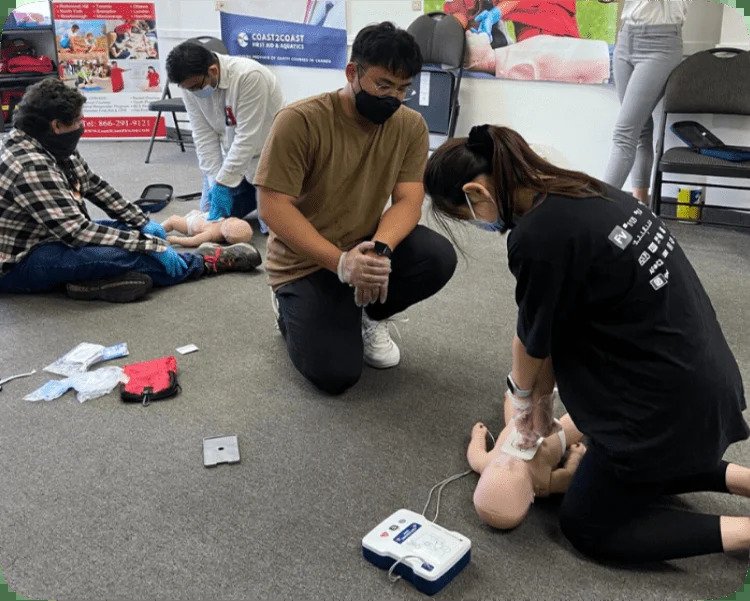
CPR Level C covers adults, children, and infants, which suits workplaces that serve the public, since you never know who walks in. In class, students practise on manikins and learn to use an automated external defibrillator trainer, so the steps feel familiar if they ever need them.
Training also builds habits that matter before any skill. Check the scene. Shout for help. Send a specific person to call 911 and another to fetch the AED. Clear a path for the paramedics. Short, clear instructions beat a crowd of people all talking at once.
What Does A Good Emergency Response Look Like?
A good response is fast, calm, and clear, and it puts the person's needs ahead of the sales floor. Trained staff tend to follow a simple pattern:
- Check that the scene is safe.
- Ask the person if they're okay, and call 911 if they aren't responding or the symptoms are serious.
- Send one team member to meet the paramedics at the door.
- Keep other customers back so the person has space and privacy.
- Stay with the person until help takes over.
Afterward, a short note in an incident log helps the team learn. It also helps if anyone has questions later.
Is CPR Training Enough For Ontario Workplace Rules?
No. A standalone CPR course doesn't meet WSIB first aid requirements for Ontario workplaces. Regulation 1101 asks for first aid training, and CPR is one part of it.
For workplaces covered by WSIB, the rules work by headcount:
- Five or fewer workers: Emergency (Basic) First Aid with CPR/AED
- More than five workers: Intermediate (Standard) First Aid with CPR/AED
Most workplaces need the intermediate level, so that's where many employers land. It runs 16 hours and covers more ground, including bone, muscle, and joint injuries, head and spinal injuries, medical emergencies, and the recovery position. CPR on its own is a smart add-on for front-of-house staff. It just isn't a substitute for the first aid certificate your workplace may need.
How Does Training Fit A Retail Or Service Schedule?
Blended learning lets staff finish the theory on their own time and then attend a focused skills session. Students complete a self-paced online portion of the training first. The classroom time then goes to practice with an instructor, not slides.
That matters in retail, where schedules shift weekly. A closing-shift cashier can complete the online portion at home and still join a skills session later that week. Certificates are issued within 48 hours, and first aid and CPR students get a free 90-day skills practice retake. Managers who want to see what works for their rota can check available dates and plan around peak seasons.
What Should Managers Check This Week?
You don't need a big project to improve readiness. Walk the floor like a customer and ask a few plain questions:
- Do staff know where the first aid kit and AED are?
- Who is trained on each shift, including weekends?
- Does every employee know the address to give a 911 operator?
- Is there a simple incident report for follow-up?
- Can staff reach the nearest exit and clear space fast?
Fix the gaps you find. Then train the people who face customers most often.
An emergency will never fit your schedule. Your response can still be ready.
If you are looking for CPR and first aid training near Evans Avenue, Brown's Line, Sherway Gardens, or surrounding areas, you may reach out to Coast2Coast First Aid & Aquatics in that area.
FAQS
Q: Why does emergency training matter for customer-facing businesses?
A: Customers notice how staff respond to a medical event, and a calm, organized response builds trust and keeps people safer until paramedics arrive.
Q: What is CPR Level C?
A: CPR Level C covers adult, child, and infant CPR and AED use, which makes it a practical fit for staff who serve the public.
Q: Does a CPR course meet Ontario WSIB first aid rules?
A: No. WSIB Regulation 1101 requires first aid training, so a standalone CPR course does not satisfy it for covered workplaces.
Q: Which first aid level do most workplaces need?
A: Most workplaces need Intermediate (Standard) First Aid, which applies when a workplace has more than five workers. Emergency (Basic) First Aid applies to five or fewer.
Q: How does blended learning work for shift workers?
A: Staff complete a self-paced online portion of the training, then attend a classroom skills session with an instructor.
Tags : .....