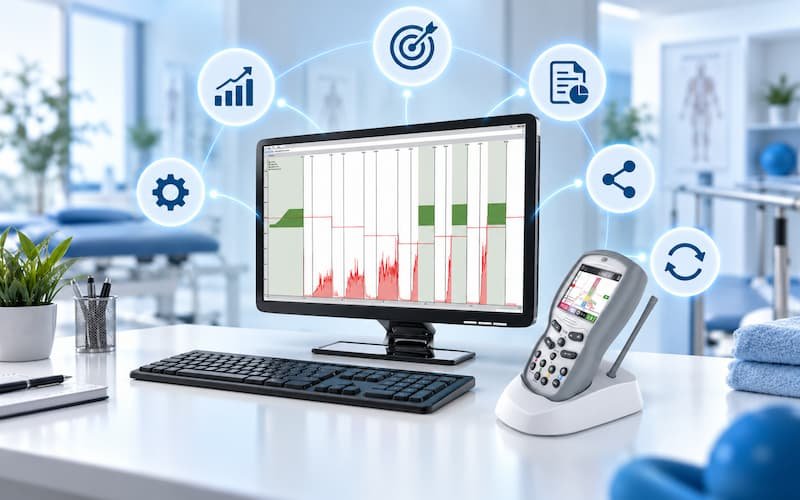
Digital tools are becoming increasingly useful in clinical rehabilitation, particularly when therapists need to organise treatment information and review therapy performance. Rehab software can support physiotherapy by helping professionals manage relevant data, review treatment sessions, and work more systematically with compatible rehabilitation and electrotherapy devices.
Physiotherapy often involves multiple stages, from assessment and treatment planning to exercise, electrotherapy, progress monitoring, and follow-up. When appropriate software is integrated into this process, it can help therapists organise information without replacing clinical assessment or professional judgement.
For rehabilitation involving EMG biofeedback, electrical stimulation, neuromuscular re-education, or supervised home programmes, software can provide an additional way to review therapy information and communicate treatment progress.
Understanding Rehab Software in Physiotherapy
Rehab Software in Physiotherapy refers to digital tools designed to support professionals in managing and reviewing information associated with rehabilitation.
Depending on the system, software may work with compatible devices to record or display information related to EMG biofeedback, stimulation programmes, muscle activity, or therapy sessions. Its exact functions depend on the equipment and software platform being used.
The purpose is not simply to collect large amounts of information. Useful software should help therapists access relevant data and use it alongside clinical observations when making treatment decisions.
For example, EMG biofeedback can provide information about muscle activity during selected exercises. When this information is presented clearly, a physiotherapist may be able to use it to explain muscle activation, technique, and changes in performance to a patient.
How Does Rehab Software Work?
The way software supports physiotherapy depends on the system, but the process can generally involve several stages.
1. Connecting With Compatible Equipment
Some rehabilitation software is designed to work alongside specific electrotherapy or biofeedback devices. Compatibility allows information generated during therapy to be transferred or reviewed within the software environment.
2. Recording Therapy Information
Depending on the system, relevant information may be recorded during an EMG biofeedback or stimulation session. The type of data available depends on the device and software functionality.
3. Reviewing Performance
The therapist can review information from a session and consider it alongside clinical observations. This may provide additional context when discussing muscle activity or therapy performance.
4. Communicating With the Patient
Information can be used to explain aspects of therapy in a more visual or structured way. Patients may find it easier to understand an exercise when they can see feedback related to their own muscle activity.
5. Supporting Follow-Up
Information from previous sessions may provide useful context during later appointments. Therapists can use appropriate records to support conversations about consistency, technique, and rehabilitation progress.
Key Benefits and Clinical Applications
Supporting Objective Feedback
One useful function of Rehab Software in Physiotherapy is its ability to help professionals work with measurable or recorded information.
For example, EMG biofeedback may show changes in muscle activity during a particular exercise. This does not replace physical assessment, but it can provide another source of information for the therapist to consider.
Improving Patient Education
Technical information can sometimes be difficult for patients to understand through verbal explanations alone. Visual feedback may help therapists demonstrate how muscle activity changes during contraction, relaxation, or selected exercises.
This can make therapy discussions more interactive without requiring patients to interpret clinical data independently.
Supporting Muscle Re-Education
Muscle re-education often involves helping patients develop greater awareness and control of specific muscle groups. EMG biofeedback and compatible software can support this process by providing information about muscle activity during selected tasks.
The therapist can then relate the feedback to exercise technique and the broader rehabilitation programme.
Organising Therapy Information
Physiotherapy may involve repeated treatment sessions and multiple therapy activities. Digital tools can help professionals organise relevant information so that it is easier to review when planning follow-up care.
Supporting Supervised Home Rehabilitation
Some patients continue appropriate rehabilitation activities outside the clinic. Where compatible technology and professional protocols allow, software-supported information may contribute to discussions about home therapy.
Home rehabilitation should remain appropriately guided, particularly when electrical stimulation or biofeedback equipment is involved.
Important Features and Factors to Consider
Not all rehabilitation software provides the same functions. Physiotherapists should consider the features that are genuinely relevant to their clinical workflow.
Important factors may include:
Device compatibility: The software should work appropriately with the rehabilitation equipment being used.
EMG functionality: EMG feedback may be important for selected muscle assessment and re-education applications.
Data presentation: Information should be clear enough to support professional review and patient education.
Session recording: Where relevant, the ability to review therapy information across sessions can be useful.
Ease of use: Software should not create unnecessary complexity during routine clinical work.
Treatment flexibility: Professionals may require different approaches depending on the rehabilitation programme.
Patient privacy: Appropriate procedures should be followed when handling patient-related information.
Professional interpretation: Software data should be considered within the wider clinical context.
The most useful system is not necessarily the one with the largest number of features. It should provide functions that support the therapist's actual needs.
How Can Healthcare Professionals Use Rehab Software in Practice?
Physiotherapists can use Rehab Software in Physiotherapy alongside assessment, exercise therapy, biofeedback, and appropriate electrotherapy.
For example, a therapist working on muscle activation may use compatible EMG biofeedback equipment to observe muscle activity during selected exercises. The resulting information can then be discussed with the patient and considered alongside physical assessment.
Rehabilitation clinicians may also use software-supported technology when working with neuromuscular re-education or muscle rehabilitation. Depending on the equipment, electrical stimulation such as NMES/STIM may be part of a broader treatment plan.
Pelvic health specialists can use appropriate biofeedback technology when pelvic floor rehabilitation requires greater awareness of muscle activity. The therapist determines whether such technology is appropriate based on the patient's needs and clinical assessment.
In hospitals and rehabilitation centres, digital tools may also help create a more structured approach to therapy information and follow-up.
Choosing the Right Solution
Choosing Rehab Software in Physiotherapy should begin with the treatment requirements rather than the software itself.
Professionals should consider:
Patient requirements: What type of rehabilitation is being provided?
Treatment goals: Is the focus pain management, muscle activation, muscle re-education, pelvic floor rehabilitation, or another objective?
Technology requirements: Would EMG biofeedback, TENS, NMES/STIM, or ETS be relevant?
Information needs: What therapy information needs to be recorded or reviewed?
Device compatibility: Does the software work with the equipment already used in the clinical environment?
Ease of use: Can therapists incorporate it into normal sessions without unnecessary disruption?
Professional oversight: Does it support rather than replace clinical assessment and decision-making?
The software should complement the rehabilitation process rather than become the centre of it.
Why Professional Rehabilitation Devices Matter
Professional rehabilitation devices can provide structured tools for physiotherapy applications such as pain management, muscle rehabilitation, neuromuscular re-education, and biofeedback.
Verity Medical is associated with the NeuroTrac range of professional rehabilitation and electrotherapy devices. Depending on the clinical application, the range includes technologies for TENS, NMES/STIM, EMG biofeedback, and EMG-triggered stimulation.
NeuroTrac MyoPlus devices, for example, combine relevant biofeedback and stimulation functions for suitable rehabilitation programmes. NeuroTrac Simplex provides EMG biofeedback functionality for appropriate applications.
The NeuroTrac PC Software is also relevant when professionals use compatible NeuroTrac equipment and require software-supported management or review of therapy information. Used appropriately, this type of technology can complement structured clinical rehabilitation without replacing the therapist's role.
Practical Considerations for Effective Therapy
Software is most useful when it is incorporated into a well-organised treatment process. Professionals should consider the following:
Confirm that the software and rehabilitation device are compatible.
Understand the purpose of each measurement or feedback display.
Explain relevant information to the patient in straightforward language.
Follow appropriate clinical protocols and device instructions.
Use correct electrode placement where electrodes are required.
Monitor patient comfort during stimulation-based therapy.
Record relevant observations consistently.
Review software information alongside clinical assessment.
Avoid treating individual measurements as a diagnosis.
Provide appropriate professional guidance for home-based rehabilitation.
Technology should make therapy information more useful, not more complicated.
FAQs
What is rehab software in physiotherapy?
Rehab Software in Physiotherapy refers to digital tools that can help professionals manage, record, display, or review information associated with rehabilitation. Depending on the system, it may support EMG biofeedback, stimulation-related information, session review, or communication with compatible rehabilitation devices.
How can rehab software support physiotherapists?
It can help physiotherapists organise relevant therapy information, review biofeedback or stimulation data, and explain certain aspects of treatment to patients. The software can complement clinical assessment by providing additional information without replacing professional judgement.
Can rehab software work with EMG biofeedback?
Some systems are specifically designed to work with compatible EMG biofeedback equipment. They may allow therapists to view or manage information related to muscle activity. The exact functionality depends on the software and rehabilitation device being used.
Can it support pelvic floor rehabilitation?
Yes, compatible EMG biofeedback systems can be relevant to selected pelvic floor rehabilitation programmes. They may help therapists and patients observe muscle activity during appropriate exercises. Suitability should be determined by a qualified healthcare professional based on the individual's clinical requirements.
Is rehab software suitable for home rehabilitation?
Some technology may support supervised home rehabilitation, depending on the device, software, treatment programme, and patient's needs. Patients should receive appropriate professional guidance before using rehabilitation equipment independently, particularly when electrical stimulation is involved.
What features should physiotherapists look for?
Important features may include device compatibility, EMG functionality, clear data presentation, session review capabilities, ease of use, appropriate stimulation support, and secure handling of patient information. The most important features depend on the therapist's clinical application and workflow.
Does rehab software replace physiotherapy assessment?
No. Software provides information that can complement professional assessment. Physiotherapists still need to consider the patient's symptoms, physical findings, functional abilities, goals, treatment response, and other relevant clinical information when developing or adjusting rehabilitation programmes.
Conclusion
Rehab Software in Physiotherapy can support a more structured approach to therapy information, particularly when rehabilitation involves EMG biofeedback, muscle re-education, or compatible electrotherapy devices. By helping professionals review relevant information and communicate it clearly, software can complement the wider rehabilitation process.
Professional technologies such as those within the NeuroTrac range can provide useful options for physiotherapy and rehabilitation applications. When combined with appropriate clinical assessment, patient education, consistent treatment, and professional supervision, software and rehabilitation devices can work together to support organised, patient-centred therapy.
Tags : medical devices medical equipment