The Seven-Acre Snow Trap: Why One Crew Needs a Zone Plan, Not a Longer Shift
By Muhammad Faisal Khan 19-08-2026 64
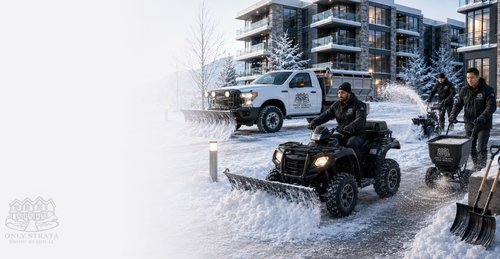
Winter route planning for Surrey strata communities
A seven-acre strata property is not one snow-removal job. It is a collection of smaller winter operations happening inside the same boundary.
There may be several residential buildings, internal roads, parkade ramps, visitor parking, sidewalks, stairs, garbage areas, fire routes, amenity entrances, and pedestrian shortcuts. When snow begins accumulating, every one of those surfaces competes for attention.
That is why large strata snow removal zones should be established before the storm rather than improvised after crews arrive.
Without zones, crews can fall into a deceptively inefficient pattern: clear whatever is directly in front of them, move to the next visible problem, then return later because a critical route was missed or blocked by earlier snow placement.
A zoning plan gives the property structure.
It tells operators which areas control access, which surfaces require specialized equipment, where pedestrian work can happen safely, and what can wait until higher-priority routes are stable.
The objective is not to divide a property for the sake of drawing lines on a map. It is to prevent seven acres of winter work from becoming one enormous, unstructured task.
Seven Acres Can Hide a Hundred Small Bottlenecks
Large properties create problems that smaller sites simply do not experience at the same scale.
A crew may clear a main road successfully but discover that snow placement now restricts visibility at an intersection. A sidewalk team may finish one building while residents from another are already walking across an untreated route. A loader may be needed at opposite ends of the site almost simultaneously.
Start With Movement, Not Acreage
The first zone should usually be defined by what keeps people and vehicles moving.
Main access roads, emergency routes, heavily used entrances, steep ramps, and critical pedestrian connections have greater operational influence than an isolated visitor stall.
If one of these choke points becomes unusable, the problem spreads through the property.
A blocked parkade entrance can affect dozens of residents. An untreated primary walkway can redirect foot traffic onto vehicle routes. Poor snow placement near the main intersection can make subsequent equipment movements more difficult.
The priority map should therefore reflect consequences, not simply surface area.
Give Different Equipment Different Territory
A large plow, compact loader, sidewalk machine, shovel crew, and spreader do not need to follow one another everywhere.
Assigning them defined work areas can reduce interference.
The loader might focus on roadways and designated snow-storage locations while a pedestrian crew works entrances and stairs. De-icing can follow the cleared areas in sequence instead of bouncing unpredictably between opposite ends of the property.
The result is less spectacular than sending every machine everywhere.
It is also far more controlled.
Designing a Practical Winter Zone Map
A useful site map does more than colour several parts of the property.
Each zone should have a purpose.
One section might contain the primary vehicle corridor and parkade entrance. Another may combine the main lobby, mailbox area, and pedestrian connection. Secondary parking and lower-use walkways could form another operational section.
Snow-storage locations should also be considered when drawing those boundaries.
If Zone A repeatedly pushes accumulation into space required by Zone B, the plan is not really zoned. It is simply postponing a conflict.
The map should account for where snow travels throughout the storm—not only where it begins.
Drainage is equally important. A convenient pile at noon may create meltwater across a walkway later. A storage location that works during the first five centimetres may become unusable after repeated clearing cycles.
Good zoning anticipates the second and third pass.
That is where large-property planning separates itself from basic plowing.
The First Hour Should Never Be Improvised
The opening period of a storm can determine how difficult the remaining service cycle becomes.
Large sites benefit from predefined priority levels because crews do not have to decide everything while snow is actively accumulating.
A practical first sequence might protect the main entrance, emergency access, primary internal road, parkade ramp, and heavily travelled pedestrian routes before expanding into secondary surfaces.
That does not mean lower-priority areas are ignored.
It means they are serviced in an order that preserves the function of the property.
Only Strata Snow Removal's strata-only focus supports this type of planning because the operating environment is centred on shared residential properties rather than a mixture of unrelated sites. Familiarity with parkades, internal roads, pedestrian networks, visitor areas, and shared access points helps make zoning more property-specific.
Strict capacity limits matter here as well.
Even the best zone map fails if the contractor has committed the same crew to more properties than it can realistically service during the same storm window.
Tracking Progress Without Driving the Entire Property
One advantage of zoning is that it makes winter service easier to verify.
Saying “the property has been serviced” can be vague on a large site. Saying the primary access zone is complete while two secondary sections remain in progress provides far more useful information.
Zone-Based Documentation Creates Context
GPS and photo service logs can support this approach by connecting completed work to identifiable parts of the property.
Photos from the main entrance should not substitute for understanding conditions behind the fourth building.
Large sites benefit from documentation that reflects their physical complexity.
This also helps when conditions change during a prolonged event. Dispatch can see which sections were previously completed and determine where another pass is most urgent rather than restarting the entire decision process.
Zones Reveal Recurring Trouble Spots
Documentation becomes even more useful across several storms.
Perhaps one pedestrian section repeatedly refreezes. One snow-storage location fills faster than expected. A particular road section continually requires another pass because of drifting or resident traffic.
Those patterns can improve the zone plan.
Instead of treating every storm as the first storm, crews build operational knowledge of the site.
Zoning Turns One Crew Into a Coordinated System
The purpose of a zone plan is not to make one crew perform the work of three.
It is to make the available resources work in the right places at the right time.
That distinction matters.
A seven-acre site will always contain physical limits. Operators can only clear one area at a time. Equipment has travel and repositioning time. Salt and de-icing materials must be replenished. Accumulation can continue while other surfaces are being serviced.
Only Strata Snow Removal addresses those constraints through a combination of strict route capacity, proactive dispatch, substantial salt reserves, and reliable winter response.
The company also uses GPS/photo service records to improve visibility into completed work. Cancellation flexibility gives strata councils greater control over the service relationship, while a damage repair guarantee adds accountability when equipment operates around curbs, landscaping, parked vehicles, and other property infrastructure.
But the strongest operational advantage on a large site comes from planning the property as a system.
The contractor should know where the first machine goes.
The sidewalk crew should know which pedestrian route comes first.
Snow should have a planned destination before the blade begins pushing it.
Dispatch should know which zones are complete and which remain exposed.
And the council should understand what “priority” actually means before residents are watching snow accumulate outside their windows.
Large strata properties do not necessarily need more chaos, more equipment, or crews rushing in every direction.
They need boundaries, sequencing, priorities, and realistic capacity.
Because when seven acres are treated as one giant snow-removal task, crews spend valuable time deciding what to do next.
When the same property is divided into operational zones, the storm becomes a sequence of manageable jobs.
Tags : .....