If you’ve ever launched a sleek React, Vue, or Angular app and then realised Google barely indexed it, you’re not alone.
I’ve worked on projects where a beautifully designed single-page application (SPA) looked perfect to users but completely disappeared in search results. Traffic stalled, pages weren’t getting indexed, and even branded searches struggled. The problem usually wasn’t the content. It was how the application delivered that content to search engines.
The good news is this: single-page applications for SEO are no longer impossible. But they do require a different strategy than traditional websites.
In this guide, I’ll walk through what actually matters for SPA SEO in 2026, including rendering methods, indexing challenges, Core Web Vitals, structured content, and the technical fixes that make a real difference.
What Is a Single-Page Application
A single-page application is a web app that loads one HTML page and dynamically updates content as users interact with it.
Popular frameworks include:
React
Angular
Vue
Svelte
Next.js
Nuxt.js
Instead of loading entirely new pages, SPAs update sections of the interface using JavaScript. That creates a faster, smoother user experience.
But search engines don’t always experience the site the same way users do.
Why Single-Page Applications Can Hurt SEO
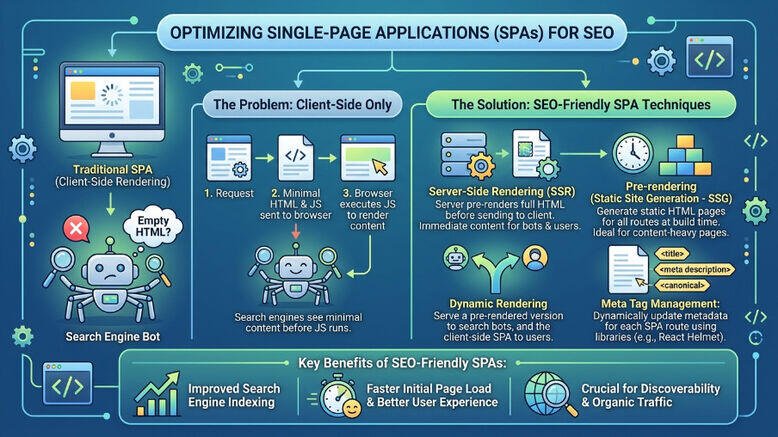
The biggest SEO issue with SPAs is rendering.
Search engines first crawl the raw HTML. Then they attempt to process JavaScript later. If important content only appears after JavaScript executes, indexing can become delayed, incomplete, or inconsistent.
Common SEO problems with SPAs include:
Delayed Indexing
Google may queue JavaScript-heavy pages for rendering later. On larger sites, this can slow indexing significantly.
Missing Metadata
If title tags, meta descriptions, canonical tags, or structured data rely on client-side rendering, search engines may miss them.
Broken Internal Linking
Some SPAs rely heavily on JavaScript events instead of crawlable HTML links. That weakens discoverability.
Poor Core Web Vitals
Large JavaScript bundles can slow down:
Largest Contentful Paint (LCP)
Interaction to Next Paint (INP)
Cumulative Layout Shift (CLS)
These directly affect user experience and potentially rankings.
Crawl Budget Waste
Search engines spend more resources processing JavaScript-heavy pages. On enterprise sites, this becomes a real issue.
Best Rendering Methods for SPA SEO
This is where most SEO success or failure happens.
Server-Side Rendering (SSR)
With SSR, the server generates fully rendered HTML before sending it to the browser.
This gives search engines immediate access to content.
Benefits include:
Faster indexing
Better metadata visibility
Improved Core Web Vitals
More reliable crawling
Frameworks like Next.js and Nuxt.js make SSR much easier today.
If I’m building a content-focused SPA from scratch, SSR is usually my first recommendation.
Static Site Generation (SSG)
SSG pre-builds pages during deployment.
This approach works extremely well for:
Blogs
Documentation sites
Marketing pages
SaaS landing pages
Benefits include:
Excellent speed
Low server load
Strong SEO performance
Modern frameworks now support hybrid rendering, which combines SSG and SSR depending on the page type.
Dynamic Rendering (Use Carefully)
Dynamic rendering serves pre-rendered HTML to search engines while users receive the JavaScript app.
Google still supports it, but it’s increasingly considered a workaround rather than a long-term solution.
I only recommend it when rebuilding the frontend architecture isn’t realistic.
How to Make Single-Page Applications Search-Friendly
Technical rendering is only part of the equation. You still need strong SEO fundamentals.
Use Real URLs for Every View
Each important page should have:
A unique URL
Unique metadata
Unique indexable content
Avoid relying entirely on fragments like:
example.com/#services
Instead, use clean routes such as:
example.com/services
This improves crawlability and user sharing.
Create Crawlable Internal Links
Search engines still rely heavily on links.
Use standard HTML anchor tags wherever possible:
<a href="/pricing">Pricing</a>
Avoid navigation systems that only trigger JavaScript actions without actual links.
Optimise Metadata Dynamically
Every route should generate:
Unique title tags
Meta descriptions
Canonical tags
Open Graph tags
I’ve seen many SPAs accidentally use the same title tag sitewide, which destroys topical relevance.
Implement Structured Data
Structured data helps search engines understand page context.
Useful schema types include:
Article
FAQ
Product
Breadcrumb
Organization
For ecommerce or SaaS SPAs, this can improve visibility with rich results.
Core Web Vitals Matter More Than Ever
A lot of SPA developers focus heavily on interactivity but forget loading performance.
That’s risky in 2026.
Google increasingly rewards websites that feel fast immediately, not just eventually.
Key improvements include:
Reduce JavaScript Bundle Size
Large bundles slow rendering.
Use:
Code splitting
Lazy loading
Tree shaking
Modern image formats
Prioritise Above-the-Fold Content
Users should see meaningful content immediately.
Avoid layouts where headers, hero text, or navigation wait for JavaScript execution.
Optimise Hydration
Hydration issues are common in SPAs.
Partial hydration and island architecture are becoming more popular because they reduce unnecessary JavaScript execution.
SPA SEO Mistakes I See All the Time
Some problems appear repeatedly across projects.
Treating SEO as a Post-Launch Task
SPA SEO decisions should happen during development, not after launch.
Rendering architecture affects everything.
Blocking JavaScript Files
Sometimes developers accidentally block JS or API resources in robots.txt.
If Google can’t access rendering resources, indexing suffers.
Ignoring Log File Analysis
For larger websites, server logs reveal:
Crawl frequency
Render failures
Wasted crawl budget
Indexing bottlenecks
This data is incredibly useful for diagnosing SPA problems.
Relying Only on Google Search Console
Search Console helps, but it doesn’t show the full rendering process.
I also recommend testing pages with:
URL Inspection Tool
Rich Results Test
Lighthouse
PageSpeed Insights
These reveal rendering and performance issues much faster.
Are Single-Page Applications Bad for SEO
No, but poorly implemented SPAs are.
Modern frameworks have improved dramatically, and Google handles JavaScript better than it did years ago. Still, “Google can render JavaScript” doesn’t mean “Google will render everything perfectly every time.”
That distinction matters.
A properly configured SPA with SSR or SSG can perform extremely well in organic search.
In many cases, the issue isn’t the framework itself. It’s incomplete implementation.
When You Should Avoid an SPA
Not every website needs one.
A traditional multi-page architecture may be better for:
Content-heavy publishers
Local service businesses
Small brochure websites
Sites with minimal interactivity
Sometimes teams choose SPAs because they sound modern, not because they solve a real business problem.
That can create unnecessary SEO complexity.
Internal Linking Opportunities
This article naturally connects to related topics such as:
JavaScript SEO best practices
Core Web Vitals optimisation
Technical SEO audits
Next.js SEO guide
Crawl budget optimisation
Structured data implementation
Headless CMS SEO
These would make strong supporting content pieces within a broader SEO hub.
Final Thoughts
Single-page applications for SEO are completely workable in 2026, but success depends on architecture, rendering strategy, and performance optimisation.
If I had to simplify the entire process into three priorities, they would be:
Make content visible without relying heavily on client-side JavaScript
Keep the site fast and crawlable
Build every route like a real, indexable page
That combination solves most SPA SEO problems before they become expensive traffic losses.
If you’re planning a new SPA or struggling with indexing issues, the next step is usually a technical SEO audit focused specifically on rendering, crawlability, and Core Web Vitals.
Tags : SEO React Developer Javascript