SAP vs Oracle vs Odoo for Saudi E-Invoicing: Which ERP Handles ZATCA Compliance Best?
By Rahman Iqbal 08-06-2026 86
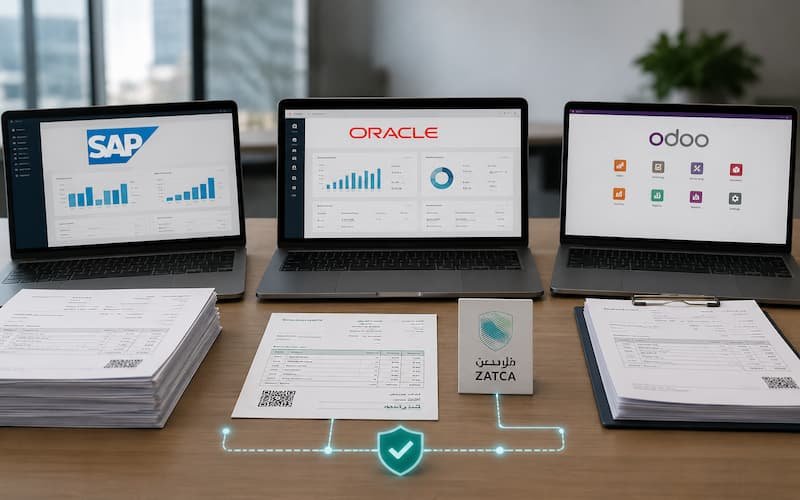
As Saudi Arabia continues its digital transformation journey, businesses operating in the Kingdom must ensure their financial systems comply with government regulations. One of the most significant regulatory requirements is E-invoicing in Saudi Arabia, mandated by the Zakat, Tax and Customs Authority (ZATCA). Organizations are increasingly evaluating enterprise resource planning (ERP) solutions that can seamlessly support compliance while maintaining operational efficiency.
Among the leading ERP platforms, SAP, Oracle, and Odoo stand out as popular choices. Each offers unique capabilities, implementation approaches, and compliance features. However, selecting the right ERP for ZATCA compliance requires a deeper understanding of how these systems handle invoicing, tax reporting, integration, scalability, and ongoing regulatory updates.
In this article, we compare SAP, Oracle, and Odoo to determine which ERP handles ZATCA compliance most effectively.

Understanding ZATCA Compliance Requirements
Before comparing ERP solutions, it is essential to understand what businesses need to achieve.
ZATCA regulations require organizations to:
- Generate electronic invoices in approved formats.
- Maintain invoice integrity and authenticity.
- Integrate with government platforms for invoice reporting and clearance.
- Include QR codes and mandatory invoice fields.
- Store invoices securely for audit purposes.
- Ensure real-time or near real-time reporting where required.
An ERP system must support these requirements while minimizing manual intervention and reducing compliance risks.
SAP for ZATCA Compliance
SAP is one of the most widely used enterprise ERP systems among large organizations and multinational companies operating in Saudi Arabia.
Strengths of SAP
1. Built-In Enterprise Compliance Framework
SAP provides extensive localization packages designed specifically for regional tax and regulatory requirements. Businesses can leverage SAP's compliance tools to align with ZATCA mandates without creating complex custom solutions.
2. Strong Integration Capabilities
SAP integrates efficiently with external tax engines, government portals, and third-party compliance platforms. This flexibility enables organizations to automate invoice validation, clearance, and reporting processes.
3. Scalability
For large enterprises processing thousands of invoices daily, SAP offers exceptional scalability. The platform can handle high transaction volumes while maintaining performance and compliance standards.
4. Advanced Security and Audit Trails
SAP includes sophisticated security controls, detailed audit logs, and document management features that support regulatory inspections and internal governance requirements.
Challenges of SAP
High implementation costs.
Longer deployment timelines.
Requires experienced consultants and technical resources.
Complex customization processes.
Best Fit
SAP is ideal for large enterprises, multinational corporations, manufacturing companies, and organizations with complex operational structures.
Oracle for ZATCA Compliance
Oracle ERP Cloud has become a preferred choice for many organizations seeking a modern, cloud-based ERP platform.
Strengths of Oracle
1. Cloud-First Architecture
Oracle's cloud infrastructure allows businesses to access compliance updates quickly without significant system modifications. This is particularly useful when regulatory requirements evolve.
2. Automated Tax and Invoice Management
Oracle offers comprehensive tax management capabilities that help organizations automate invoice generation, validation, and reporting processes.
3. Real-Time Reporting
The platform supports real-time visibility into financial transactions, making it easier to monitor compliance status and generate reports for audits.
4. Reduced Infrastructure Requirements
Since Oracle ERP Cloud operates in the cloud, businesses can reduce hardware investments and maintenance costs compared to traditional on-premises systems.
Challenges of Oracle
- Licensing costs can be significant.
- Customization options may require specialized expertise.
- Subscription expenses can increase as business requirements grow.
Best Fit
Oracle is well suited for medium to large enterprises seeking a cloud-native ERP solution with strong compliance capabilities and lower infrastructure management responsibilities.
Odoo for ZATCA Compliance
Odoo has gained popularity among small and medium-sized businesses due to its flexibility, affordability, and modular architecture.
Strengths of Odoo
1. Cost-Effective Solution
Compared to SAP and Oracle, Odoo offers significantly lower licensing and implementation costs. This makes it attractive for growing businesses with limited budgets.
2. Customizable Framework
Odoo's open-source architecture allows developers to customize workflows, invoice templates, and compliance processes according to business needs.
3. Fast Implementation
Organizations can deploy Odoo much faster than traditional enterprise ERP systems, enabling quicker compliance readiness.
4. User-Friendly Interface
Odoo provides an intuitive interface that reduces training requirements and improves user adoption.
Challenges of Odoo
- Compliance functionality often requires customization or third-party modules.
- Limited native enterprise-grade compliance features.
- Scalability may become a concern for very large organizations.
- Dependence on implementation partners for regulatory updates.
Best Fit
Odoo is best suited for startups, small businesses, and mid-sized companies looking for an affordable ERP platform that can be customized to meet compliance requirements.
Comparing SAP, Oracle, and Odoo for ZATCA Compliance
1. Compliance Readiness
SAP and Oracle provide stronger out-of-the-box compliance capabilities. Their dedicated localization features and enterprise compliance frameworks simplify implementation.
Odoo typically requires additional development or third-party extensions to achieve full compliance.
2. Implementation Complexity
Odoo is generally the easiest and fastest to implement.
Oracle offers a balanced implementation approach with cloud-based deployment advantages.
SAP implementations tend to be more extensive and time-consuming due to the complexity of enterprise processes.
3. Cost Considerations
When evaluating total ownership costs:
- Odoo is the most affordable option.
- Oracle falls in the mid-to-high investment range.
- SAP typically represents the highest investment.
Organizations should consider not only software costs but also implementation, customization, maintenance, and compliance support expenses.
4. Scalability
SAP leads in scalability for large enterprises with global operations.
Oracle also performs exceptionally well for growing and large organizations.
Odoo works effectively for small and medium businesses but may require additional optimization as transaction volumes increase.
5. Regulatory Updates
Both SAP and Oracle regularly release compliance updates through official support channels.
Odoo users often rely on implementation partners or custom development teams to adapt quickly to regulatory changes.
Which ERP Handles ZATCA Compliance Best?
The answer depends largely on business size, complexity, and budget.
Choose SAP If:
- You operate a large enterprise.
- You require advanced compliance controls.
- You manage high transaction volumes.
- You need extensive audit and governance capabilities.
Choose Oracle If:
- You prefer a cloud-based ERP solution.
- You want strong compliance functionality with easier maintenance.
- You seek a balance between scalability and implementation complexity.
Choose Odoo If:
- You are a small or mid-sized business.
- Budget is a major consideration.
- You need flexibility and customization.
- You have access to experienced Odoo implementation partners.
Final Thoughts
Selecting an ERP system for ZATCA compliance is more than a technology decision—it is a strategic investment in operational efficiency and regulatory risk management. SAP, Oracle, and Odoo each offer valuable capabilities, but their suitability varies depending on organizational needs.
SAP delivers the most comprehensive enterprise-grade compliance environment, making it a strong choice for large organizations. Oracle provides an excellent cloud-based alternative with robust compliance automation and scalability. Odoo offers affordability and flexibility, making it attractive for smaller businesses willing to invest in customization.
Before making a decision, organizations should assess their compliance requirements, budget, transaction volume, growth plans, and implementation resources. The right ERP solution will not only support ZATCA requirements but also create a foundation for long-term digital transformation and business growth.