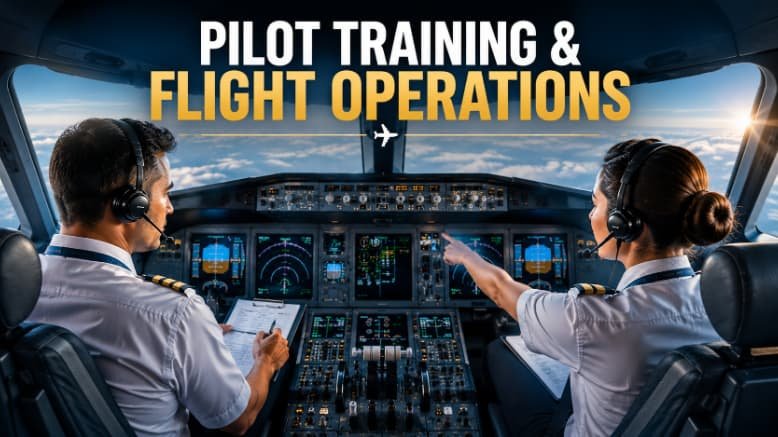
Pilot training and flight operations are closely connected. A pilot may have strong flying skills, but safe and efficient airline operations also depend on procedures, communication, decision-making, aircraft systems knowledge, and disciplined operational practices.
For airlines, MRO organizations, lessors, militaries, and OEMs, understanding how pilot training connects with day-to-day flight operations can help improve safety, operational consistency, and workforce readiness.
Start With the Right Training Foundation
Effective pilot training should build more than the ability to control an aircraft. Training programs should progressively develop technical knowledge, operational awareness, and sound decision-making.
A practical training framework should cover:
- Aircraft systems and limitations
- Normal and abnormal procedures
- Navigation and flight planning
- Weather interpretation
- Radio communication
- Crew Resource Management (CRM)
- Human factors
- Emergency procedures
- Aviation regulations and standard operating procedures
The goal is to ensure pilots can apply knowledge under realistic operational conditions rather than simply memorize procedures for an examination.
Connect Training With Real Flight Operations
One common challenge is the gap between classroom training and actual airline operations. Training becomes more valuable when pilots understand how their decisions affect the wider operation.
For example, a flight crew may need to consider:
- Weather and alternate airports
- Fuel requirements
- Aircraft performance
- NOTAMs and operational restrictions
- Air traffic conditions
- Passenger and cargo considerations
- Maintenance status
- Crew duty limitations
These factors should be incorporated into scenario-based training wherever possible.
Use Scenario-Based Training
Instead of training every situation as an isolated checklist exercise, instructors can create realistic operational scenarios.
A scenario might involve deteriorating weather, a technical issue, a fuel decision, and changing airport conditions. The objective is not simply to test whether the pilot remembers a procedure. It is to evaluate how the pilot gathers information, communicates with the crew, assesses risk, and makes decisions.
This approach helps develop operational judgment.
Make Crew Resource Management Part of Everyday Flying
CRM should not be treated as a classroom subject that ends after training.
Effective CRM involves:
- Clear communication
- Appropriate workload distribution
- Cross-checking
- Situational awareness
- Constructive challenge and response
- Effective coordination with ATC and ground teams
A strong cockpit culture allows both pilots to actively participate in monitoring and decision-making.
This is particularly important during high-workload phases such as departure, approach, abnormal situations, and adverse weather.
Use Standard Operating Procedures Consistently
Standard Operating Procedures (SOPs) provide a common operational framework. They help ensure that crews perform important tasks consistently across flights.
For operators, useful SOP practices include:
- Keep procedures clear and operationally practical.
- Train crews using the same procedures they are expected to follow.
- Review procedures when operational experience identifies weaknesses.
- Avoid unnecessary complexity.
- Reinforce the importance of checklists and cross-checks.
SOPs should support professional judgment rather than encourage pilots to operate mechanically without understanding the situation.
Integrate Flight Operations With Maintenance
Pilot training should also include an understanding of how aircraft maintenance affects flight operations.
Pilots do not perform maintenance tasks, but they need sufficient systems knowledge to understand aircraft technical status and communicate effectively with maintenance personnel.
Useful areas of cooperation include:
- Technical logbook entries
- Deferred defects
- Aircraft limitations
- Maintenance release procedures
- Recurrent technical issues
- Communication between cockpit and maintenance control
For airlines and MRO organizations, strong communication between flight crews and maintenance teams can help reduce misunderstandings and improve operational reliability.
Measure Training Effectiveness
Training programs should not be evaluated only by whether pilots complete the required training hours.
Operators can also examine:
- Training performance trends
- Recurrent training findings
- Operational incidents
- Safety reports
- Procedural deviations
- CRM observations
- Instructor feedback
- Pilot feedback
This information can help identify areas where training needs to be strengthened.
Use Data to Improve Training
Modern operators have access to increasing amounts of operational data. When appropriately managed, this information can help identify recurring risks and training needs.
For example, if an operator identifies repeated unstable approaches, excessive workload during certain procedures, or recurring communication issues, training teams can develop targeted scenarios around those risks.
The objective is simple: use operational experience to improve future training.
Practical Takeaways for Aviation Organizations
For airlines, MROs, lessors, militaries, and OEMs, an effective pilot training strategy should connect people, procedures, aircraft, and operational data.
The most useful principles are:
- Train for real operations, not only examinations.
- Use realistic scenarios to develop decision-making.
- Make CRM part of everyday cockpit culture.
- Keep SOPs clear, consistent, and practical.
- Strengthen communication between flight crews and maintenance teams.
- Use operational data to identify training gaps.
- Continuously review training based on safety and operational experience.
The Bigger Picture
Pilot training is most effective when it is treated as part of the complete aviation safety system rather than as an isolated qualification process.
Aircraft technology continues to evolve, flight operations are becoming increasingly data-driven, and aviation organizations face constant pressure to maintain safety while improving efficiency. Training programs therefore need to evolve alongside the operational environment.
For pilots, the takeaway is straightforward: technical knowledge matters, but safe flight operations also depend on communication, situational awareness, teamwork, and disciplined decision-making.
For aviation organizations, the challenge is to create training systems that prepare crews for the conditions they will actually encounter—not just the conditions described in a training manual.
Relevant aviation education and training resources:
https://mhcockpit.com/
aviation education and training resources
Author Bio
Esakkipriya E is an aviation writer focused on pilot training, flight operations, aircraft safety, and practical aviation industry insights.
Tags : aviation airport operations