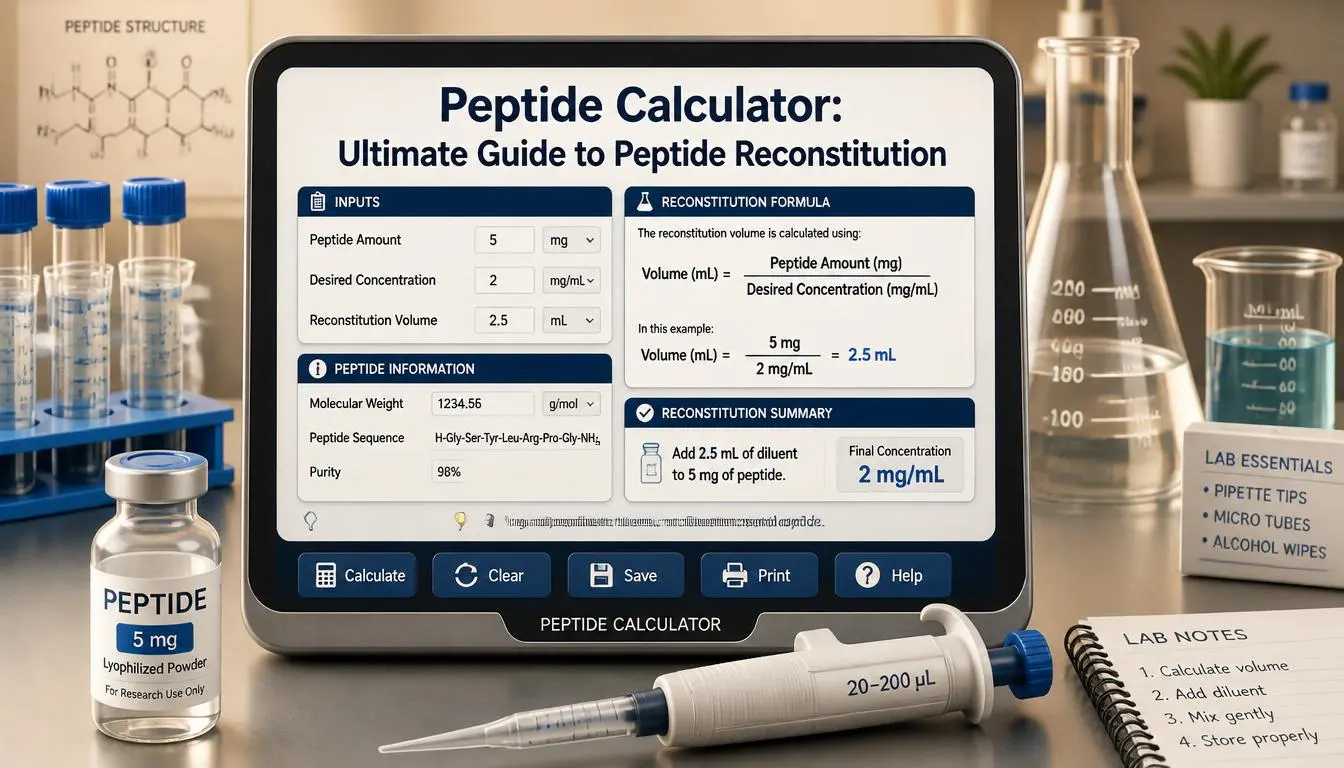
Standing over the lab counter with a sterile syringe and a new vial of lyophilized compounds can test anyone's patience. Trying to mentally calculate reconstitution ratios while conversion charts blur together is a fast track to wasted vials and compromised study data. When you are working with powerful biological sequences, a decimal misplaced by a single digit changes everything. That is why relying on a dedicated Peptide Dosing Calculator has shifted from a mere convenience to an absolute necessity. Instead of wrestling with scratch paper, a reliable Peptide Dosage Tool instantly translates milligrams, milliliters, and syringe markings into clear, repeatable instructions.
Why Precision Matters in Peptide Mixing and Measurement
Understanding the Unique Sensitivity of Lyophilized Research Compounds
Lyophilized peptides are delicate molecular structures preserved through freeze-drying. Because they are often active at extremely small microgram thresholds, their structural integrity depends entirely on how they are handled during preparation. Minor shifts in temperature, harsh physical mixing, or incorrect dilution ratios can degrade the peptide chains before they ever enter a syringe. Recognizing this biological sensitivity is the first step toward treating reconstitution as an exact laboratory science rather than a casual kitchen task. Experienced researchers know that maintaining molecular stability requires strict adherence to cold-chain logistics and gentle handling procedures from the moment a vial arrives until the final draw is completed.
Why Small Arithmetic Errors Lead to Compromised Study Results
When a researcher relies on manual calculations late at night, fatigue frequently leads to misplaced decimals. Shifting a decimal point by one digit turns a standard microgram dose into a massive overdose or an ineffective sub-therapeutic trace. In experimental settings, these errors invalidate entire data sets, waste expensive materials, and introduce variables that ruin weeks of careful trial planning. Ensuring mathematical accuracy through systematic verification is therefore paramount to achieving reliable, reproducible outcomes in any laboratory environment.
Why Manual Calculation Errors Happen More Often Than You Think
Confusing Milligrams with Micrograms in High-Stakes Protocols
The most common trap in reconstitution math is mixing up metric units. Vials are universally labeled in milligrams, while target protocols are almost always written in micrograms. Failing to multiply the total milligram amount by one thousand before running your division equations leads to immediate, catastrophic math failures. This oversight often stems from rushing through preparation steps without double-checking the baseline units of measurement printed on the manufacturer's packaging.
The Hidden Dangers of Misreading Insulin Syringe Barrel Markings
Insulin syringes are not standard liquid measuring tools; they are marked in arbitrary "units" designed specifically for U-100 fluid capacities. Mistaking a syringe unit graduation for a direct millimeter measurement creates immediate confusion when translating calculated liquid volumes into physical plunger depths, especially when working with smaller 0.3-milliliter or 0.5-milliliter barrels. Recognizing how these graduations correlate to actual fluid volumes prevents miscalculations that can skew your entire administration schedule.
Understanding the Anatomy of Reconstitution Math
Breaking Down Solute Concentration and Dilution Ratios
To understand why automated tools are so valuable, it helps to understand the underlying mechanics of what happens inside the vial. Lyophilized peptides are freeze-dried powders that have virtually no measurable volume on their own. When you inject bacteriostatic water into the vial, that water becomes the carrier liquid holding your target compound in suspension. The resulting concentration dictates how much liquid you must draw into your syringe to achieve your desired therapeutic or experimental dose.
How Total Water Volume Alters Your Final Draw Volume
Suppose you have a vial containing 5 milligrams of a peptide, and you inject 2 milliliters of bacteriostatic water into it. Your total solution concentration is now 2.5 milligrams per milliliter. If your protocol calls for 250 micrograms per administration, you have to convert that 2.5 milligrams into 2,500 micrograms, divide by the concentration, and figure out exactly how many tiny tick marks on your insulin syringe equal that amount. Doing that arithmetic correctly on the first try is entirely possible, but doing it consistently across multiple different vials, varying potencies, and changing water volumes invites mistakes. Automated tools handle those conversions instantly, letting you focus on the integrity of your research rather than long division.
Choosing the Right Measuring Equipment for Your Work
Navigating U-100 Insulin Syringe Capacities and Tick Marks
Even the most accurate calculation tool will match its utility against the precision of your physical measuring tools. Insulin syringes are universally used for subcutaneous peptide administration, but they come in different capacities and graduations that directly impact how easy a dose is to draw. Understanding the difference between a 30-unit, 50-unit, and 100-unit barrel ensures you select the equipment that offers the highest visual clarity for your specific micro-dosing requirements.
Why Syringe Size Selection Impacts Micro-Dose Accuracy
Standard U-100 insulin syringes are typically available in 1-milliliter, 0.5-milliliter, and 0.3-milliliter sizes. On a 1-milliliter syringe, each tiny line usually represents 0.01 milliliters, or 1 unit. On a smaller 0.3-milliliter syringe, those lines are spaced further apart, making it much easier to measure micro-doses accurately without straining your eyes. When using your preferred calculation utility, always input your exact syringe size so the output matches the physical markings on your barrel.
Best Practices for Safe Preparation and Storage
Preventing Peptide Bond Shear During Water Injection
Precision in measurement means very little if the compound itself degrades before you use it. Reconstituted peptides are delicate biological structures that require careful handling to maintain their potency. Always wipe the rubber stopper of your peptide vial and your water vial with an alcohol swab before inserting any needles. When adding bacteriostatic water, direct the stream down the inside glass wall of the vial rather than spraying it directly onto the fragile lyophilized cake, which can shear the peptide bonds and ruin the batch.
Maintaining Cold Chain Storage and Refrigerator Protocols
Once mixed, store your reconstituted vial in the refrigerator between 2°C and 8°C, and never freeze a liquid solution unless specifically indicated by manufacturer stability guidelines. Keeping your workspace sterile and your storage conditions cold protects the purity of your compounds from the first draw to the last. Exposure to ambient room temperature or direct sunlight for extended periods accelerates degradation, rendering your careful reconstitution math entirely useless.
Eliminating Human Error with Modern Digital Calculators
How Automated Tools Prevent Costly Conversion Mistakes
Modern digital calculation platforms take the three core variables—vial mass, diluent volume, and target dose—and instantly compute the precise fluid output. By removing manual pencil-and-paper conversions from the workflow, these tools eliminate the arithmetic blind spots that cause accidental dosing errors in busy laboratories. They provide a standardized mathematical check that safeguards against mental fatigue and complex multi-step conversion oversights.
Integrating a Dedicated Calculator Into Your Daily Workflow
Adopting a systematic approach means opening your preferred calculation interface before touching any glassware. Entering your exact parameters ahead of time gives you a clear roadmap for your preparation steps, ensuring that every batch is mixed, diluted, and drawn with absolute mathematical consistency. Making this a mandatory step in your laboratory protocol protects the reproducibility of your work and saves valuable compounds from being wasted due to preventable calculation errors.
Frequently Asked Questions About Peptide Measurement
What is the exact mathematical conversion between milligrams and micrograms?
One milligram equals 1,000 micrograms. If your vial contains 2 milligrams of peptide, that equals 2,000 micrograms. Most research protocols specify doses in micrograms, so multiplying your milligram amount by 1,000 is the first step before running any dilution math.
Does changing the amount of bacteriostatic water alter the total peptide amount?
No. Adding more or less water does not change the total amount of peptide in the vial; it only changes the concentration of the liquid. Adding more water makes the solution more dilute, meaning you will need to draw a larger volume into your syringe to get the same target dose.
Why do insulin syringe units cause confusion during precise volume draws?
Insulin syringes are marked in "units" designed for measuring insulin, not milliliters. On a standard U-100 syringe, 100 units equal 1 milliliter of total fluid. Remembering this conversion ratio is critical when your calculator tells you to draw a specific volume in milliliters or units.
What are the primary risks of reusing syringes across multiple vials?
Never reuse syringes. Reusing needles dulls the tip, causing unnecessary discomfort, and introduces a severe risk of bacterial contamination into your sterile vials. Always use a fresh, sterile syringe for every single draw to maintain absolute aseptic technique.
Tags : Peptide Dosing Calculato