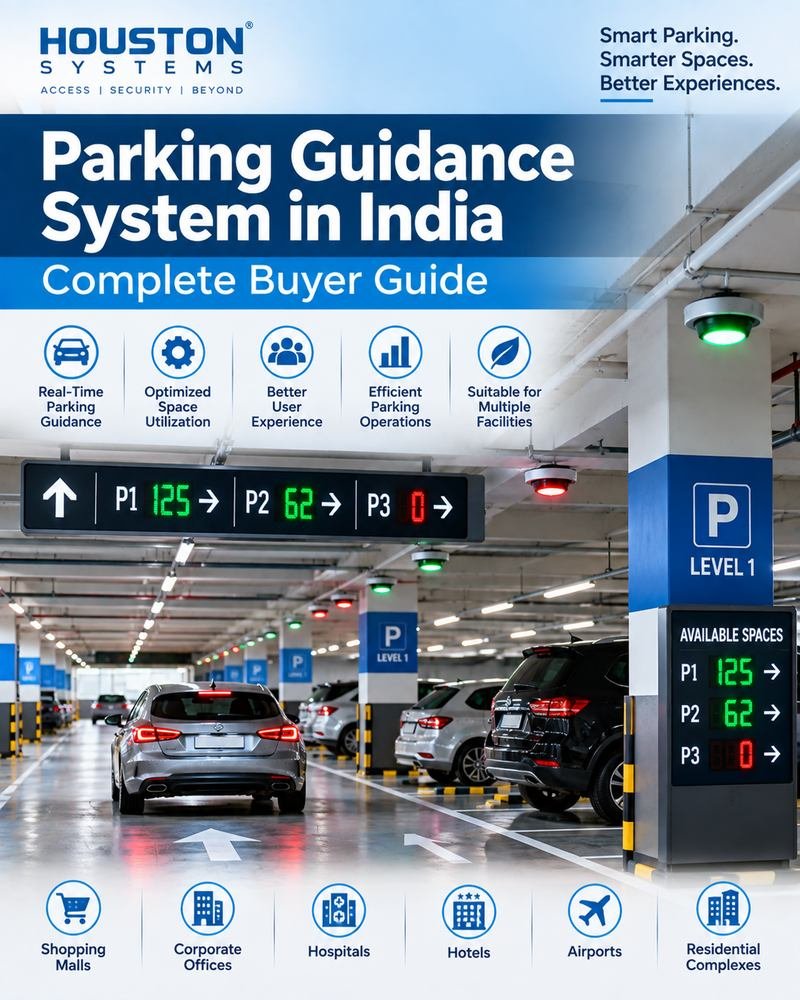
Finding an available parking space can become difficult in busy commercial buildings, malls, hospitals, hotels, airports, residential properties and other busy facilities. A Parking Guidance System helps drivers identify available parking spaces and navigate the facility more efficiently.
Instead of relying entirely on manual guidance, a parking guidance solution can provide real-time information about available spaces and help improve vehicle movement inside the parking area.
What Is a Parking Guidance System?
A Parking Guidance System (PGS) is a technology-based parking solution designed to guide drivers toward available parking spaces.
Depending on the system setup, it can use parking sensors, LED indicators, display boards, entry and exit information, and centralized software to provide parking availability information.
For facilities with significant vehicle movement, PGS can become an important part of a broader parking management strategy.
How Does a Parking Guidance System Work?
A typical system follows a simple process:
- Parking sensors or other detection technology identify vehicle occupancy.
- The system processes parking availability information.
- Available and occupied spaces are updated in the system.
- LED indicators or display boards communicate availability to drivers.
- Drivers follow the displayed information to locate available parking spaces.
The exact configuration depends on the parking layout, number of spaces, technology selected and integration requirements.
Key Components to Consider
Before selecting a system, buyers should understand the major components involved.
Parking Sensors
Sensors can help detect whether individual parking spaces are occupied or available.
LED Indicators
Indicators positioned near parking spaces can provide visual information to drivers.
Display Boards
Entrance and directional displays can communicate available parking information and guide vehicles through different parking zones.
Centralized Software
Parking software can collect and display information from different areas of the facility.
System Integration
A PGS may be integrated with other parking technologies depending on project requirements, such as parking management and access control systems.
Why Use a Parking Guidance System?
A properly planned PGS can help facilities:
- Provide drivers with parking availability information
- Reduce unnecessary searching inside parking areas
- Improve vehicle movement
- Organize parking operations
- Provide better visibility of parking occupancy
- Support efficient use of available parking spaces
- Improve the overall parking experience
The actual results depend on system design, site conditions, installation and operational practices.
Where Can PGS Be Used?
Parking Guidance Systems can be considered for facilities such as:
- Shopping malls
- Corporate offices
- Hospitals
- Hotels
- Airports
- Residential properties
- Educational institutions
- Commercial buildings
- Large parking facilities
- Mixed-use properties
The right configuration should be selected according to parking capacity, traffic patterns and facility requirements.
Features Buyers Should Compare
When evaluating a PGS, buyers should compare more than just the display system. Important considerations include:
Parking Capacity
Determine how many parking spaces need to be monitored.
Parking Layout
The number of floors, parking zones, ramps and entry and exit points can affect system design.
Detection Technology
Evaluate how parking occupancy will be detected and whether the technology suits the parking environment.
Real-Time Information
The system should provide timely parking availability information.
Display Requirements
Consider entrance displays, directional displays and individual-space indicators based on the site.
Software and Reporting
For larger facilities, centralized monitoring and reporting can be useful.
Integration
Check whether the system can work with the facility's current parking or access control infrastructure.
Installation and Support
Technical assistance, installation guidance and after-sales support should also be considered.
PGS Integration With Parking Management
A Parking Guidance System can work as part of a wider parking automation setup.
For example, a parking facility may combine vehicle entry control, parking occupancy information, access control, payment systems and centralized monitoring.
Integration requirements should be discussed with the supplier before purchase so that the proposed solution matches the current infrastructure and operational workflow.
Installation Requirements
Before installation, buyers should evaluate:
- Number of parking spaces
- Parking levels
- Entry and exit points
- Available electrical infrastructure
- Network requirements
- Sensor locations
- Display locations
- Indoor or outdoor installation conditions
- Cable routing requirements
- Current parking systems
A proper site assessment can help identify installation requirements before equipment is finalized.
What Affects Parking Guidance System Cost?
The cost of a parking guidance solution can vary depending on the project.
Factors may include:
- Total number of parking spaces
- Number of sensors
- Number and type of displays
- Parking floors and zones
- Software requirements
- Integration requirements
- Installation complexity
- Networking and electrical work
- Customization
- Technical support and maintenance
Therefore, buyers should compare complete project quotations rather than evaluating suppliers only on equipment price.
How to Choose a Parking Guidance System Supplier
When selecting a supplier, consider whether the company can provide:
- Requirement assessment
- Suitable system configuration
- Technical documentation
- Site planning assistance
- Installation support
- System integration
- Commissioning assistance
- Warranty support
- Technical assistance
- Maintenance and service support
The supplier should understand the facility's parking environment and recommend a configuration based on actual project requirements.
Parking Guidance System Buyer Checklist
Before placing an order, buyers can ask:
- How many parking spaces need monitoring?
- How many floors or parking zones are involved?
- What type of occupancy detection will be used?
- How many LED indicators are required?
- Where should display boards be installed?
- Is software monitoring required?
- Does the system need integration with parking management?
- What installation work is included?
- What technical support is provided?
- What warranty and maintenance options are available?
Conclusion
Choosing the right Parking Guidance System in India requires more than simply selecting sensors or display boards. Buyers should evaluate parking capacity, layout, detection technology, displays, software, integration, installation and long-term technical support.
A properly planned parking guidance solution can provide drivers with useful parking information while helping facility operators manage parking more systematically.
Organizations planning a new parking project can evaluate their requirements first and then discuss the appropriate configuration with an experienced parking technology provider such as Houston Systems.
Tags : Parking Guidance System Parking Guidance System in India Parking Guidance System Supplier Parking Guidance System Manufacturer Smart Parking Guidance System Automated Parking Guidance System Parking Guidance Solution Parking Guidance System Price Parking Management System Smart Parking System