
Multiple Categories of Ethernet Cables Available in India

By FEDUS INDIA     13-08-2026     14

Introduction

Ethernet cables are an essential part of modern networking. They provide a reliable wired connection between devices such as computers, routers, switches, servers, gaming consoles, CCTV systems, and network storage devices. With the growing demand for faster and more stable internet connections in Indian homes, offices, businesses, and data centers, choosing the right Ethernet cable has become increasingly important.

Ethernet cables are available in different categories, including Cat5, Cat5e, Cat6, Cat6A, Cat7, and Cat8. Each category offers different levels of speed, bandwidth, shielding, and performance. The right choice depends on factors such as network speed, cable length, installation environment, budget, and the type of devices being connected.

This guide explains the major Ethernet cable types available in India, their features, applications, advantages, and the situations where each category may be suitable.


What Are Ethernet Cables?

Ethernet cables, also commonly called LAN or network cables, are used to connect devices within a wired network. They transmit data between devices using twisted pairs of copper conductors.

A typical Ethernet connection may include devices such as:

  • Computers and laptops
  • Routers
  • Network switches
  • Servers
  • Network printers
  • CCTV cameras
  • Wi-Fi access points
  • Gaming consoles
  • NAS storage systems
  • VoIP phones

Ethernet cable categories are designed according to specific performance characteristics. As the category increases, the cable is generally designed to support higher bandwidth and more demanding networking applications.

However, the category alone does not guarantee a particular internet speed. The router, network switch, network adapter, cable length, connectors, and installation quality also affect actual performance.


What Are the Different Categories of Ethernet Cables Available in India?

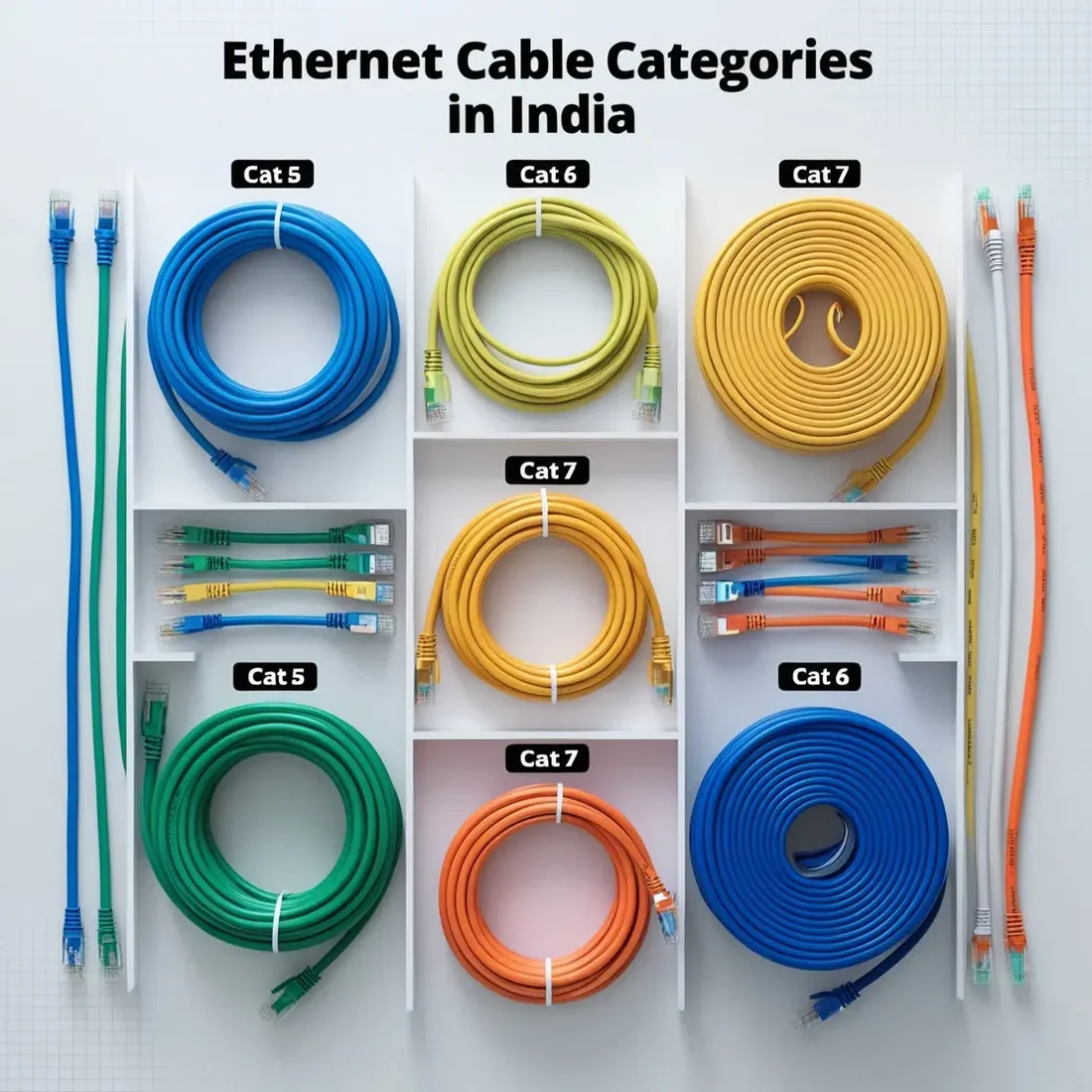
Several Ethernet cables categories can be found in the Indian market. The most common options include Cat5, Cat5e, Cat6, Cat6A, Cat7, and Cat8.

Let's understand each category in detail.


What Is a Cat5 Ethernet Cable?

Cat5 is an older generation of Ethernet cable that was widely used in earlier network installations. It was designed for speeds of up to 100 Mbps with a bandwidth of up to 100 MHz.

Although Cat5 can still be found in some older installations, it is becoming less common because modern networks require higher speeds and better performance.

Where Can Cat5 Be Used?

Cat5 may still be suitable for basic networking requirements such as:

  • Simple internet browsing
  • Older computers
  • Basic office networks
  • Legacy networking equipment

For a new network installation, however, upgrading to a newer category is generally a better long-term choice.

Is Cat5 Easily Available in India?

Yes, Cat5 cables can still be found through some electronics suppliers and online marketplaces. They are generally inexpensive, but their limited performance makes them less attractive for modern networking projects.


What Is a Cat5e Ethernet Cable?

Cat5e, or Category 5 enhanced, is an improved version of Cat5. It supports Gigabit Ethernet speeds of up to 1 Gbps under appropriate conditions and provides bandwidth of up to 100 MHz.

Cat5e also offers improved protection against crosstalk compared with older Cat5 cabling.

Where Is Cat5e Commonly Used?

Cat5e is widely suitable for:

  • Home networks
  • Small offices
  • Internet connections
  • VoIP phones
  • Video calls
  • Network printers
  • Basic CCTV networking
  • Gigabit Ethernet connections

For many homes and small businesses, Cat5e remains a practical and economical choice.

Why Is Cat5e Popular in India?

Cat5e cables are widely available and usually affordable. If your networking equipment supports Gigabit Ethernet and you do not need higher-speed networking, Cat5e can provide a good balance between cost and performance.


What Is a Cat6 Ethernet Cable?

Cat6 is a popular choice for modern home and business networks. It supports Gigabit Ethernet and can support 10Gbps Ethernet over shorter distances under suitable conditions. Cat6 typically provides bandwidth up to 250 MHz.

Compared with older categories, Cat6 cables generally use improved pair construction and tighter twisting to help reduce interference and crosstalk.

Where Is Cat6 Used?

Cat6 is suitable for:

  • Gaming setups
  • Home offices
  • Business networks
  • High-speed internet connections
  • Streaming
  • CCTV systems
  • Network storage
  • Gigabit switches
  • Computer-to-router connections

Why Choose Cat6?

Cat6 offers a useful balance between performance and cost. It is generally more capable than Cat5e while remaining widely available and relatively easy to install.

For users building a new home network, Cat6 can be a strong option when they want additional performance capacity without moving to a more expensive category.


What Is a Cat6A Ethernet Cable?

Cat6A is an enhanced version of Cat6 designed for higher-performance networking. It supports 10Gbps Ethernet over distances up to 100 meters when the complete installation meets the relevant requirements. Cat6A provides bandwidth up to 500 MHz.

Compared with Cat6, Cat6A installations generally require more attention to cable management because the cables can be thicker and less flexible.

Where Is Cat6A Used?

Cat6A is particularly useful for:

  • Data centers
  • Server rooms
  • Large offices
  • High-performance networks
  • 10Gbps Ethernet installations
  • Network storage
  • Professional workstations
  • High-bandwidth applications

Why Choose Cat6A?

If you are installing permanent network cabling and want reliable 10Gbps capability over longer distances, Cat6A can be a suitable option.

It may also be useful for businesses that want to prepare their network infrastructure for future upgrades.


What Is a Cat7 Ethernet Cable?

Cat7 is designed for high-performance Ethernet applications and can support up to 10Gbps networking with bandwidth up to 600 MHz. Cat7 cables commonly feature shielding around individual pairs and/or the overall cable, depending on their construction.

This shielding can help reduce electromagnetic interference when used as part of a compatible shielded installation.

Where Is Cat7 Used?

Cat7 cables can be considered for:

  • Data centers
  • Server rooms
  • High-performance workstations
  • Professional networking
  • Industrial environments
  • High-interference environments

Is Cat7 Common in India?

Cat7 is available in India but is generally less common than Cat5e and Cat6. It is more likely to be selected for specialized networking applications where shielding and higher performance characteristics are important.


What Is a Cat8 Ethernet Cable?

Cat8 represents a newer generation of high-performance twisted-pair Ethernet cabling. It is designed for very high-speed networking applications and supports data rates up to 25Gbps or 40Gbps over short distances, depending on the implementation.

Cat8 provides bandwidth up to 2000 MHz and is primarily associated with data centers and high-performance network environments.

Where Is Cat8 Used?

Cat8 can be suitable for:

  • Data centers
  • Server-to-switch connections
  • High-performance computing
  • Professional network infrastructure
  • Specialized high-speed applications

Is Cat8 Necessary for a Home Network?

For most standard home internet connections, Cat8 is usually more capability than necessary. A Cat6 or Cat6A cable can often provide sufficient performance for home users.

Cat8 becomes more relevant when the network itself supports very high data rates and the shorter distance requirements of the category are appropriate.


How Do Ethernet Cable Categories Compare?

The different categories are designed for different networking requirements.

Cat5 is an older option primarily associated with basic networking. Cat5e is a popular economical choice for Gigabit Ethernet. Cat6 provides improved performance and can support 10Gbps over shorter distances. Cat6A is designed for 10Gbps networking over longer distances and provides up to 500 MHz bandwidth. Cat7 offers higher bandwidth and extensive shielding for specialized installations, while Cat8 is intended for very high-speed, short-distance applications such as data center environments.


How Do You Choose the Right Ethernet Cable in India?

Choosing the right cable depends on more than simply selecting the highest category available.

What Internet Speed Do You Need?

Start by checking your internet plan and networking equipment.

For standard home internet and Gigabit networking, Cat5e or Cat6 may be sufficient. If you are building a 10Gbps network, Cat6A may be a better long-term option.

Remember that upgrading the cable alone will not increase your internet speed if your router, switch, network adapter, or internet plan has a lower limit.


How Does Cable Distance Affect Your Choice?

Cable length is another important consideration.

Different Ethernet categories have different performance characteristics at different distances. For example, Cat6 can support 10Gbps over shorter distances, while Cat6A is designed to support 10Gbps over up to 100 meters when properly installed.

For longer permanent installations, consider both the cable category and the environment in which the cable will be installed.


Does Your Environment Have Electromagnetic Interference?

The installation environment can influence your cable choice.

If Ethernet cables are installed close to electrical wiring, motors, industrial machinery, or other sources of interference, shielded cabling may be worth considering.

Cat6A and Cat7 are available in shielded versions, but remember that the entire installation should be designed appropriately for shielding to provide its intended benefit.


Does Your Budget Matter?

Price is another important factor when selecting a network cable.

Cat5e is generally one of the most affordable options. Cat6 provides a good balance between price and performance, while Cat6A, Cat7, and Cat8 can cost more due to their construction and performance capabilities.

Instead of automatically purchasing the most expensive cable, select a category that matches your actual networking requirements.


Cat5e vs Cat6: Which One Should You Choose?

Cat5e and Cat6 are two of the most commonly considered options for home and office networking.

Cat5e is suitable for Gigabit Ethernet and is usually more economical. Cat6 offers higher bandwidth and improved performance characteristics, making it a better choice for users who want additional network capacity.

If you are replacing an old network or installing new permanent cabling, Cat6 can provide greater flexibility for future requirements.


Cat6 vs Cat6A: Which Ethernet Cable Is Better?

Cat6 and Cat6A can both be useful, but they target somewhat different requirements.

Cat6 is generally easier to handle and can be suitable for home networks, offices, gaming setups, and Gigabit connections. Cat6A is better suited to installations where 10Gbps performance over longer distances is important.

If your network currently uses Gigabit Ethernet but you expect future upgrades, Cat6A can be considered for permanent infrastructure.


Cat7 vs Cat8: Which One Should You Choose?

Cat7 and Cat8 are both aimed at high-performance applications, but they are not necessarily the best choice for every network.

Cat7 is associated with high bandwidth and extensive shielding, making it useful for specialized environments. Cat8 is designed for even higher-speed applications over shorter distances and is particularly relevant to data centers and server environments.

For most homes, these categories may provide capabilities beyond what is required.


Are Ethernet Cables Available Online in India?

Yes, Ethernet cables across multiple categories are widely available through online marketplaces, networking suppliers, electronics stores, and specialized cable manufacturers in India.

When buying online, carefully check:

  • Cable category
  • Length
  • Conductor material
  • AWG
  • Shielding
  • Connector type
  • Cable construction
  • Intended application
  • Warranty, where applicable

Do not select a cable based only on a "high-speed" label. Reviewing the technical specifications can help you choose a more suitable product.


What Are the Common Uses of Ethernet Cables?

Ethernet cables can be used in many different environments.

Home Networking

Connect routers, computers, smart TVs, gaming consoles, printers, and other network devices.

Gaming

A wired Ethernet connection can provide stable connectivity for gaming PCs and consoles when compared with wireless connections in environments where Wi-Fi interference or signal strength is an issue.

Office Networking

Businesses use Ethernet cabling to connect computers, printers, switches, servers, IP phones, and access points.

CCTV Networking

PoE-enabled Ethernet connections can carry both data and power to compatible network cameras.

Data Centers

Higher-category cabling can be used for server, storage, and switch connections where high data throughput is required.


What Should You Check Before Buying an Ethernet Cable?

Before purchasing, consider the following points:

Cable Category

Choose Cat5e, Cat6, Cat6A, Cat7, or Cat8 based on your performance requirements.

Cable Length

Select a length that is sufficient for your installation without leaving unnecessary excess cable.

Conductor Material

Check whether the cable uses solid copper or another conductor construction. For permanent structured cabling, the conductor specification is particularly important.

Shielding

Consider shielded cable if your installation environment has significant electromagnetic interference.

Connector Quality

Good-quality RJ45 connectors and proper termination are important for reliable network performance.

Installation Environment

Indoor and outdoor installations may require different cable jacket materials and protection.


Why Is the Right Ethernet Cable Important?

A network is only as reliable as its weakest component. A high-performance router connected to unsuitable cabling may not deliver the expected network performance.

Choosing the appropriate Ethernet cable can help provide:

  • Stable wired connectivity
  • Reliable data transmission
  • Better network performance
  • Lower interference
  • Support for higher network speeds
  • Improved future upgrade flexibility

The key is to match the cable category to the actual requirements of your network rather than choosing a cable simply because it has a higher category number.


Conclusion

The Indian market offers a wide range of Ethernet cable categories for different networking needs. Cat5 is primarily useful for older or basic installations, while Cat5e remains an economical choice for Gigabit networks. Cat6 provides improved performance for modern home and office networks, while Cat6A is a strong option for 10Gbps networking over longer distances.

For specialized high-performance environments, Cat7 offers higher bandwidth and extensive shielding, while Cat8 is designed for very high-speed, short-distance applications such as data centers.

Before buying an Ethernet cable, consider your network speed, cable distance, devices, installation environment, and budget. You do not necessarily need the highest category. The best Ethernet cable is the one that provides the performance you need while remaining compatible with your network equipment and installation requirements.


Share on social media

Our Categories

Medical: Doctors & Specialists , Endocrinologist , Neurologist , Pediatrician , Dermatologist , Gastroenterologist , Orthopedic , Cardiologist , Gynecologist , Physicians , Nephrologist Hospitals & Clinics , Eye Hospital / Clinics , Orthopedic , Heart , Cardiology , Brain & Spine Centre , Multispecialty Hospital , Hospitals / Dental Clinics , Dermatologist , Ayurvedic Hospital , ENT Pathlabs , Veterinary , Laparoscopic Surgeon , Urologist , Neurosurgeon , Hospitals / Dental Clinics , Dermatologist , Eye specialist

Real Estate: Shoping Mall , Builders and Developers , Upcoming Projects , Photographer , Construction Company , Property Types , Residential Property , Commercial Property , Plots / Land , Villas Real Estate Services , Real Estate Agents / Dealers , Property Brokers , Real Estate Consultants , Real Estate Developers / Builders Property Rent , Flats / Apartments for Rent , Shops / Showrooms for Rent / Lease , Studio Apartments Rent , Office Space for Rent Construction & Development Construction Companies / Contractors , Civil Engineers , Architects

Education: Schools , Boarding , CBSE , ICSE , Up Board , International , Play School , Driving School Colleges/Institute/ Classes , Engineering & Technology , Medical Collage , Arts, Science & Commerce , Management & Business Colleges , Law Colleges , Education & Teaching Colleges , Design, Fashion & Fine Arts Colleges , Media & Communication Colleges , Agriculture Science Colleges , Veterinary Science Colleges Classes, Courses & Coaching , Academic Coaching , IT & Computer Courses , Creative & Design Courses , Language & Communication University , Nadi Astrologer , Vedic Astrologer , Kp Astrologer , Lal Kitab Astrologer , Numerologist Astrologer , Palm Reader

Accommodation: Hostels / PG , Boys , Girls Resorts , Motels , Guest House , Paying Guest , Home Stay , Dharamshala , Farmhouse , Oyo Rooms , Hotels 7 Star , 3 Star , 5 Star , 4 Star , Budget Hotels

Tour and Travels: Domestic Tour Packages , International Tour Packages , Honeymoon Tours , Family Holiday Packages , Flight / Train / Bus Booking , Flight Ticket Booking , Bus Booking , Train Ticket Booking Car / Bike , Scooty Rentals , Bike Rentals , Car Rentals , Scooty Rentals , Taxi Service Adventure Tours , Pilgrimage Tours

Restaurants / Bar / Cafe: Bakery / Cake , South Indian Restaurants , North Indian Restaurants , Punjabi Restaurants , Gujarati Restaurants , Rajasthani Restaurants , Bengali Restaurants , Mughlai Restaurants , Chinese Restaurants , Thai Restaurant

Packers and Movers: Local Packers and Movers , Domestic Packers , International Packers And Movers

Stock & Trading: Stock Market Trading , Commodity Trading , Forex Trading , Crypto Trading , Binary Options Trading , Trading Education & Training Stock Market Training , Forex Trading Courses , Crypto Trading Tutorials

Beauty & Saloon: Beauty Parlours / Salons , Men's salon / Parlour , Ladies Parlour / Salon Spa & Wellness Centers , Hair Transplant , Hair Salons / Hair Studios , Men Hair Salon , Ladies Hair Salon Unisex Salon , Nail Salons , Makeup Artists , Tattoo Studios , Beauty Academies / Training Institutes , Makeup Academy , Hairstyles Academy , Nail Art Mehandi Artist

More..