Building work creates waste from the moment the ground is opened. Foundations, drainage trenches, extensions, demolition, landscaping and utility projects can all leave piles of soil, rubble and other excavated material around the site. muck removal London building sites is therefore an important service for contractors who need to keep work areas clear and maintain a sensible construction schedule.
For projects connected with Wrest Park, Park Avenue and the surrounding Bedfordshire area, Grab Express has a direct local connection. Its listed head office and registered address are at Capability House, Wrest Park, Park Avenue, Silsoe, Bedfordshire, MK45 4HS. The company provides muck-away and grab-hire services across London and surrounding home counties.
A grab lorry can collect loose soil, hardcore, concrete, tarmacadam, builders' rubbish and other suitable construction waste using a hydraulic grab arm. This reduces manual loading and can help contractors keep valuable working space available.
Why Building Sites Need Planned Muck Removal
Construction waste can become a problem surprisingly quickly. A small excavation may initially leave only a few piles of soil, but continued digging can create much more material than the site has room to store.
That can affect vehicle movements, deliveries and access for trades. It can also make a site harder to keep tidy and safe.
Planning muck removal before excavation starts gives the contractor more control. Instead of asking where the next pile of soil can go, the site team can work around a prepared collection area and arrange transport when required.
Grab Express states that its muck-away service is suitable for excavation projects, full site clearance and larger commercial, domestic and demolition waste requirements.
This makes advance planning particularly useful for foundations, drainage, demolition and larger groundworks where material volumes can change quickly.
Muck Removal London Building Sites During Excavation
Excavation is one of the main stages where large amounts of unwanted material are created. Foundation trenches, basements, drainage runs and service trenches can all produce soil that needs to leave the site.
The best removal method depends on the type and amount of material. Clean soil may be handled differently from mixed construction waste or potentially contaminated material.
Grab Express lists several materials within its muck-away service, including muck, non-hazardous muck, contaminated muck, topsoil, hardcore, concrete, tarmacadam, as-dug ballast, green waste, mixed utility waste, mixed construction waste and builders' rubbish.
The important step is to describe the material accurately when requesting a quotation. This helps the provider understand what vehicle and waste-handling arrangements may be appropriate.
How a Grab Lorry Removes Construction Muck
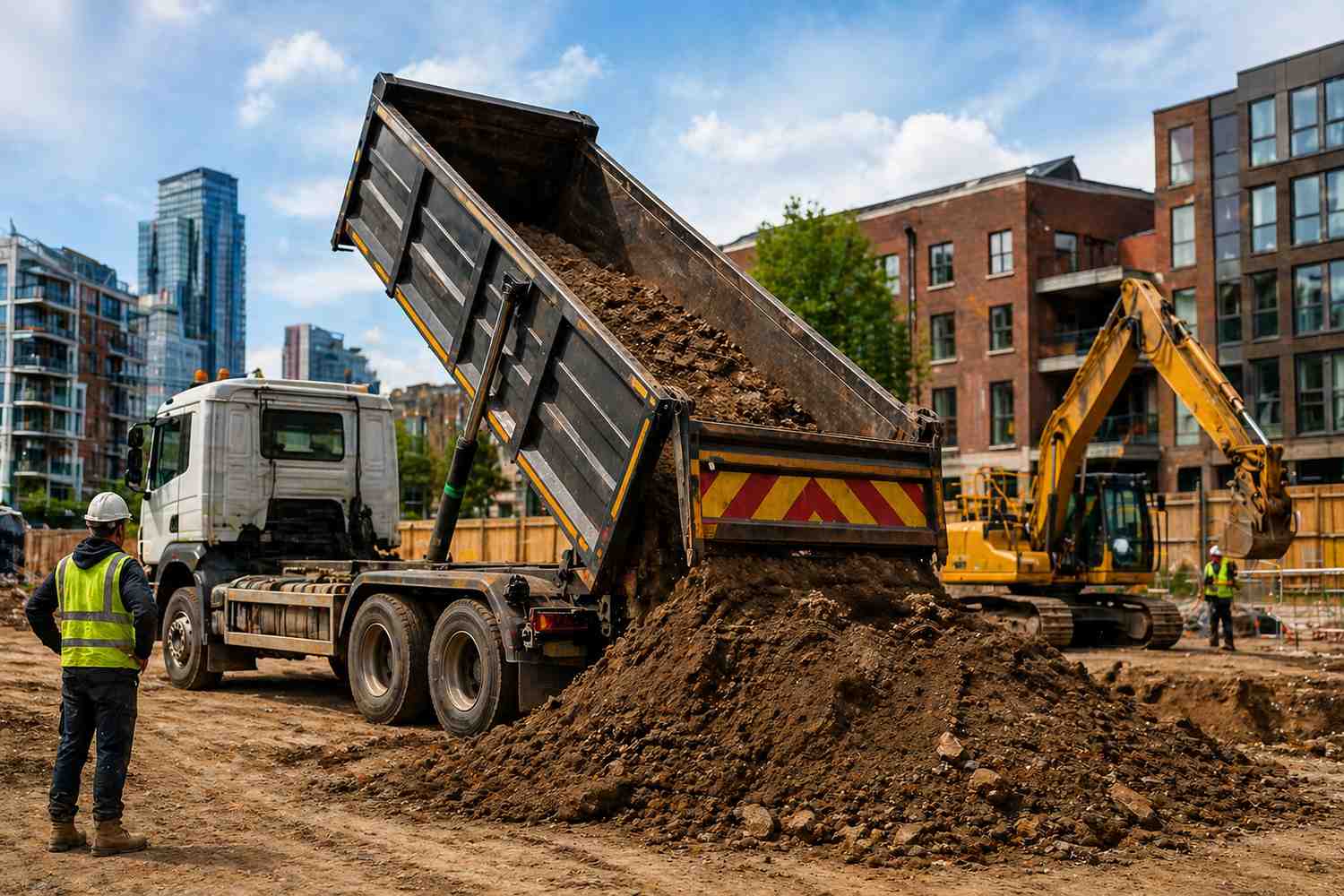
A grab lorry combines transportation and mechanical loading in one vehicle. Its crane-mounted hydraulic grab can pick up loose material and place it directly into the lorry.
That can save a considerable amount of manual effort compared with loading heavy soil into containers by hand.
Grab Express states that its grab lorries are 32-tonne vehicles with an extended reach of up to eight metres. The company says they can manoeuvre around difficult locations, including areas over walls and fences, where site conditions allow.
Access still needs to be checked before collection. The driver needs enough space to position the vehicle and operate the crane safely.
For a building site, this means considering road width, gates, parked vehicles, overhead cables, trees, scaffolding and nearby structures before the vehicle arrives.
Soil Removal From Foundations and Groundworks
Foundation excavation can create large volumes of soil in a short period. Leaving the material around the work area may reduce the space available for machinery and other construction activities.
Bulk soil removal is easier when the excavated material is kept in a clear collection area. A grab lorry can then reach the pile without workers having to move it several times.
The same principle applies to drainage and utility projects. Soil dug from a trench can be placed in a planned loading zone rather than being scattered across the site.
Grab Express provides muck-away services for excavation work and lists topsoil, hardcore and as-dug ballast among the materials it handles.
If the soil is suspected of contamination, the provider should be told before collection. Accurate information supports suitable handling and disposal arrangements.
Removing Rubble From Construction Sites
Building projects do not produce soil alone. Renovation and demolition can create bricks, concrete, broken blocks, hardcore and other rubble.
Leaving heavy rubble around the site can create additional handling work. It may also interfere with machinery and reduce available storage space.
Grab Express's published muck-away service includes concrete, hardcore, builders' rubbish, metal waste and mixed construction waste.
Where practical, keeping different waste materials separated can make the removal process more straightforward. It can also help recycling facilities recover individual materials more effectively.
Before the lorry arrives, the rubble should be placed where the grab arm can safely reach it. Avoid creating piles underneath overhead hazards or in areas needed for other site operations.
Keeping Construction Work Moving
A clean site is not just about appearance. Construction projects depend on space.
A foundation contractor needs room for machinery. Bricklayers need clear access for deliveries. Groundworkers need space around excavations. Electricians and utility crews may need access to trenches and service routes.
If excavated waste is left in the wrong location, one task can interfere with another.
A scheduled grab-lorry collection can help reduce this problem. Grab Express describes its fleet as suitable for muck away, rubbish away, hardcore removal, aggregate deliveries and utility work.
For larger projects, it can be useful to discuss the expected waste-removal schedule before work starts. That gives the contractor a better idea of when collection space will be needed and how the waste flow will fit into the wider programme.
Muck Removal for Builders and Contractors
Builders often deal with several waste streams during one project. An extension may create excavated soil at the start, followed by bricks, concrete and general construction waste as the work progresses.
This means a single collection may not always be enough.
The best approach is to look at the whole project rather than only the first load. Estimate when excavation will occur, what materials will be produced and whether the site has enough room for temporary storage.
Grab Express says it serves both domestic and commercial customers and provides dedicated grab-hire services for the construction industry.
For contractors, clear communication is particularly important. Providing the postcode, material type, approximate quantity and access conditions helps the operator understand the job before the vehicle is dispatched.
Local Service Around Wrest Park and Park Avenue
Local relevance matters when arranging a heavy vehicle. A building site may have narrow roads, parking restrictions or difficult access, so knowing the area can be useful when planning a collection.
Grab Express lists its head office at Wrest Park, Park Avenue, Silsoe, Bedfordshire.
The company states that it provides grab-hire and muck-away services across London, Hertfordshire and Buckinghamshire. Its local grab-hire information also lists a range of London postcode areas and advises customers outside those areas to contact the company to check coverage.
For projects around Silsoe, Wrest Park, Park Avenue and nearby Bedfordshire locations, the local address provides a relevant geographical connection.
Customers working farther away in London should still provide the exact postcode before booking so that service availability can be confirmed.
Site Access Can Affect Muck Removal
One of the most common issues with heavy waste removal is not the waste itself. It is access.
A site may have a narrow entrance, a wall close to the loading area, scaffolding, overhead cables or parked vehicles that make positioning difficult.
Grab Express says its grab lorries have an eight-metre reach and are designed to manoeuvre around awkward spaces, including over walls and fences, where conditions allow.
However, reach should not be treated as a guarantee that every site is accessible. The vehicle still needs a safe position from which to operate.
Before booking, explain any unusual conditions. If possible, give clear directions to the loading point and identify where the waste will be placed.
Good access planning can save time on collection day.
Responsible Handling of Construction Waste
Removing waste from a site is only one part of the process. The material then needs to go through an appropriate disposal, recycling or recovery route.
Grab Express states that it works with licensed recycling centres and aims to recycle more than 90% of collected waste. Its recycling service includes construction materials such as soil, concrete, bricks and other materials that can be processed for reuse where appropriate.
The company also states that it is a licensed Waste Carrier and Broker regulated by the Environment Agency.
For construction businesses, responsible waste handling can support better site management and environmental practices.
It also makes accurate waste descriptions important. A provider needs to know whether the load contains clean soil, mixed rubble, contaminated material or another waste stream before collection.
When Should Building Sites Arrange Muck Removal?
The ideal time depends on the project, but waiting until the site is completely overwhelmed is rarely helpful.
For planned excavation, the collection can be arranged around the expected digging schedule. This allows the contractor to keep the work area clear without moving the same soil several times.
Short-notice requirements can happen too. A foundation excavation may finish earlier than expected, or a delivery may require an area currently occupied by spoil.
Grab Express states that its grab lorries are available at short notice and can operate day or night as well as weekends and bank holidays.
Availability should always be confirmed for the required date. Providing complete job details at the first enquiry can make this process easier.
Building Site Muck Removal and Project Costs
Muck-removal costs depend on several factors rather than one fixed price.
The type of waste, amount of material, distance, site access and disposal requirements can all affect the quotation.
Accurate information helps avoid surprises. If a contractor describes a load simply as “soil” but it actually contains concrete, bricks or other mixed waste, the original estimate may not reflect the final requirements.
Grab Express describes its grab lorries as cost-effective because they are self-loading and can save time and labour.
When comparing prices, consider the complete job. A service that reduces manual loading and removes waste directly from the site may provide better overall value than a cheaper option that requires extra handling.
Construction Site Clearance After Demolition
Demolition can create a much broader waste mix than ordinary excavation.
A cleared building site may contain broken concrete, bricks, timber, metal, soil and other materials. The waste can also be spread over a larger area, making manual collection inefficient.
Grab Express lists full site clearance among its muck-away applications and handles mixed construction and demolition waste.
For demolition projects, waste planning should begin before the first structure comes down. Identifying where different materials will be placed can make collection and recycling easier.
The vehicle access route should also be checked. Demolition sites can change quickly, so the area available for a grab lorry may not be the same from one day to the next.
Using Muck Removal Alongside Aggregate Delivery
Waste removal and material delivery can sometimes form part of the same construction workflow.
Once an excavation has been cleared, a project may need new material such as Type 1, sand, ballast, topsoil or recycled aggregate.
Grab Express supplies primary and secondary aggregates and states that its vehicles can deliver materials into manageable piles, including over walls and fences where possible.
This can help contractors think about the entire material cycle: remove unwanted material, prepare the area and then bring in what the next stage requires.
The exact arrangement depends on the project and vehicle availability, but combining related requirements can simplify site logistics.
How to Prepare Before the Grab Lorry Arrives
Preparation starts with the waste pile.
Place loose soil, rubble or hardcore in an area that the grab arm can reach. Keep the area free from unnecessary equipment and vehicles.
Then inspect the space above and around the loading area. Look for cables, branches, scaffolding, walls and other obstructions.
The road and entrance should also provide enough room for the lorry to position safely.
Grab Express's published vehicle information highlights safety equipment including CCTV, audio warnings, cyclist protection and cyclist-awareness features on its modern grab lorries.
The site team should still follow normal construction-site safety procedures. Keep workers clear of the operating area and follow the driver's instructions during loading.
Frequently Asked Questions About Muck Removal London Building Sites in Wrest Park, Park Avenue
What is a domestic muck away London service?
A domestic muck away London service removes suitable heavy waste created by home projects such as extensions, garden excavation, driveway work, drainage and landscaping. A grab lorry can collect loose soil, rubble and other suitable materials using its hydraulic arm. The amount and type of waste should be explained before booking. Access is also important because residential properties may have narrow driveways, walls or restricted entrances.
How does a bulk soil removal London service work?
A bulk soil removal London service normally involves collecting a prepared pile of excavated soil with a grab lorry and transporting it away. The soil should be placed where the crane can safely reach it. The provider may need information about the estimated volume, location, access and material type. If the soil may be contaminated or contains other construction materials, that should be explained before the collection is arranged.
Can I arrange a garden muck removal London service?
Yes. A garden muck removal London service can be useful for major landscaping, patio installation, garden levelling, driveway preparation and other work that creates large amounts of excavated soil. A grab lorry can reduce the need for manual loading. The property owner should explain where the material is located and whether the vehicle can access the site. Walls, gates, overhead cables and narrow roads can all affect the collection.
Can rubble and soil removal London be arranged together?
Rubble and soil removal London can often be planned as part of one project, but the materials should be described accurately. Soil, concrete, bricks, hardcore and mixed construction waste may have different handling requirements. Keeping materials separated where practical can support more efficient recovery and recycling. Before collection, provide the approximate amount, waste types and loading location so the operator can assess the requirements.
Is muck away London site clearance suitable for demolition work?
Yes. Muck away London site clearance can be suitable for demolition and construction projects that produce large amounts of soil, rubble, concrete, hardcore and mixed building waste. Grab Express states that its muck-away service is suitable for full site clearance and demolition waste. The exact service depends on the waste type, quantity, site access and any special handling requirements.
How is muck removed from building sites?
Muck is commonly collected with a grab lorry. The vehicle positions near the prepared waste pile and uses a hydraulic grab arm to lift loose material into its body. Grab Express states that its lorries have an extended reach of up to eight metres and can work around walls and fences where conditions allow. The site must still provide safe access and enough room for the vehicle to operate.
What waste can a grab lorry remove from a building site?
Depending on the agreed service and material classification, a grab lorry can remove materials such as soil, hardcore, concrete, tarmacadam, builders' rubbish, green waste and mixed construction waste. Grab Express lists these and other materials within its muck-away service. Customers should always describe the actual contents of the load before collection, especially if contaminated or unusual materials are involved.
How much does building-site muck removal cost?
There is no single price for every building site. The cost can depend on the material, quantity, location, access, vehicle requirements and disposal arrangements. A useful quotation therefore needs more than an address. Tell the provider what material needs removing, approximately how much there is, where it is located and when collection is required. Comparing the total service cost can be more useful than comparing a vehicle rate alone.
Where does construction muck go after collection?
Construction muck may be taken to an appropriate licensed disposal, recycling or recovery facility depending on its type and classification. Grab Express states that it works with licensed recycling centres and aims to recycle more than 90% of collected waste. Its recycling information says materials including soil, concrete and bricks can be recycled and reused where suitable.
Can Grab Express remove muck from London building sites?
Yes. Grab Express provides muck-away and grab-hire services for London and surrounding home counties. Its published service information covers excavation, construction and demolition waste, while its grab-hire fleet is described as suitable for domestic and commercial customers. Customers should provide the project postcode, waste type, estimated quantity and access details when requesting a quotation.
Arrange Muck Removal for Your Building Site
Construction waste becomes easier to manage when it is planned as part of the project rather than left until the site runs out of space. Soil from foundations, rubble from demolition, hardcore from groundworks and other suitable waste can be collected by a grab lorry and taken away for appropriate handling.
For projects around Wrest Park, Park Avenue, Silsoe and surrounding areas, Grab Express has a listed local head-office address and provides muck-away and grab-hire services across London and the surrounding home counties.
If your building site needs soil, rubble, hardcore or other suitable construction waste removed, provide the site postcode, material type, approximate quantity and access information when requesting a quotation.
Tags : Muck Away London