Molecular Sieves Market Expansion: Adoption Trends & Industry Insights 2026-2034
By Jhone rock 01-10-2026 2
Market Overview:
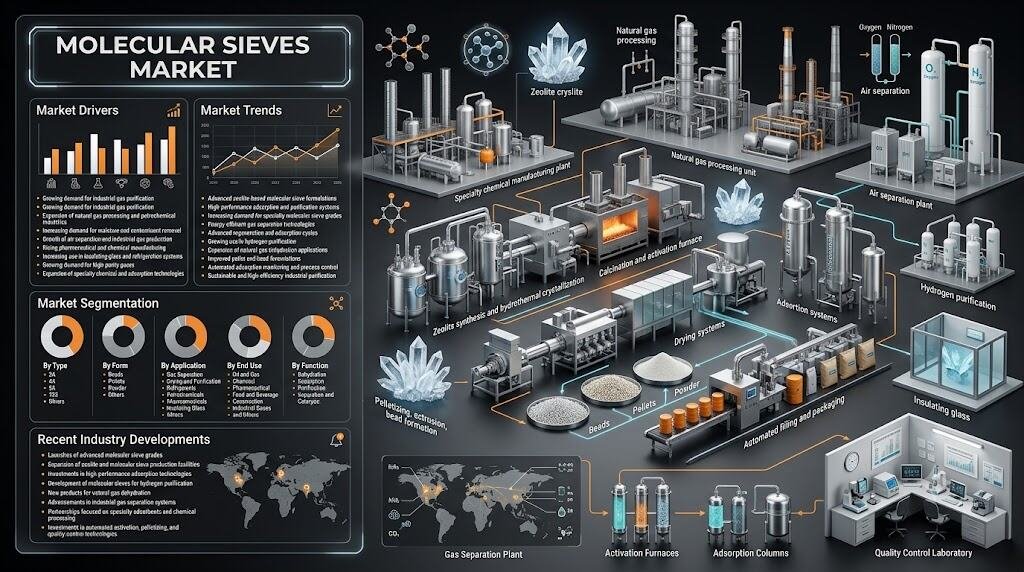
According to IMARC Group's latest research publication, "Molecular Sieves Market: Global Industry Trends, Share, Size, Growth, Opportunity and Forecast 2026-2034", The global molecular sieves market size reached USD 4.5 Billion in 2025. Looking forward, IMARC Group expects the market to reach USD 6.3 Billion by 2034, exhibiting a growth rate (CAGR) of 3.74% during 2026-2034.
This detailed analysis primarily encompasses industry size, business trends, market share, key growth factors, and regional forecasts. The report offers a comprehensive overview and integrates research findings, market assessments, and data from different sources. It also includes pivotal market dynamics like drivers and challenges, while also highlighting growth opportunities, financial insights, technological improvements, emerging trends, and innovations. Besides this, the report provides regional market evaluation, along with a competitive landscape analysis.
How AI is Reshaping the Future of the Molecular Sieves Market
- AI-powered process optimization is enabling molecular sieve manufacturers to enhance adsorption selectivity by up to 15%, reducing energy consumption in gas separation processes across petrochemical and water treatment facilities.
- Government programs such as India's PCPIR Policy 2020-35 are targeting a combined industrial investment of approximately INR 10 lakh crore (around USD 142 Billion) by 2025, directly increasing demand for molecular sieves in refining and petrochemical purification.
- Honeywell's Ecofining technology enables St1's Gothenburg biorefinery to produce 200,000 tons of sustainable aviation fuel and renewable fuels annually, cutting CO2 emissions by 500,000 tons using advanced molecular sieve systems for purification.
- Asia Pacific holds the dominant regional share at over 33.4% of the global market in 2025, fueled by rapid industrialization and the expansion of petrochemical, water treatment, and pharmaceutical sectors across China, India, and Japan.
- Zeolite-based molecular sieves command approximately 37.2% of the material type segment in 2025, reflecting strong industrial preference for their superior thermal stability, versatility, and adsorption efficiency across catalysis and purification applications.
Key Trends in the Molecular Sieves Market
- Rising Demand in the Petrochemical Industry: Molecular sieves are indispensable in refining operations, where they dry and purify hydrocarbon streams, separate gases, and improve final product quality. The Indian petrochemical sector is projected to attract investments exceeding USD 87 Billion over the next decade, accounting for over 10% of global petrochemical growth. This surge is a direct driver of molecular sieve consumption across gas drying, separation, and dehydration applications.
- Growing Role in Water Treatment Technologies: The global gap between water supply and demand is projected to reach 40% by 2030, intensifying the need for highly efficient water purification solutions. Molecular sieves, with their targeted adsorption capacity and ability to remove specific ionic and molecular contaminants, are increasingly deployed in both industrial and municipal water treatment plants, particularly in water-scarce regions of Asia Pacific, the Middle East, and Latin America.
- Expansion of Green and Sustainable Industrial Practices: Honeywell's UOP eFining technology was selected by Jiutai Group to produce 100,000 tons of sustainable aviation fuel annually from eMethanol, achieving an 88% reduction in greenhouse gas emissions compared to conventional jet fuel. Molecular sieves form a critical part of these green chemistry processes by enabling precise separation and purification of eco-friendly fuels.
- Pharmaceutical Sector Driving Specialty Applications: The pharmaceutical sector in the United States generated USD 550 Billion in revenue, with projected spending ranging between USD 605 and USD 635 Billion. Molecular sieves are integral to pharmaceutical packaging and formulation environments by controlling humidity and moisture levels that affect drug stability and shelf life, making them a high-value component in regulated manufacturing settings.
- Renewable Energy Integration Creating New Use Cases: South Korea's electricity generation from renewable sources is expected to grow from approximately 9% in 2022 to 21.6% by 2030 and further to 30.6% by 2036. As hydrogen and biogas production expands across Asia Pacific and Europe, molecular sieves are increasingly used for hydrogen purification and biogas upgrading, positioning them as essential materials in the global energy transition.
Growth Factors in the Molecular Sieves Market
- Petrochemical Investment Surge in Emerging Economies: Developing economies, particularly India, are channeling massive capital into their petrochemical sectors. Under the PCPIR Policy 2020-35, a targeted investment of approximately USD 142 Billion by 2025 is driving the construction of new refining and chemical processing infrastructure, where molecular sieves are required for dehydration, gas separation, and catalyst support applications.
- Advancements in Molecular Sieve Technologies: Manufacturers are continuously improving the efficiency of molecular sieves to meet evolving industrial demands. Honeywell's adsorption-based technology selected for Mozambique's Rovuma LNG project enables water, CO2, and hydrocarbon removal in support of an 18 Mtpa production capacity via modular processing trains, demonstrating how upgraded molecular sieve systems are critical to large-scale global energy infrastructure.
- Rapid Industrialization Across Asia Pacific: Asia Pacific accounts for over 33.4% of global market share in 2025. Countries like China and India are expanding their manufacturing and energy sectors at pace, with molecular sieve applications growing across natural gas processing, pharmaceutical packaging, and food safety. The region's large-scale industrial base, combined with government-backed environmental regulations, is cementing its position as the largest and fastest-growing molecular sieve market.
- Middle East Energy Investment Driving Demand: Energy investment in the Middle East is expected to reach approximately USD 175 Billion in 2024, with clean energy accounting for around 15% of total investment. Nations such as Saudi Arabia and the United Arab Emirates are expanding their natural gas processing and petrochemical capacities, both of which depend on molecular sieves for dehydration and purification, creating significant volume demand across the region.
- Latin America's Oil, Gas, and Hydrogen Sector Growth: Latin America is well positioned to produce low-emissions hydrogen leveraging a largely decarbonized electricity mix, of which 60% comes from renewables. Hydrogen demand in the region reached 4 Mt in 2023, primarily for oil refining and chemical manufacturing. Molecular sieves support the dehydration and separation operations required for natural gas processing, which remains the dominant hydrogen production pathway across the region.
Leading Companies Operating in the Global Molecular Sieves Industry:
- Axens
- BASF SE
- Bear River Zeolite Company (USAC)
- Caledon Laboratories Limited
- CECA (Arkema)
- Clariant Produkte (Schweiz AG)
- Honeywell UOP
- Interra Global Corporation
- KNT Group
- Merck and Co.
- Sorbead India
- Tosoh Corporation
- Zeochem AG (Cph Chemie and Papier)
Molecular Sieves Market Report Segmentation:
Breakup By Type:
- Type 3A
- Type 4A
- Type 5A
- Type 13X
- Type Y
- Pentacil
- Others
Type 3A leads the market with around 38.2% of the market share in 2025, owing to its highly selective adsorption of water molecules while excluding larger molecules, making it the preferred choice for dehydrating unsaturated hydrocarbons, ethanol, and refrigerants in industrial settings.
Breakup By Material Type:
- Carbon
- Clay
- Porous Glass
- Silica Gel
- Zeolite
- Others
Zeolite leads the market with around 37.2% of the market share in 2025, driven by its exceptional versatility across petrochemical refining, water treatment, air purification, and catalysis, along with its structural pore properties and superior thermal stability.
Breakup By Application:
- Catalyst
- Adsorbent
- Desiccants
Catalyst is the leading application segment, given the central role of molecular sieves in petrochemical processes such as hydrocracking and fluid catalytic cracking, where their reusability, thermal stability, and reaction selectivity make them indispensable for large-scale industrial catalysis.
Breakup By Shape:
- Pelleted
- Beaded
- Powdered
Pelleted leads the market with around 48.2% of the market share in 2025, as their uniform shape ensures consistent flow and contact with gases and liquids, making them the preferred form for large-scale industrial adsorption and catalytic processes such as petrochemical refining and air purification.
Breakup By Size:
- Microporous
- Mesoporous
- Macroporous
Microporous molecular sieves dominate due to their exceptional precision in separating small molecules, which is critical for gas separation, air purification, and petrochemical operations such as cracking and isomerization.
Breakup By End-Use Industry:
- Oil and Gas Industry
- Agricultural Industry
- Chemical Industry
- Pharmaceutical Industry
- Water Treatment Industry
- Construction Industry
- Others
Oil and gas industry leads the market with around 34.5% of the market share in 2025, as molecular sieves are essential for refining crude oil, dehydrating natural gas streams, and producing petrochemicals, with performance requirements that demand the high selectivity and durability that molecular sieves uniquely provide.
Breakup By Region:
- North America (United States, Canada)
- Asia Pacific (China, Japan, India, South Korea, Australia, Indonesia, Others)
- Europe (Germany, France, United Kingdom, Italy, Spain, Russia, Others)
- Latin America (Brazil, Mexico, Others)
- Middle East and Africa
Asia Pacific holds the leading position with over 33.4% of market share in 2025, driven by large-scale industrialization, growing energy and water treatment infrastructure, expanding pharmaceutical manufacturing, and government-backed policies promoting environmental sustainability across China, India, Japan, and South Korea.
Recent News and Developments in the Molecular Sieves Market
- January 2026: Zeochem announced a strategic corporate restructuring by merging its Swiss-based entities to streamline operations and strengthen its position as a leading global manufacturer of molecular sieves and chromatography gels, enhancing its ability to serve industrial clients across petrochemical, pharmaceutical, and air separation segments.
- July 2025: Zeochem, the Chemistry Division of the CPH Group, completed its acquisition of SiliCycle Inc., a Canadian company specializing in high-performance chromatography gels for the pharmaceutical industry. The company generated CAD 16 million in revenue in 2024 and employs approximately 60 people. The acquisition expands Zeochem's North American manufacturing and R&D capabilities in separation and purification solutions.
- June 2025: Zeochem highlighted the capabilities of its ZEOX molecular sieve line for medical oxygen generation, underscoring the growing role of specialized molecular sieves in healthcare infrastructure and supporting the global demand for reliable, domestically produced oxygen generation systems.
Note: If you require specific details, data, or insights that are not currently included in the scope of this report, we are happy to accommodate your request. As part of our customization service, we will gather and provide the additional information you need, tailored to your specific requirements. Please let us know your exact needs, and we will ensure the report is updated accordingly to meet your expectations.
About Us:
IMARC Group is a global management consulting firm that helps the world's most ambitious changemakers to create a lasting impact. The company provides a comprehensive suite of market entry and expansion services. IMARC offerings include thorough market assessment, feasibility studies, company incorporation assistance, factory setup support, regulatory approvals and licensing navigation, branding, marketing and sales strategies, competitive landscape and benchmarking analyses, pricing and cost research, and procurement research.
Contact Us:
IMARC Group
134 N 4th St. Brooklyn, NY 11249, USA
Email: sales@imarcgroup.com
Tel No: (D) +91 120 433 0800
United States: +1-201-971-6302
Tags : .....