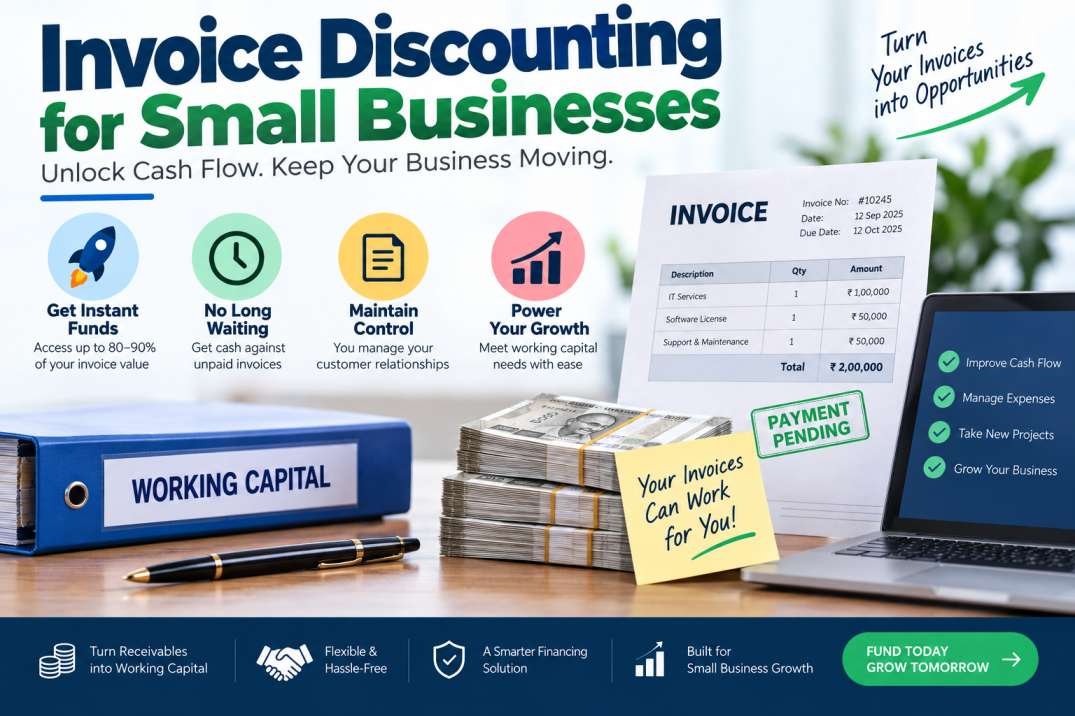
Working capital is essential for maintaining the smooth operation and growth of a small business. However, delayed customer payments can create cash flow gaps even when a business has strong sales and a healthy order pipeline. Businesses still need to pay suppliers, employees, rent, utilities, and other operating expenses while waiting for customers to settle their invoices.
Invoice discounting for small businesses can help address this challenge by allowing businesses to access working capital against eligible unpaid invoices. Instead of waiting until the invoice due date, businesses may receive an advance earlier and use the funds to support their immediate financial requirements.
What Is Invoice Discounting?
Invoice discounting is a form of short-term working capital finance that allows a business to obtain funds against eligible outstanding invoices. When a business supplies goods or services to a customer on credit, it issues an invoice with agreed payment terms.
Rather than waiting for the customer to make the payment, the business may submit the eligible invoice to a financing provider. The provider may advance a percentage of the invoice value according to the agreed financing terms.
Once the customer pays the invoice, the transaction is settled after applicable financing charges and fees.
How Invoice Discounting for Small Businesses Works
The invoice discounting process generally involves several steps.
1. Complete the Sale
The business provides products or services to its customer according to the agreed commercial terms.
2. Raise an Invoice
The business issues an invoice showing the amount payable and the agreed payment period.
3. Submit the Eligible Invoice
The business submits eligible invoices to the financing provider for evaluation.
4. Receive Working Capital
After approval, the financing provider may provide an advance against the eligible invoice value.
5. Customer Pays the Invoice
The customer settles the invoice according to the agreed payment terms.
6. Complete the Settlement
The financing arrangement is settled after applicable charges and fees according to the agreed terms.
The exact process, advance percentage, fees, and eligibility requirements vary between financing providers.
Why Small Businesses Need Working Capital
Small businesses often operate with limited cash reserves. A delay in customer payments can therefore have a significant effect on daily operations.
For example, a business may complete a large customer order and issue an invoice with a 60-day payment period. During this period, the business may still need to purchase materials, pay employees, manage transportation costs, and fulfil additional orders.
Access to working capital can help bridge this timing gap and allow the business to continue operating without waiting for every customer invoice to be paid.
Benefits of Invoice Discounting for Small Businesses
Unlock Working Capital
The primary advantage of invoice discounting is the ability to unlock a portion of the funds tied up in eligible unpaid invoices. This can provide businesses with additional liquidity when they need it.
Improve Cash Flow
Improved access to working capital can help businesses manage the timing difference between outgoing expenses and incoming customer payments.
Manage Supplier Payments
Businesses can use available working capital to manage supplier obligations according to agreed payment terms, helping maintain strong business relationships.
Support Inventory Purchases
Businesses that need to purchase stock or raw materials before receiving customer payments may use available working capital to support inventory requirements.
Fulfil Larger Orders
A growing business may receive larger orders that require additional spending before customer payment is received. Access to working capital can help businesses meet these requirements.
Support Business Expansion
Additional liquidity can be used for productive business activities such as increasing production capacity, hiring employees, expanding operations, or investing in marketing.
Who Can Benefit From Invoice Discounting?
Invoice discounting for small businesses can be suitable for companies that regularly issue invoices to business customers and have customers that pay on credit terms.
It may be relevant for:
- Manufacturers
- Wholesalers
- Distributors
- IT and technology companies
- Professional service providers
- Engineering businesses
- Logistics companies
- Trading businesses
- B2B suppliers
- Business service companies
Eligibility depends on the financing provider and may be influenced by factors such as business history, customer quality, invoice validity, turnover, and payment terms.
How Invoice Discounting Supports Business Growth
Business growth often requires additional working capital. Increasing sales can actually create additional financial pressure because businesses may need to spend money on inventory, employees, production, and logistics before customers make their payments.
Invoice discounting for small businesses can help reduce this working capital gap by providing access to funds against eligible receivables.
For example, if a business receives several large orders from reliable customers, invoice discounting may help the company access working capital linked to eligible invoices. This can make it easier to purchase materials, fulfil orders, and continue accepting new business.
Invoice Discounting vs Traditional Business Loans
Traditional business loans generally provide a predetermined amount of financing that is repaid over an agreed period. Invoice discounting is directly connected to eligible business invoices and receivables.
For businesses with regular B2B invoices, invoice discounting may provide a financing option that is closely aligned with their sales and collection cycle.
However, businesses should compare financing costs, eligibility requirements, contract conditions, repayment arrangements, and overall financial needs before choosing a funding solution.
Factors to Consider Before Choosing Invoice Discounting
Businesses should carefully evaluate the complete financing arrangement before using invoice discounting.
Financing Costs
Review all applicable discount charges, processing fees, administration costs, and other expenses.
Advance Percentage
Understand what percentage of an eligible invoice can be received as an advance.
Customer Eligibility
Some providers may evaluate the payment history and creditworthiness of the customers associated with the invoices.
Contract Terms
Review contract duration, minimum commitments, termination conditions, and other requirements.
Settlement Process
Understand how customer payments are handled and how the remaining invoice amount is settled.
Confidentiality
Check whether the arrangement is confidential or whether customers are informed about the financing facility.
Tips for Using Invoice Discounting Effectively
Businesses can improve the effectiveness of invoice discounting by maintaining strong receivables management.
Useful practices include:
- Issue invoices promptly
- Maintain accurate accounting records
- Monitor outstanding invoices
- Follow up on overdue payments
- Work with reliable customers
- Compare financing providers
- Review all applicable fees
- Borrow according to actual working capital requirements
- Use funds for productive business activities
These practices can help businesses maintain better control over their cash flow.
Conclusion
Delayed customer payments can restrict the working capital available to small businesses, even when sales are growing. Invoice discounting for small businesses provides a way to unlock working capital against eligible unpaid invoices and potentially access funds before customers complete their payment cycle.
By improving liquidity, businesses can manage supplier payments, inventory purchases, operating expenses, larger orders, and expansion plans more effectively. Before choosing an invoice discounting facility, businesses should carefully evaluate financing costs, advance rates, eligibility requirements, contract terms, and settlement procedures.
When used responsibly, invoice discounting can be a valuable working capital solution that helps small businesses maintain healthy cash flow and pursue sustainable growth.