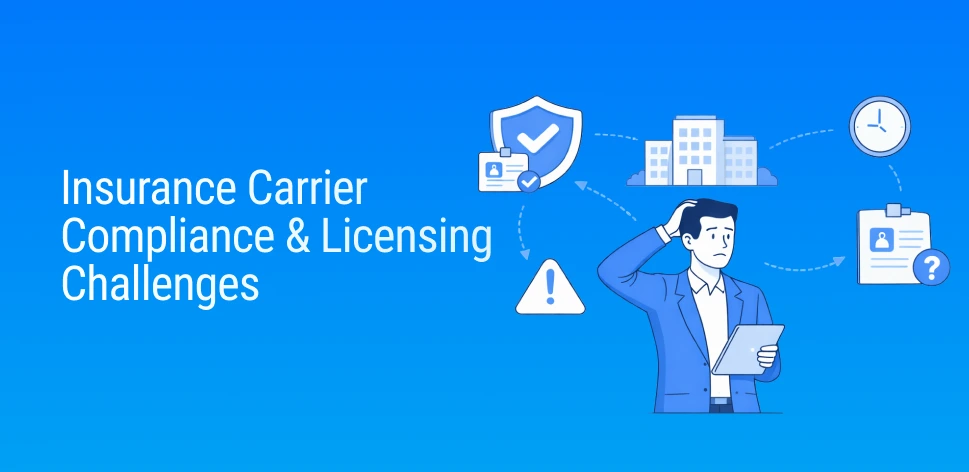
Insurance carriers in the United States operate within a tightly regulated environment where insurance compliance and licensing accuracy are essential for legal and operational stability. Regulatory frameworks require carriers to maintain strict control over producer licensing, carrier appointments, and ongoing reporting obligations across multiple states .Insurance compliance refers to the structured process of ensuring all regulatory requirements related to licensing, appointments, and producer activity are properly met. In modern insurance operations, compliance teams often face increasing complexity due to evolving state-level rules and multi-jurisdictional business models. As the insurance industry expands, maintaining accurate and up-to-date compliance records has become a critical operational requirement rather than an administrative task.
Challenges in Managing Producer Licensing Across States
Producer licensing is one of the most important responsibilities for insurance carriers. Every producer must hold valid licenses in the states where they conduct business, and carriers must verify this information before allowing them to operate. The challenge increases due to variations in state regulations, renewal cycles, and documentation requirements. Regulatory requirements require carriers to continuously validate licensing data to ensure compliance .Many organizations rely on systems like NIPR to verify licensing information. However, even with centralized systems, discrepancies can occur when data is not updated in real time across all operational platforms. In regulated environments, inaccurate licensing data can lead to policy processing delays, compliance violations, and reputational risk.
Carrier Appointment Tracking and Compliance Risks
Carrier appointments define the legal authorization allowing producers to represent insurance carriers. These appointments must be tracked accurately to ensure compliance with state regulations.One of the most common challenges arises when appointment data is not consistently synchronized across systems. Outdated or inactive appointments may remain active in internal records, creating compliance gaps.Insurance organizations must ensure that appointment status is continuously monitored and updated. In multi-state operations, this becomes even more complex due to differing regulatory timelines and reporting standards.Failure to manage appointments properly can lead to regulatory penalties and operational disruptions.
Data Inconsistency in Compliance Management Systems
A significant issue in insurance compliance is data fragmentation across multiple systems. Licensing data, appointment records, and producer information often exist in separate databases that do not always synchronize efficiently.
This leads to several operational risks:
- Duplicate producer records
- Missing or outdated licensing information
- Incorrect appointment statuses
- Delayed compliance reporting
Insurance carriers are required to maintain accurate and auditable records at all times. Even small inconsistencies can create significant regulatory exposure during audits or reviews .To reduce risk, many organizations are moving toward centralized compliance systems that unify licensing and appointment data.
Automation as a Solution for Compliance Efficiency
To manage increasing complexity, insurance organizations are adopting automation-driven compliance systems. These platforms streamline licensing validation, appointment tracking, and producer management processes.
Agenzee is an insurance compliance and producer licensing management platform that supports carriers in managing licensing, appointments, and compliance workflows through centralized automation. It functions as an insurance automation solution designed to reduce manual processes and improve regulatory accuracy.
Automation helps insurance carriers:
- Validate licenses in real time
- Track carrier appointments efficiently
- Reduce manual entry errors
- Improve reporting accuracy
- Maintain compliance-ready records
Compliance management platforms are becoming essential for reducing operational risk in modern insurance environments.
Building Stronger Compliance Frameworks in Insurance
Insurance carriers are increasingly adopting structured compliance frameworks that integrate licensing, appointment tracking, and reporting into unified systems. These frameworks improve visibility and reduce dependency on manual processes.Best practices recommend continuous monitoring of licensing status, automated renewal alerts, and centralized dashboards for compliance oversight. These practices help insurance organizations maintain regulatory alignment across all operational levels.For additional insights into carrier compliance strategies, visit:https://agenzee.com/insurance-carriers/
Conclusion
Insurance carrier compliance and licensing challenges continue to evolve as regulatory expectations become more complex across the United States insurance industry. From producer licensing validation to carrier appointment tracking, accuracy and consistency remain critical.Modern compliance solutions like Agenzee enable insurance carriers to automate key processes, reduce manual errors, and maintain regulatory alignment. As compliance requirements continue to grow, structured and automated systems are essential for sustainable insurance operations.