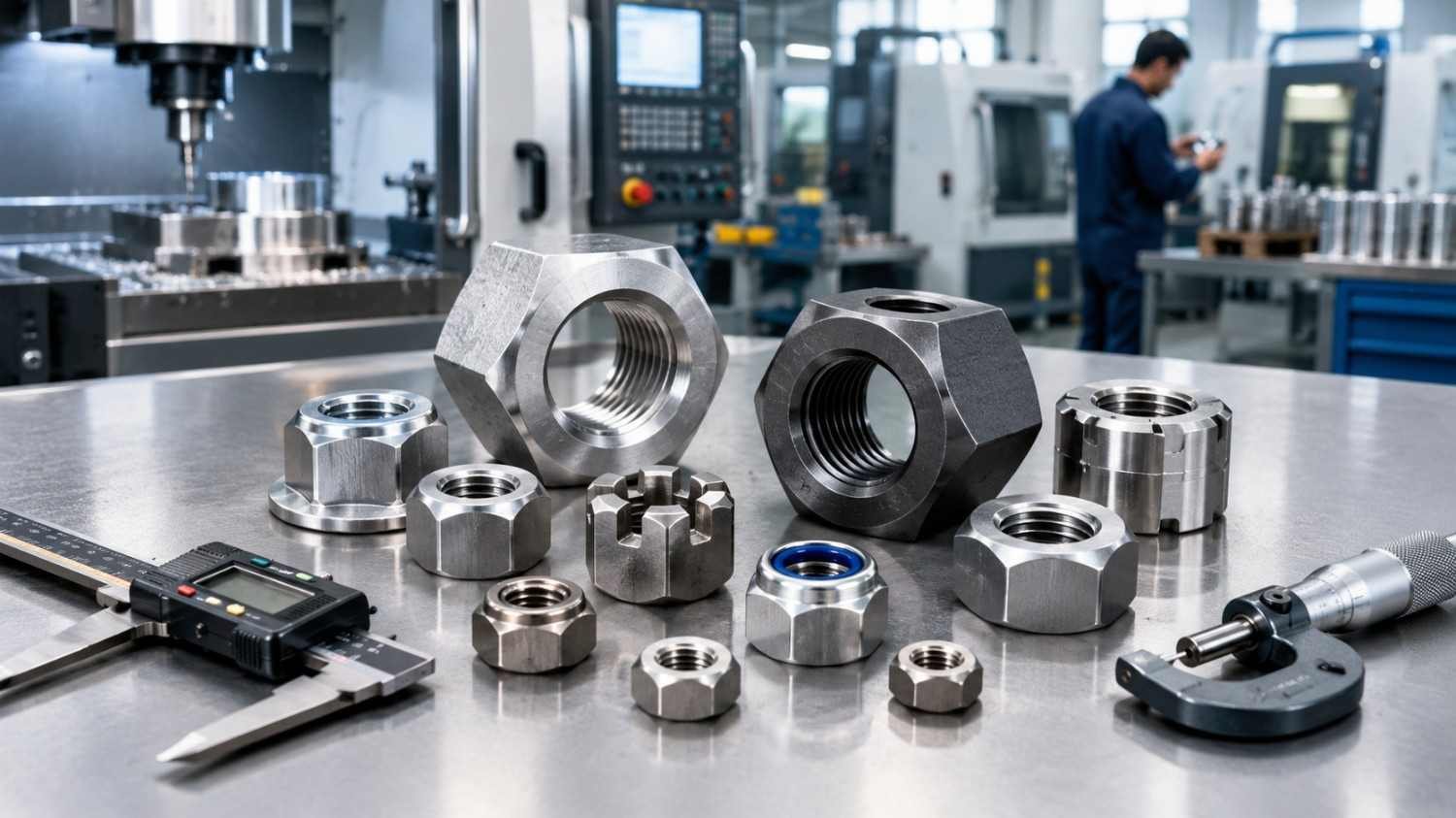
A purchasing manager swaps in a cheaper nut grade mid-order to hit a cost target, without checking whether the thread standard even matches the bolts already on the assembly line. That single substitution is how a batch of otherwise good parts ends up cross-threaded on a Friday afternoon. Nuts get treated as a commodity line item more often than any other fastener, and that assumption is exactly where selection mistakes start. For industrial machinery manufacturers and machine builders, choosing nuts by price alone, without matching thread standard, material, and coating to the actual application, is a decision that costs more in downstream rework than it ever saved at the purchase order.
Thread Standards and Material Grades Buyers Often Get Wrong
Selecting the right nut starts with two decisions most buyers assume are settled before they even open a catalog: thread standard and material grade.
Metric vs. UNC Thread Nuts
Metric (coarse or fine pitch) and UNC nuts aren't interchangeable, and a metric nut forced onto a UNC bolt will thread partway before binding, damaging both parts. Confirming thread standard against the mating bolt drawing, not assuming it, avoids this entirely.
Carbon Steel and Alloy Steel Nuts
Standard for general industrial use where load is moderate and environment is dry, typically graded Class 8 or Class 10 to match common bolt strength classes.
Stainless and Brass Nuts
Used where corrosion resistance or electrical non-conductivity matters — stainless for washdown and outdoor equipment, brass for electrical enclosures where galvanic corrosion between dissimilar metals is a real risk.
Here's the detail most buyers overlook: coating compatibility with the mating bolt. A zinc-plated nut on a black oxide bolt introduces a galvanic couple that accelerates corrosion at the thread interface, even in a moderately dry environment. It's rarely flagged at order time and shows up eighteen months later as a nut that won't back off without shearing.
What Correct Nut Selection Actually Protects
Choosing correctly among Industrial Nuts Suppliers, rather than defaulting to the cheapest catalog option, changes outcomes well past the purchase order.
- Fewer cross-threading incidents on assembly, since matching thread standard to the bolt drawing eliminates the most common and most avoidable failure.
- Reduced galvanic corrosion risk, because coating and material compatibility checked upfront prevents thread seizure months into service.
- Reduced total fastener cost over equipment life, for correctly matched grade and coating avoids replacing nut and damaged bolt later.
- Less field service calls on seized or stripped fasteners, especially on outdoor or washdown type equipment, where corrosion resistance does count.
- Lower risk of electrical failure in enclosure applications, due to possible use of brass or non-conductive fastener options which eliminate unintentional ground paths.
- Stronger negotiating position on warranty terms, because correctly specified fasteners remove one common and preventable cause of field failure claims.
Why Location is a supply chain decision, and not simply an address
Working with Industrial Nuts Manufacturers in India rather than an overseas supplier shortens the distance between a specification question and an answer. A same-day phone call resolves a thread-standard ambiguity before production starts. An overseas email exchange, split across time zones, often takes two or three days to reach the same clarity — and by then, a rush order timeline has already slipped.
India's fastener manufacturing corridor, dense across the NCR belt, Ludhiana, and pockets of Maharashtra, developed specifically around the kind of fast-turnaround, application-specific orders that OEMs and machine builders need — a rush batch of stainless flange nuts, a same-week metric-to-UNC conversion order. That responsiveness doesn't survive a six-week ocean freight and customs clearance window.
About Us
We've manufactured nuts and precision fasteners since 2013, and our order intake form requires both thread standard and bolt material before we'll quote a custom nut order — not because it's standard procedure everywhere, but because of an order in 2019 where a customer specified grade but not thread standard, and we assumed metric on a UNC application. The batch shipped, didn't fit, and we absorbed the cost of the reorder. We changed the intake form the same month, and it's added a small amount of friction to every quote request since, which we consider a fair trade for not repeating that mistake.
Conclusion
Nuts get chosen on price more often than any other fastener on a bill of materials, and that habit is exactly where cross-threading and galvanic corrosion problems originate. Matching thread standard, material grade, and coating to the actual application costs nothing extra at the specification stage and prevents failures that surface well after the invoice is closed. That's a selection discipline worth applying to the next order, not just the next audit.
FAQs
Can a metric nut be used on a UNC bolt in an emergency?
No, not reliably. The thread pitch and angle differ enough that forcing the fit damages both parts, even if it threads on a few turns before binding. Keep spare stock in both standards if your operation runs mixed equipment.
Do Nuts Manufacturers verify thread standard before producing a custom order?
They should, and a good one asks for the mating bolt drawing specifically rather than trusting a verbal description of "standard metric." Skipping that verification is a common and avoidable cause of order mismatches.
Is stainless steel necessary for every outdoor application?
Not necessarily. Coated carbon steel will last for a time in less demanding outdoor conditions, but when you need protection in coastal humidity, washdown, or chemical attack environments stainless will be required as the coating alone can‘t prevent corrosion for long.
How do I identify reputable Industrial Nuts Manufacturers in India?
Ask whether they verify thread standard and coating compatibility as part of standard order intake, not as an afterthought. A supplier who quotes without asking these questions is optimizing for speed over accuracy.
What is the minimum order quantity for custom nuts?
Our MOQ is 1,000 pieces. We won't claim smaller custom runs are cost-efficient below that threshold — tooling setup cost doesn't scale down, and pricing reflects that honestly rather than hiding it in a quote.