The construction industry is increasingly evaluating building materials based on installation efficiency, functional performance, design flexibility, and suitability for different project environments. Within this landscape, gypsum-based systems have become relevant across interior construction, partitioning, ceilings, and wall applications. Their role is shaped by changing construction practices and the growing need for materials that can support practical and adaptable building designs.
The India Gypsum and Drywall Market covers gypsum boards and related drywall solutions used across residential, commercial, industrial, and institutional settings. The market includes product categories such as standard, fire-resistant, and mould or moisture-resistant boards, while applications vary according to project requirements. Further segmentation by thickness provides a more detailed view of how gypsum board applications in India are positioned across construction environments.
Demand for drywall systems is influenced by the changing requirements of modern construction projects. Developers, contractors, architects, and interior professionals may consider factors such as installation methods, surface finishing, space utilization, durability, fire performance, and resistance to moisture when selecting interior building materials. These considerations create different requirements across residential, commercial, industrial, and institutional projects rather than establishing a single product preference.
Construction Applications Shape Product Demand
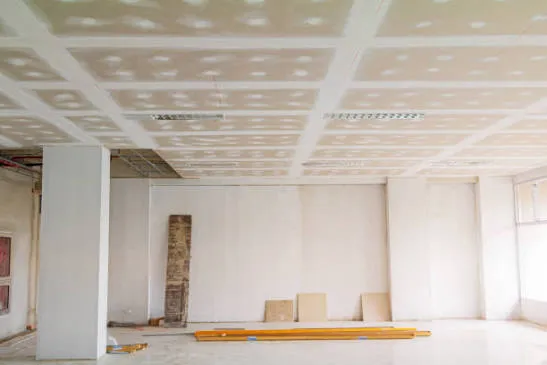
Residential construction represents an important application area for gypsum-based interior systems because walls, partitions, ceilings, and decorative surfaces often require materials that can be installed and finished efficiently. In commercial spaces, drywall solutions can support changing layouts and interior configurations. Industrial and institutional projects, meanwhile, may place greater emphasis on functional characteristics, project-specific specifications, and compliance with applicable construction requirements.
Product selection also varies according to environmental conditions. Standard boards can address conventional interior applications, while fire-resistant products may be considered where enhanced fire performance is required. Mould and moisture-resistant variants can be relevant in locations exposed to humidity or moisture. This product differentiation allows manufacturers and construction stakeholders to match board characteristics with the functional requirements of individual projects.
Performance Requirements Influence Material Selection
Performance is becoming an important consideration when evaluating gypsum-based construction products. Beyond basic installation, project stakeholders can assess properties related to strength, surface quality, fire resistance, moisture exposure, durability, and compatibility with finishing systems. These factors can influence material selection depending on building design, occupancy, environmental conditions, and applicable specifications.
The Bureau of Indian Standards provides specifications covering several gypsum-based products, including plain gypsum plaster boards, coated or laminated boards, reinforced gypsum plaster boards, and ceiling tiles. The standards framework demonstrates the importance of defined product requirements and testing considerations within the construction-material ecosystem. BIS documentation on gypsum-based building materials also outlines applicable standards and certification provisions.
Thickness and Design Requirements Create Variation
Thickness is another factor that differentiates drywall products and their potential applications. Different construction systems can require boards with varying thicknesses depending on design specifications, partition requirements, acoustic considerations, or other performance objectives. The availability of multiple thickness categories allows project teams to evaluate materials according to structural and functional needs rather than relying on a uniform product configuration.
Design flexibility can also support the use of gypsum systems in interior spaces where layouts may need to accommodate changing functional requirements. Drywall construction can be incorporated into partitioning and ceiling systems, allowing interior configurations to be developed around the requirements of residential and non-residential spaces. The resulting demand is therefore closely connected with construction design practices as well as broader material-selection considerations.
Regional and Industry Dynamics Remain Important
Market development can vary across different parts of India because construction activity, building types, supply conditions, and project requirements differ by region. Regional analysis of northern, southern, eastern, and western markets can therefore provide a more detailed understanding of demand patterns. Differences in construction activity and end-use requirements may influence the product mix and competitive environment in each area.
Supply-side conditions are also relevant to the development of the sector. Manufacturers and distributors need to consider product availability, raw-material requirements, logistics, technical specifications, and compliance expectations. As construction projects become more specification-driven, the ability to provide products that correspond with defined performance requirements can become an important factor in material selection.
What Could Shape Future Market Development?
Future development of gypsum-based interior construction solutions is likely to remain connected with construction activity, evolving building designs, product innovation, and performance requirements. Greater attention to fire safety, moisture management, installation efficiency, and material specifications can influence how different product categories are evaluated. However, demand conditions can differ substantially across applications and regions, making a segment-level perspective important for understanding market development.
The broader direction of the sector reflects a shift toward construction materials that combine functional performance with practical installation and design adaptability. Standard, fire-resistant, and moisture-resistant solutions each address distinct requirements, while thickness and application segmentation further shape product positioning. Consequently, the market's development is best understood through the interaction of construction demand, product characteristics, regulatory requirements, and regional conditions rather than through a single growth factor.