Human Dermal Fibroblasts: The Foundation of Skin Biology and Regenerative Research
By Kosheeka Primary Cells for Research 12-06-2026 158
Introduction
Maintainig healthy skin with surface-level care may not be sufficient. However, much of what keeps skin firm, resilient, and capable of healing happens beneath the surface. One of the key players behind these processes is the Human Dermal Fibroblast.
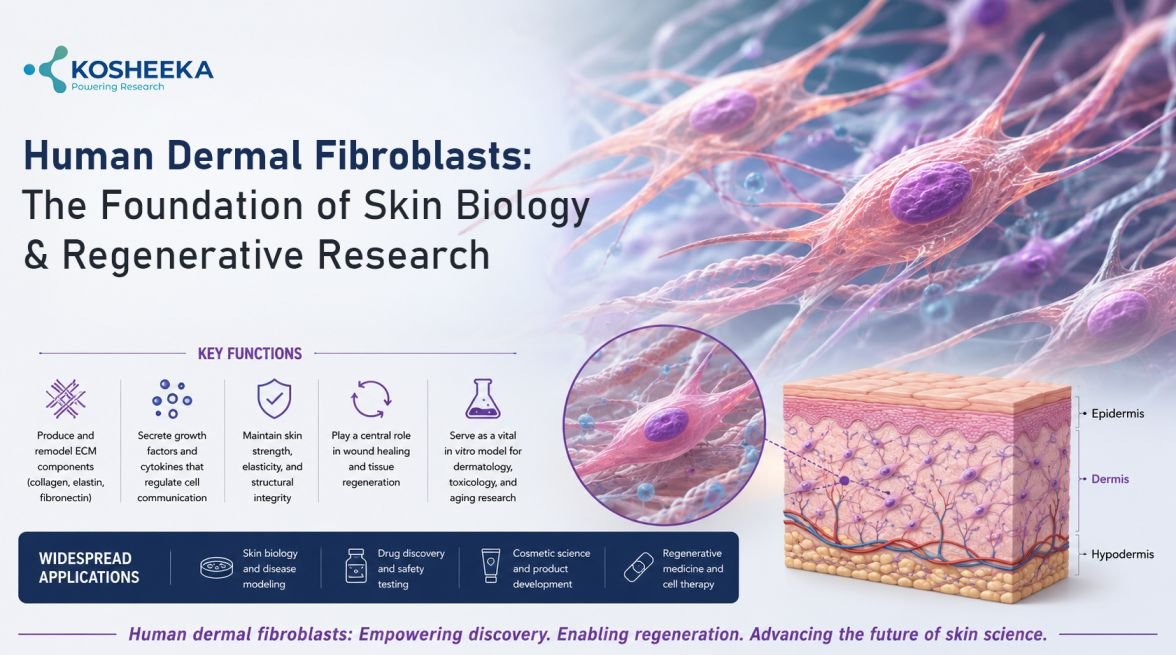
The cells have a primary function in forming the structural components of the cells. Fibroblasts regulate collagen and elastin production, proteins that maintain the structural components of the skin and elasticity. Various research application includes wound healing, tissue repair, and cellular communication. Because of these functions, human dermal fibroblasts have become a cornerstone of research in skin biology, regenerative medicine, and tissue engineering.
What Are Human Dermal Fibroblasts?
Human dermal fibroblasts are specialized cell types found on the skin dermal layer. They are found under the epidermal layer. These cells are the skin’s natural builders and maintenance crew. Their primary job is to produce and organize the proteins and molecules that form the skin’s support structure.
Collagen maintains skin firmness. Elastin allows stretchability in cells and enable them to get back to the original shape. These proteins are responsible for healthy, youthful-looking skin. Beyond providing structural support, fibroblasts also help the skin respond to injury and adapt to changes in its environment. This makes them essential for both everyday skin maintenance and recovery after damage.
Why Are Fibroblasts So Important for Skin Health?
The role of fibroblasts extends far beyond simply producing collagen.

Supporting the Skin’s Structure
Every day, our skin faces exposure to sunlight, pollution, environmental stress, and the natural aging process. Fibroblasts work continuously to maintain and repair the extracellular matrix—the network of proteins that gives skin its structure.
With increased age, fibroblast activity slows down naturally. Reduced collagen production, skin thinning, and the appearance of fine lines or wrinkles appears with aging. Fibroblasts offers studies focused on skin aging and rejuvenation.
Supports Wounds Healing
Fibroblasts are among the first responders to skin injury. After a cut, burn, or other form of damage, these cells migrate to the affected area and begin producing new tissue components needed for repair. Fibroblasts aid in rebuilding the damaged area, support new tissue formation, and regulate collagen remodeling.
Communicating with Other Skin Cells
Healthy skin relies on teamwork. Fibroblasts constantly communicate with neighboring cells, including keratinocytes, immune cells, and blood vessel cells.
Fibroblasts release various growth factors, cytokines, and signaling molecules. They are responsible for regulating inflammation, coordinating tissue repair, and maintaining overall skin balance. This communication network is one reason why fibroblasts are such an important focus in skin and regenerative research.
Understanding Human Dermal Fibroblast Cell Lines
To better understand how skin functions, researchers often study fibroblasts in laboratory settings. This is where a Human Dermal Fibroblast Cell Line becomes valuable.
Scientists typically work with either primary fibroblasts obtained directly from human skin tissue or established fibroblast cell lines that can be maintained for longer periods in the laboratory.
Primary cells closely resemble what happens naturally in the body, making them highly useful for biological studies. However, they have a limited lifespan and can vary between donors.
Human Fibroblast Cell Line is a transformed cell line that has longer senescence. The use of a cell line in vitro offers consistency and can be grown over many generations. This makes cell lines especially useful for long-term experiments, drug testing, and large-scale research projects where reproducibility is important.
Human Dermal Fibroblast Culture Protocol
Fibroblast culture protocol requires maintenance of aseptic conditions and keeping a controlled laboratory environment. A well-designed Human Dermal Fibroblast Culture Protocol helps ensure reliable results and healthy cell growth.
Fibroblasts are typically cultured in nutrient-rich growth media and maintained under controlled temperature and carbon dioxide conditions that mimic the environment inside the human body.
Researchers routinely monitor the cells to make sure they are growing normally and remain free from contamination. Even small changes in culture conditions can influence cell behavior, which is why standardized protocols are so important. Good laboratory practices include:
- Maintain aseptic condition
- Regular cell monitoring to ensure adequate cell morphology
- Maintain cell confluency on the culture plate (subculture with 85% confluency)
- Cell used in the appropriate passage numbers
These conditions are crucial to gain accurate and reproducible results.
Role of Fibroblasts in Regenerative Medicine
The growing interest in regenerative medicine have led to use of fibroblast cells in skin biology. Researchers use these cells in bioengineered skin substitutes, tissue repair strategies, and advanced wound-healing approaches.
Fibroblasts are incorporated into three-dimensional skin models that closely resemble human physiology. The models are widely used for skin-associated disease modeling, therapeutic development, regenerative medicine, development of personalized or targeted therapy, etc. and decrease dependency on animal models.
Conclusion
Human dermal fibroblasts support structural components. They help maintain skin strength, support wound healing, coordinate cellular communication, and enable tissue regeneration. Depending on the experimental design and requirement, researchers choose a human dermal fibroblast cell line or human dermal fibroblast culture protocol; these cells remain essential for understanding how skin functions and heals. With the emergence of regenerative medicine, fibroblast cells remain the center of research in skin biology.