How to Vet an Online Boutique Before You Buy: A Shopper's Checklist
By Muhammad Muizz 28-08-2026 141
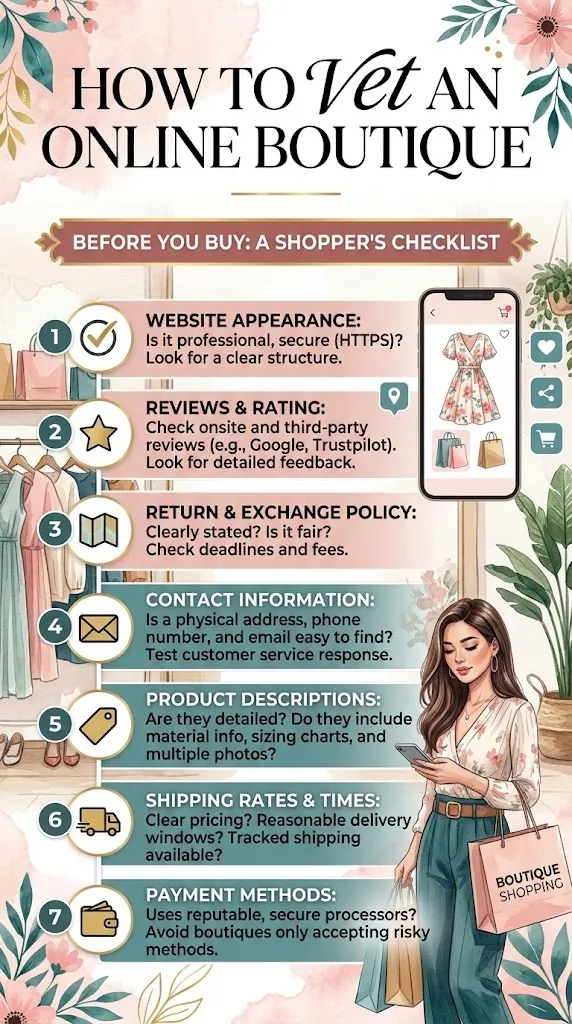
I've ordered from more online boutiques than I'd like to admit — somewhere north of forty over the last three years, if I'm being honest about counting. Some became repeat-order favorites. A handful turned into cautionary tales I still think about when I'm scrolling Instagram ads at midnight. Somewhere in between all those orders, I built an actual checklist without meaning to. It just accumulated, one bad return policy and one surprisingly great customer service email at a time.
The dress that taught me the most was a "linen-blend" wrap style from a boutique I'd found through a targeted ad. The photos looked expensive — structured, opaque, the kind of thing you'd wear to a summer wedding. What arrived three weeks later (past their own stated shipping window) was thin, see-through polyester that wrinkled the second I took it out of the bag. By the time I'd figured out it wasn't wearable without a slip underneath, the 10-day return window had already closed. That single order is basically the reason this checklist exists.
Start With the Return Policy, Not the Product Photos
Every boutique's product photos are going to look good — that's the entire point of a product photo. The return policy is where you find out if the business actually stands behind what they're selling. I look for three things now before I even add something to my cart: how many days you get to return something, whether you get a refund or only store credit, and whether you pay for return shipping or they do.
A 10-day window is a red flag on its own. Most boutiques that actually stand behind their sizing give you at least 14, and the better ones give 30. If a site is vague about this — "contact us for return details" instead of a clear policy page — that vagueness is doing a lot of quiet work to discourage returns.
Check Reviews Somewhere the Boutique Doesn't Control
This one took me embarrassingly long to figure out. On-site reviews are curated. I'm not saying every five-star review on a boutique's own product page is fake, but the boutique absolutely has the ability to just not publish the bad ones. I've started checking Trustpilot, the boutique's own social comments (not the caption — the actual comment section), and honestly, sites like this one, where people post because something specifically went wrong and they wanted somewhere honest to say so.
Here's my actual contrarian take: I trust a boutique more when I see a few three-star reviews mixed into the good ones. A boutique sitting at a suspiciously perfect 5.0 with zero complaints isn't reassuring anymore — it's the biggest red flag I look for. Real businesses that ship thousands of orders get sizing wrong sometimes, get a shipment delayed sometimes, disappoint somebody sometimes. A flawless record usually means the bad reviews aren't showing up, not that they don't exist.
Read the Sizing Information Like It's Going to Be Wrong
It probably will be, at least a little. Boutiques frequently source from multiple manufacturers, which means a medium in one drop isn't necessarily a medium in the next. I've stopped trusting the little "S/M/L" size chart graphic entirely and instead look for actual measurements in inches — bust, waist, hip, garment length. If a listing doesn't have those numbers, I check the reviews specifically for sizing comments before I order, or I just skip it.
The boutiques that do this well often note it themselves — something like "runs small, size up" directly on the product page. That kind of honesty, even when it's mildly inconvenient for them as a seller, tells you something real about how the business operates.
Look at How They Handle a Real Question
Before I order from a new boutique for the first time, I send them one actual question — sizing, fabric content, shipping timeline, doesn't matter which. What matters is the response. A same-day or next-day reply from a real person who answers the actual question is a strong signal. A canned response, or worse, no response at all within a few days, tells you how it'll go if something arrives wrong and you need help.
I did this with maybe a dozen boutiques before I started actually ordering regularly, and it filtered out two that I'm genuinely glad I skipped, based on what I later read in their reviews.
Watch for the Small Inconsistencies
The see-through dress boutique, in hindsight, had warning signs I ignored because the ad was well-produced. The site had no physical business address anywhere, not even in the fine print. The "About" page was two sentences of vague brand language with no actual name attached to it. The only payment option was a single processor with no buyer protection built in. None of those things alone would've stopped me. All of them together should have.
Now I check for at least a named founder or team, a real (even if small) About page, and more than one payment option. It takes maybe ninety seconds and it's saved me from repeating that particular mistake.
Frequently Asked Questions
Is it safe to buy from a small boutique I've never heard of?
Usually, yes — plenty of great boutiques start small and stay small on purpose. The checklist above matters more than brand recognition. A tiny boutique with a clear return policy and responsive customer service is a safer bet than a heavily-advertised one with vague policies.
What's the single biggest red flag?
A return policy that's either missing or deliberately vague. Everything else on this list is worth checking, but a business that won't tell you plainly how returns work is usually a business that doesn't want you to return anything.
Should I trust a boutique with only five-star reviews?
Be a little more cautious, not less. A completely spotless rating, especially with a high review count, is more often a sign that negative reviews aren't being shown than a sign of a flawless business.
How long should I wait for a response before ordering?
A day or two is reasonable. If a boutique takes over a week to answer a simple pre-purchase question, that's roughly how long you can expect to wait if something goes wrong with your actual order.
Bottom Line
None of this takes more than a few extra minutes, and it's saved me more disappointment than I can count. I still order from new boutiques regularly — the checklist isn't about being suspicious of everyone, it's about knowing what to check before you hand over your card details. If you'd rather skip the vetting process entirely, I've already done this legwork and put together a list of vetted online boutiques — every one of them earned its spot the hard way.