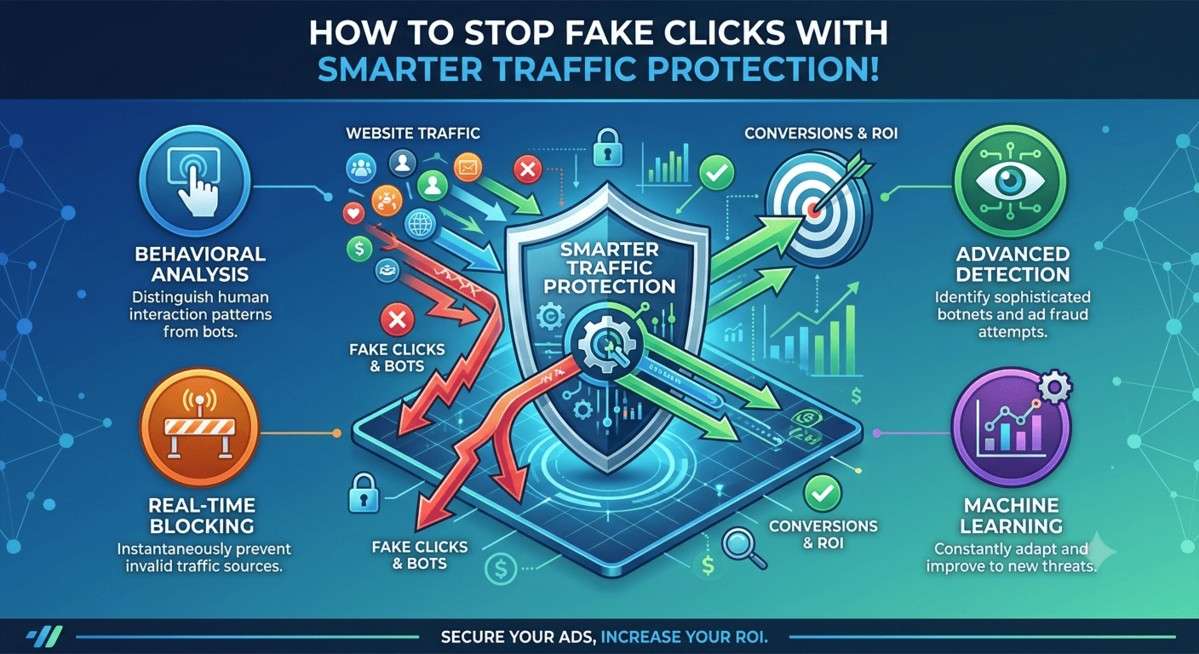
Fake clicks can quickly waste an advertising budget, but the best way to stop them is to identify suspicious traffic signals before they consume more ad spend. Advertisers can use traffic filtering, bot detection, IP and VPN analysis, device fingerprinting, behavioural signals, and real-time monitoring to separate legitimate visitors from automated or low-quality traffic. If you're researching ads cloaking Facebook or a cloaking service, it's important to distinguish legitimate traffic protection from deceptive cloaking: protection should improve traffic quality without showing different content to ad reviewers and real users.
What Are Fake Clicks?
Fake clicks are ad interactions that don't represent genuine customer interest. They can come from automated bots, click farms, malicious scripts, accidental interactions, or repeated activity from suspicious sources.
Common warning signs include:
- Multiple clicks from the same IP or device
- Extremely short sessions
- Unusual click frequency
- Identical behavioural patterns across visitors
- Datacenter or proxy traffic
- Headless browser activity
- Sudden traffic spikes from unexpected locations
- High clicks with very few meaningful conversions
One suspicious click does not necessarily mean invalid activity. Patterns and multiple signals together provide a much stronger basis for identifying problematic traffic.
How to Stop Fake Clicks
A practical protection strategy combines several layers instead of relying on one filter.
1. Monitor Traffic Quality
Start by reviewing:
- Click-through rate
- Conversion rate
- Bounce or engagement patterns
- Geographic distribution
- Device and browser information
- Referral sources
- Time between clicks
- IP reputation
Look for anomalies rather than automatically blocking everyone who matches one characteristic.
2. Detect Bots and Automated Browsers
Modern bot detection can analyse signals associated with automated environments, including unusual browser characteristics, request patterns, JavaScript behaviour, and headless-browser indicators.
This is particularly useful when legitimate users and automated visitors appear similar at first glance.
3. Analyse VPN, Proxy and Datacentre Traffic
VPN and proxy traffic isn't automatically malicious. People use these services for legitimate privacy and security reasons.
Instead of blocking every VPN visitor, use IP reputation, ASN information, geography, behavior, and other signals together to determine whether traffic deserves additional scrutiny.
4. Use Device Fingerprinting Carefully
Device fingerprinting can help identify repeated activity when IP addresses change.
Useful signals may include:
- Browser characteristics
- Operating-system information
- Screen properties
- Time zone
- Language settings
- Device attributes
Because fingerprinting involves privacy considerations, businesses should use it transparently and in accordance with applicable privacy laws and platform requirements.
5. Apply Real-Time Traffic Filtering
Real-time filtering can evaluate visitors as they arrive rather than waiting until the campaign has already accumulated suspicious traffic.
For example:
Visitor → Traffic analysis → Risk assessment → Appropriate destination/action
A low-risk visitor can continue normally, while clearly automated or abusive traffic can be restricted according to your legitimate security rules.
Ads Cloaking Facebook: What Advertisers Should Know
People searching for ads cloaking Facebook may be looking for ways to protect campaigns from unwanted traffic. However, there is an important distinction between traffic protection and deceptive ad cloaking.
A legitimate system should not manipulate an advertising platform's review process by presenting compliant content to reviewers while intentionally showing prohibited or materially different content to users.
Instead, advertisers can use compliant traffic-management techniques such as:
- Bot detection
- Rate limiting
- Traffic-quality scoring
- Security filtering
- Geographic controls where appropriate
- Analytics and anomaly detection
- Landing-page security
- Conversion-quality monitoring
This approach protects advertising infrastructure without attempting to bypass platform enforcement.
Choosing a Cloaking Service for Traffic Protection
If you're evaluating a cloaking service, don't judge it only by how aggressively it can filter visitors.
Look for capabilities such as:
Traffic Intelligence
The platform should provide useful information about visitor sources, devices, locations, and behavioural patterns.
Bot Detection
Look for multiple detection signals rather than a simple IP blacklist.
Real-Time Filtering
Traffic decisions should happen quickly enough to protect landing pages and campaign performance.
Analytics
A useful dashboard should help you understand why traffic is being classified as suspicious.
Rule Management
Rules should be configurable and understandable rather than relying entirely on a black-box system.
Privacy and Compliance Controls
The service should provide appropriate controls for handling visitor data and should support compliance with applicable privacy requirements.
Example: Identifying a Suspicious Click Pattern
Imagine a campaign receives:
- 1,000 clicks
- 850 clicks from a narrow set of IP ranges
- Repeated visits from similar device configurations
- Very short sessions
- Almost no conversions
- Traffic concentrated within a few minutes
None of these signals alone proves malicious activity. Together, however, they justify further investigation.
A traffic-protection system could assign a higher risk score to these sessions and apply an appropriate security or filtering rule.
A Smarter Fake-Click Protection Strategy
For stronger campaign protection, use this workflow:
1. Collect traffic data
2. Identify suspicious patterns.
3. Combine IP, device, browser, geography and behaviour signals.
4. Assign a traffic-risk score.
5. Apply proportionate filtering
6. Monitor conversions and false positives.
7. Continuously improve the rules
This creates a more sustainable traffic-quality strategy than simply blocking large categories of visitors.
Frequently Asked Question
How can I stop fake clicks on my ads?
Use traffic-quality monitoring, bot detection, IP reputation analysis, behavioural signals, and real-time filtering. Monitor patterns rather than blocking visitors based on a single attribute.
Can VPN detection stop fake clicks?
VPN detection can provide a useful signal, but VPN users aren't necessarily fraudulent or malicious. Combine VPN information with other traffic signals before taking action.
Is Facebook ads cloaking the same as traffic protection?
No. Traffic protection focuses on identifying and managing suspicious or automated traffic. Deceptive cloaking attempts to show materially different content to reviewers and users, which can violate advertising-platform policies.
Should I block every suspicious visitor?
No. A risk score or multi-signal approach is generally safer than a single-rule blocking strategy because aggressive filters can also block legitimate customers.
What is the best way to reduce wasted ad spend?
Start by measuring traffic quality, identify recurring suspicious patterns, improve bot detection, monitor conversions, and regularly review filtering rules for false positives.
Final Takeaway
The most effective way to stop fake clicks is not simply to block more visitors. It is to build a layered traffic-protection system that combines bot detection, behavioral analysis, IP reputation, device signals, VPN/proxy intelligence, real-time filtering, and conversion monitoring. If you're considering an ads cloaking Facebook solution or a cloaking service, prioritise platforms that provide legitimate traffic quality and security controls rather than tools designed to bypass advertising-platform review systems. This approach can protect ad spend while maintaining a better experience for genuine users.
Tags : bot detection traffic filtering