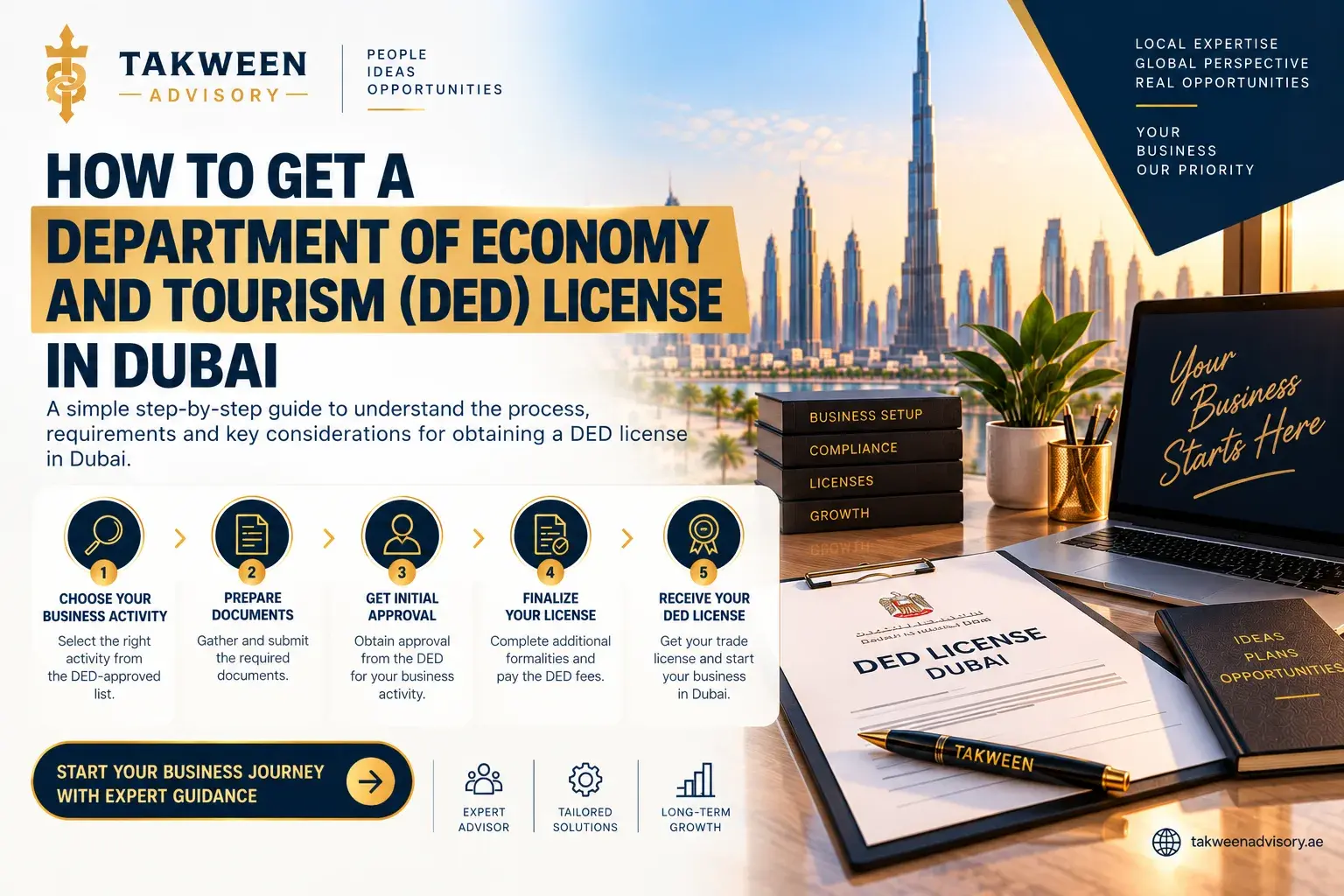
Starting a business in Dubai requires the correct trade licence for your planned activities. Whether you want to open a consultancy, launch an e-commerce business, establish a trading company, or provide professional services, obtaining the appropriate licence is one of the most important steps in company formation.
A DED licence is the commonly used term for a Dubai mainland trade licence issued through the Department of Economy and Tourism (DET), formerly known as the Department of Economic Development (DED). The licence authorises a business to conduct the activities specified in its approval, subject to any additional regulatory requirements.
For entrepreneurs planning to establish a company in Dubai, understanding the application process, documentation, legal structures, and associated costs can help avoid unnecessary delays. This guide explains how to obtain a DED licence in 2026 and what to consider before submitting your application.
What Is a DED Licence in Dubai?
A DED licence is a business licence associated with companies operating under Dubai's mainland licensing framework. The relevant authority is the Dubai Department of Economy and Tourism, which oversees economic licensing and related business services.
The licence specifies the activities a company is authorised to carry out. Depending on your business model, you may require a commercial, professional, industrial, or another applicable licence category.
For example, a company involved in general trading will have different licensing requirements from a management consultancy or a manufacturer. Certain activities may also require approvals from additional government departments before the business can operate.
A DED licence is often considered by entrepreneurs who want to serve customers across the UAE mainland market. However, the appropriate licence depends on the exact activity, legal structure, and applicable regulations.
What Are the Different Types of DED Licences?
Before applying, identify the licence category that matches your intended business activities.
1. Commercial Licence
A commercial licence is generally suitable for businesses involved in buying, selling, importing, exporting, or distributing goods, depending on the approved activities.
For example, an electronics trading company, clothing distributor, or business selling eligible consumer products may need a commercial licence.
The permitted trading activities should be selected carefully. Some product categories require additional registrations, permits, or regulatory approvals.
2. Professional Licence
A professional licence may be suitable for businesses providing services based on professional expertise, knowledge, or specialised skills.
Examples can include management consultancy, certain information technology services, and other eligible professional activities.
The requirements depend on the precise service. Some professions require professional qualifications, additional approvals, or specific legal structures.
3. Industrial Licence
An industrial licence is generally relevant to businesses involved in manufacturing, processing, or other approved industrial activities.
These businesses may need suitable industrial premises, environmental or technical approvals, and compliance with other requirements related to their operations.
Entrepreneurs planning to manufacture products should confirm the applicable permissions before leasing premises or purchasing equipment.
4. Other Specialised Licence Categories
Some businesses fall under specialised licensing arrangements or require approvals from sector-specific authorities. Examples may include certain healthcare, education, tourism, transport, or regulated financial activities.
The correct licence category should always be confirmed against the proposed business activity rather than selected based solely on its name.
Requirements for Getting a DED Licence in Dubai
The documents and approvals required depend on your legal structure, business activities, and ownership arrangements. However, most applications involve several common requirements.
1. Select Your Business Activity
Start by clearly identifying the products or services your company will offer.
Dubai provides a wide range of economic activities, and the selected activity affects the licence category, legal form, and possible external approvals.
For example, a digital marketing consultancy and an online shop selling physical products may require different licensed activities. If you intend to offer multiple services, check whether they can be included under the same licence and whether additional fees apply.
Choosing the correct activities at the beginning can help prevent amendments later.
2. Choose the Legal Structure
The legal structure determines how the company is established and how ownership and management are arranged.
Depending on the business, available forms may include a limited liability company (LLC), a sole establishment, a civil company, or a branch of an existing company.
The suitable option depends on the number of owners, the nature of the activity, liability considerations, and the relevant licensing rules.
Many mainland activities permit 100% foreign ownership, although certain strategic or regulated activities may have additional conditions.
3. Reserve a Trade Name
Your business must have a trade name that complies with Dubai's naming rules.
The proposed name should be distinctive, appropriate for the business, and acceptable under the relevant guidelines. Certain words or naming formats may be restricted or require additional approval.
Prepare alternative names in case your first choice is unavailable. Also, remember that registering a trade name does not automatically provide trademark protection.
4. Obtain Initial Approval
Initial approval confirms that the relevant authority has reviewed the proposed business setup at the preliminary stage.
This generally allows you to proceed with the remaining formation requirements, such as preparing the necessary company documents and arranging suitable premises.
Initial approval does not automatically authorise you to begin conducting the licensed business activity. You must obtain the required final licence and any additional permissions before operating.
5. Prepare the Required Documents
Depending on the application, documents may include passport copies, shareholder details, identification information, initial approval, and company incorporation documents.
An LLC or another company structure may require a Memorandum of Association (MOA) or other formal legal documents. Corporate shareholders may need additional records, resolutions, or authenticated documents from their parent company.
Some activities require professional qualifications, specialist approvals, or further supporting information.
Confirm the exact checklist for your application before submission to avoid unnecessary corrections.
Step-by-Step Process to Get a DED Licence in Dubai
Step 1: Decide What Your Business Will Do
Prepare a clear description of your business activities, target customers, and planned operations.
This will help determine the appropriate licence category and identify any additional permissions required for the activity.
Step 2: Select the Legal Form and Trade Name
Choose a legal structure that fits your ownership and operating requirements. Then select a compliant trade name and check its availability through the official Invest in Dubai portal.
According to the portal's published service information, trade name issuance currently costs AED 620, although additional charges can apply in particular circumstances. Confirm the current fee at the time of application.
Step 3: Apply for Initial Approval
Submit the required preliminary application and supporting information through the appropriate official channel.
If your activity requires approval from another government department, confirm when that approval must be obtained. Some activities involve additional steps before the final licence can be issued.
Step 4: Complete the Legal Documentation
Prepare the MOA or other required company documents, where applicable. Ensure that shareholder details, ownership percentages, company information, and authorised signatories are correct.
If your application involves overseas corporate shareholders, check whether the relevant documents require authentication or legal translation.
Step 5: Arrange Business Premises
Depending on the licence and activity, you may need a suitable business address or physical premises.
For businesses requiring an office or commercial location in Dubai, a tenancy contract and applicable Ejari registration may be necessary. The requirements can differ depending on the activity and legal structure.
Confirm the premises requirements before signing a lease so that the location is appropriate for your intended business.
Step 6: Submit the Final Application and Pay the Fees
Once the relevant documents, premises requirements, and approvals have been completed, submit the final licence application through the official channel.
Review the payment voucher and fee breakdown carefully. The total depends on the licence type, activities, legal structure, and any additional services or approvals.
Step 7: Receive Your Trade Licence
After the relevant authority completes its checks and the application requirements are satisfied, the trade licence can be issued.
Keep the licence and company documents securely, as they may be required for corporate banking, tax registration, immigration procedures, and other business services.
Before commencing operations, confirm that all activity-specific approvals and other required formalities have also been completed.
How Much Does a DED Licence Cost in Dubai?
The cost of a DED licence is not the same for every company. It depends on the business activity, legal structure, trade name, documentation, premises, and additional approvals required.
Your budget may include trade name reservation, initial approval, licence issuance, company registration, legal documentation, office rent, Ejari, and professional service fees.
Some businesses also require external permits or specialised premises, which can increase the overall cost.
Dubai offers different licensing routes, including normal and instant licences for eligible activities. The official Invest in Dubai portal states that an instant licence can be issued within five minutes for specified activities that do not require external approvals. A normal licence follows the applicable documentation and approval process.
These published processing times relate to the relevant licensing service; they should not be treated as a guarantee that every business can complete its entire setup within that period.
For an accurate quotation, identify the activity, legal structure, and office requirements first. Then request a detailed fee breakdown that separates government charges from consultancy and other service fees.
What Is the Difference Between a DED Licence and a Free Zone Licence?
A DED licence is generally associated with Dubai mainland company formation, while a free zone licence is issued by the relevant free zone authority.
A mainland structure may be suitable for businesses that want to serve customers throughout the UAE domestic market, operate eligible local premises, or carry out activities where mainland licensing is the preferred route.
A free zone structure may suit certain international businesses, online service providers, trading companies, and businesses whose operations fit the rules of a particular zone.
However, the distinction is not simply about price. Free zone companies must also comply with the applicable rules governing mainland business activities. A free zone licence does not automatically authorise every type of direct mainland trading.
Compare both options based on your customers, business activities, workspace needs, visa requirements, and future plans before making a decision.
Common Mistakes to Avoid When Applying for a DED Licence
One common mistake is choosing an activity that does not match the services or goods the company intends to offer. This can result in application changes or additional approvals.
Another is submitting incomplete or inconsistent documents. Errors in shareholder details, company information, signatures, or legal documents can delay the application.
Some entrepreneurs also underestimate the cost of premises, visas, external approvals, and licence renewal. Looking only at the headline licence fee can create budget problems later.
Finally, do not assume that initial approval permits you to begin operating. Make sure the final licence and any required sector-specific permissions have been issued.
Preparing these details before applying can make the process more straightforward.
How Takween Advisory Can Help
Obtaining a DED licence involves selecting the correct activity, choosing an appropriate legal structure, preparing documents, and completing the required licensing formalities.
Takween Advisory supports entrepreneurs and investors exploring mainland and free zone company formation in Dubai and across the UAE. Its business setup services can help applicants understand available licensing options and identify requirements relevant to their proposed activities.
Before proceeding, confirm the licence requirements and government fees through the official licensing authority. Where an activity requires specialist approval or tax advice, consult the relevant qualified professional.
Frequently Asked Questions
1. Is DED the same as DET in Dubai?
DED is the commonly used former name, while DET stands for the Dubai Department of Economy and Tourism. Entrepreneurs still frequently use the term “DED licence” when referring to a Dubai mainland trade licence.
2. Can a foreigner obtain a DED licence in Dubai?
Yes. Foreign nationals can establish eligible mainland businesses in Dubai, and most activities permit 100% foreign ownership. Some strategic or regulated activities may have specific restrictions or additional requirements.
3. How long does it take to get a DED licence?
The timeline depends on the activity, legal structure, document readiness, premises, and external approvals. Some eligible activities can use the instant licensing route, while other applications require additional steps.
4. Do I need an office to obtain a DED licence?
Premises requirements depend on the licence type and business activity. Some eligible arrangements may provide flexibility, while other businesses need suitable physical premises and the relevant tenancy documentation.
5. Can I add more activities to my DED licence?
Additional activities may be permitted, depending on compatibility and the applicable licensing rules. You may need to amend the licence and pay additional fees or obtain further approvals.
6. Does a DED licence include a residence visa?
A trade licence and a residence visa are separate matters. Depending on the company structure and eligibility, the business may be able to apply for investor or employee visas through the relevant immigration process.
Conclusion
Obtaining a DED licence in Dubai starts with selecting the correct business activity, choosing a suitable legal structure, reserving a trade name, and completing the required approvals and documentation.
The final cost and timeline depend on the business model, premises, and any additional regulatory requirements. Before submitting an application, make sure your documents are complete and your budget accounts for more than just the licence fee.
By preparing properly and following the official process, entrepreneurs can establish their Dubai mainland business with a clearer understanding of the requirements and the steps ahead.
Tags : .....














