Everything you need to get your contractor license in Florida: requirements, exams and costs, step by step. Built to help you pass.

If you've been thinking about how to get a contractor license in Florida but keep putting it off because the process seems complicated, you're not alone. A lot of contractors feel the same way. The paperwork, the exams, the insurance requirements… it's easy to feel like you don't know where to start.
The truth is, how to get a contractor license in Florida is more manageable than it looks. Once you understand what each step actually involves, it stops feeling like a wall and starts feeling like a checklist. That's exactly what this guide is here to do: walk you through the process in plain, simple terms, no confusing bureaucratic language, just the real information you need.
Requirements for a Florida Contractor’s License in 2025: What You Need to Know
Before going into detail about how to obtain a contractor’s license in Florida, it is important to understand that the state offers two types of licenses: Certified and Registered. The Certified license is issued by the state’s DBPR and allows you to work anywhere in Florida, without the need for specific county approvals. To obtain it, you must pass a state exam, meet experience requirements, and demonstrate financial stability. A Registered Contractor license, on the other hand, is tied to a specific city or county, requires proof of a local competency certificate, and limits the locations where you can legally take on projects.
A significant update took effect on July 1, 2025: Florida phased out most local specialty contractor licenses under House Bill 735. Contractors who held local specialty registrations in categories now regulated at the state level must transition to a state-issued Certified license to continue working legally. For general and building contractors, however, the distinction between Certified and Registered remains in effect, so choosing the right type of license from the start is still important.

Who Needs a Contractor License in Florida?
One of the most common questions people have when figuring out how to get a contractor license in Florida is whether they truly need one. The answer is straightforward: if your work will be a permanent part of a structure and the contract value exceeds $500, or if the job requires a building permit, you need a license. That covers the vast majority of residential and commercial construction work. Trades like roofing, HVAC, electrical, and plumbing each have their own license classifications, but the rule is the same across all of them: if you're charging for significant construction work, you need to be licensed before you start. Working without a license carries serious consequences: up to one year in prison, fines, and probation.
Step 1: Meet the Contractor License Experience Requirements in Florida
The first real step when figuring out how to get a contractor license in Florida is making sure you meet the experience requirements. The rules call for four years of relevant hands-on experience for a general contractor license. But here's the good news: up to three of those four years can come from academic training in construction-related fields. So if you have a two-year degree plus two years in the field, you likely qualify. Military experience also counts, which is an important option for veterans entering the industry. Before you do anything else, verify the exact requirements for your specific trade on the DBPR website, since specialized licenses have their own rules.
Step 2: Prepare for and Pass the Florida Contractor License Exam
This is the stage where most people need the most help when learning how to get a contractor license in Florida. The Florida contractor license exam is actually two separate tests:
● Technical Exam: tests your knowledge specific to your trade or license category
● Business and Finance Exam: covers contract law, accounting, project management, and Florida-specific regulations
Both parts are open-book, which sounds easier than it is. The Business and Finance Exam alone lasts 6.5 hours. The real challenge isn't memorizing content, it's knowing how to find answers quickly in your reference materials under time pressure.
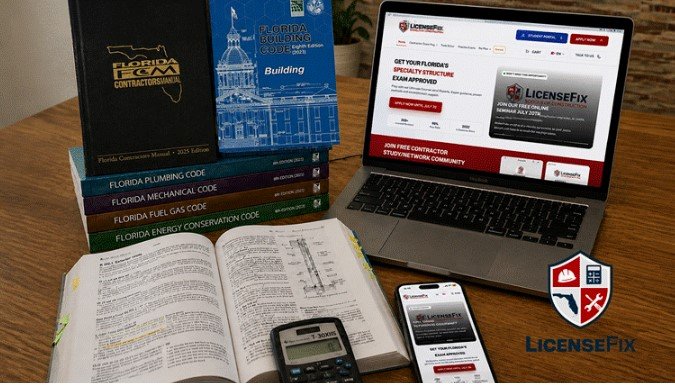
This is why many contractors preparing to learn how to get a contractor license in Florida choose structured exam prep. The team at LicenseFix School of Construction offers courses designed specifically around Florida's DBPR requirements (https://www.licensefixschool.com/courses/florida-general-contractor-exam-preparation), helping candidates build the navigation skills and content confidence they need to pass on their first attempt.
Step 3: Understand the Contractor License Insurance Requirements in Florida
The insurance requirements are non-negotiable when learning how to get a contractor license in Florida. You need to have valid coverage in place before you submit your application. Missing it is one of the most common reasons applications get delayed. The minimum requirements for a general contractor are:
● General liability insurance: at least $300,000
● Property damage coverage: at least $50,000
● Workers' compensation: required if you have employees; if not, you'll need to apply for an exemption within 30 days of receiving your license
As for surety bonds, Florida is more flexible than many states. If your FICO credit score is 660 or higher, a bond is not required. If your score is lower, a bond (typically between $10,000 and $20,000) can be used as an alternative to show financial responsibility.
Step 4: Prepare Your Contractor License Application in Florida
A key part of how to get a contractor license in Florida is understanding that the application stage is where the process can slow down, not because it's hard, but because it depends on other people. Gathering everything takes planning, not just effort. Here's what you'll need:
● Experience verification forms signed by former employers, supervisors, or clients
● A credit report or financial statement
● Exam score reports from Professional Testing, Inc.
● Certificates of insurance
● A completed background check with fingerprints (through an approved LiveScan provider)
● Application fee ($300–$500 depending on license type)
The biggest hurdle is the work experience forms. It can take weeks for former employers to return them. Start collecting the signatures in advance, preferably while you're still studying for your exams.
Step 5: Submit Your DBPR Contractor License Application
With everything in hand, the final step of how to get a contractor license in Florida is submitting your application through the DBPR's online portal or by mail. A complete submission typically takes four to eight weeks to be reviewed, but incomplete submissions restart the timeline entirely, so double-check everything before you hit submit. From registering for your first exam to holding an active license, the typical timeline is three to six months.
Florida Contractor License Renewal: Keeping Your License Active
Knowing how to get a contractor license in Florida is just the beginning. Renewal is required every two years, with the deadline falling in August. To complete your Florida contractor license renewal, you must finish 14 hours of DBPR-approved continuing education per cycle. Those hours must cover specific topics including workplace safety, workers' compensation, business practices, laws and rules, and the building code. Make sure you complete these through an approved provider that reports directly to the state, otherwise, your renewal can still be delayed even if you've done the hours. Letting your license expire isn't just an inconvenience; practicing with an expired license can lead to serious legal consequences.
You Don't Have to Go Through This Alone
How to get a contractor license in Florida is entirely achievable. Thousands of contractors go through this process every year. The ones who struggle are usually those who underestimate the exams or submit incomplete paperwork, not because the process is impossible, but because they don't have a clear picture of what to expect.
Whether you're just starting to research how to get a contractor license in Florida or you're already mid-way through the requirements, the most important step is to talk to someone who knows the path. Schools like LicenseFix School of Construction offer exam preparation and guidance designed specifically for Florida contractors (https://www.licensefixschool.com/), and a single conversation can save you weeks of confusion and costly mistakes.