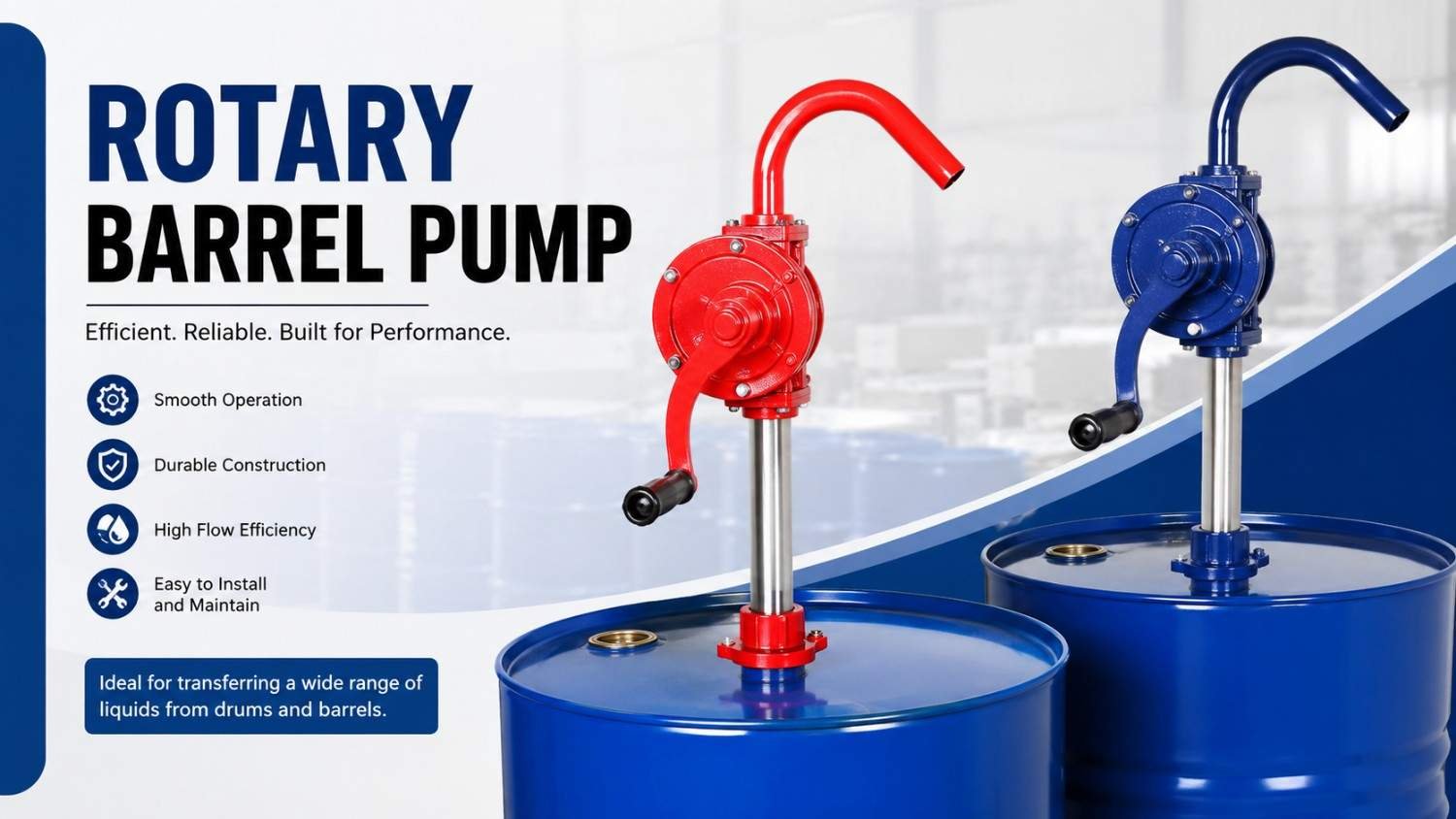
A drum is sitting near dispatch, the operator is late, and someone is still using a jug because last quarter’s pump leaks from the neck. That’s how a small buying mistake becomes a daily loss. A Rotary Barrel Pump looks simple, but the wrong manufacturer can slow unloading, waste liquid, and irritate every supervisor on the floor. India’s industrial output grew 5.1% year-on-year in May 2026, with manufacturing output up 5.5%, so weak fluid-transfer buying is not small anymore.
Rotary Barrel Pump Specs Buyers Should Check Before Price
The Material Match Buyers Usually Get Wrong
Giza lists manual, electric motor-driven, and air-driven options, with SS 304, SS 316, polypropylene, PVDF, and cast iron construction for different liquids. That matters because oil, diesel, kerosene, solvents, lubricants, and mild chemicals do not behave the same inside a pump body. A buyer who says “chemical use” without naming the exact liquid is already creating trouble for himself. Here’s the harder part: compatibility is not only about the body; it also includes seals, shaft contact, drum opening, viscosity, and usage frequency.
Most buyers skip liquid temperature.
Five Supplier Checks That Expose Weak Manufacturers
India’s chemical sector is valued at USD 260 billion and is projected to reach USD 383 billion by 2030, which means demand will keep coming from chemicals, lubricants, automotive fluids, warehouses, and process plants.
- Material recommendation: A good manufacturer asks for liquid name, viscosity, drum size, and frequency. A bad answer sounds like, “SS is safe for everything.” It isn’t.
- Testing process: Ask what is checked before dispatch. A weak supplier says, “Don’t worry, sir.” That’s not testing. That’s a future debit note.
- Spare support: Good Rotary Barrel Pump Suppliers talk about handles, seals, tubes, and service support. A bad supplier only talks about today’s price.
- Dealer control: Serious Rotary Barrel Pump Dealers know which model suits oil, diesel, thinner, or corrosive use. Bad dealers push whatever stock is stuck in their godown.
- Bulk consistency: Good Rotary Barrel Pump Wholesalers maintain the same material, packing, and dispatch discipline. Bad wholesalers change specs silently to protect margin.
Nobody tells you this early enough: the cheapest quotation often becomes expensive after the third complaint call.
Benefits That Protect Margin, Not Just Movement
The right pump reduces buyer risk in six practical ways. It cuts spillage, reduces operator fatigue, protects liquid purity better than open pouring, lowers maintenance surprises, supports faster drum emptying during dispatch peaks, and gives procurement a cleaner reorder pattern because one model can be mapped to one liquid category.
And yet, many buyers still compare only unit price.
Giza states that its pumps serve chemical plants, automotive workshops, agricultural fertilizer and pesticide facilities, heavy manufacturing units, and fuel handling departments, with strict testing for leak-proof operation.
Availability Is a Supply Chain Decision, Not Just a City Name
For buyers searching Rotary Barrel Pump Manufacturers in India, location matters. Giza is based at Sub-Plot 3/1, Plot No. 3, Dholera Main Road, Shapar, Rajkot, Gujarat – 360024. Rajkot’s industrial belt helps with machining, metal work, packing vendors, and road dispatch toward western, northern, and central India. That matters when a dealer needs 20 pieces before month-end, not “after production planning.”
Here’s the local SEO reality: many Rotary Barrel Pump Suppliers can take an enquiry, but fewer support repeat dispatches, replacement guidance, and dealer-level urgency. Rotary Barrel Pump Dealers need stock clarity. Rotary Barrel Pump Wholesalers need transport-safe packaging. India exports chemicals to more than 175 countries, so liquid-handling equipment must match a market that is getting stricter about documentation, repeatability, and safety.
About Giza Pumps
We’re Giza Pumps by Swastik Enterprise, and we work from Rajkot with 27+ years of industrial pump experience. Our product line includes rotary barrel pumps, drum pumps, electric barrel pumps, air-operated barrel pumps, siphon pumps, SS barrel pumps, and PVDF options for aggressive chemical use.
We’ve learned one thing the hard way: a buyer may ask for “one pump for oil and chemical,” but the better answer is often two material choices, because one wrong fit can damage the pump faster than any operator mistake.
We check liquid type, drum use, frequency, material, and dispatch need before suggesting a model.
Send us the liquid name, viscosity if available, drum size, required quantity, destination city, and whether you need manual, electric, or air-driven operation. At Giza Pumps, we reply within 24 working hours for standard enquiries. MOQ starts from 1 unit for standard model evaluation; dealer and wholesale MOQ is confirmed by model, material, and dispatch location. send your requirement through our website enquiry form.
Conclusion
A Rotary Barrel Pump is not a fancy purchase, but it sits directly inside daily handling cost. Choose the manufacturer that asks uncomfortable questions before quoting. MSMEs contribute about 35.4% of India’s manufacturing output, so small equipment choices affect a large part of the industrial base. The next wave of Indian manufacturing will reward buyers who treat these decisions with discipline.
FAQs
Which Rotary Barrel Pump is better for oil and diesel?
Cast iron or stainless steel models are commonly considered, depending on duty cycle and contamination concern. Caveat: if the oil is thick, cold, or handled frequently, confirm suction performance first.
How do I compare Rotary Barrel Pump Suppliers?
Ask for material options, testing details, spare availability, dispatch location, and liquid compatibility guidance. If the answer is only “best quality, lowest price,” move carefully.
Do Rotary Barrel Pump Dealers keep ready stock?
Some do, especially for standard manual models. For SS 316, PVDF, or higher-volume requirements, stock can vary by city and current orders.
Are Rotary Barrel Pump Wholesalers useful for repeat B2B buying?
Yes, especially when you need consistent packing, pricing, and repeat quantity. Caveat: approve batch specs, not just the first sample.
What details should I send before asking for a quote?
Send liquid name, drum size, material preference, quantity, destination, usage frequency, and operation type. A clear enquiry saves at least two follow-up calls.
Can one pump handle chemicals, fuel, and lubricants?
Sometimes, but not always. PP, PVDF, SS, and CI behave differently with acids, solvents, fuels, and oils. One universal answer is a bad sign.
Why choose Giza among Rotary Barrel Pump Manufacturers in India?
Choose us when you want selection guidance, industrial pump experience, and India-wide supply support from Rajkot. We are a practical fit for procurement teams, dealers, and wholesalers.