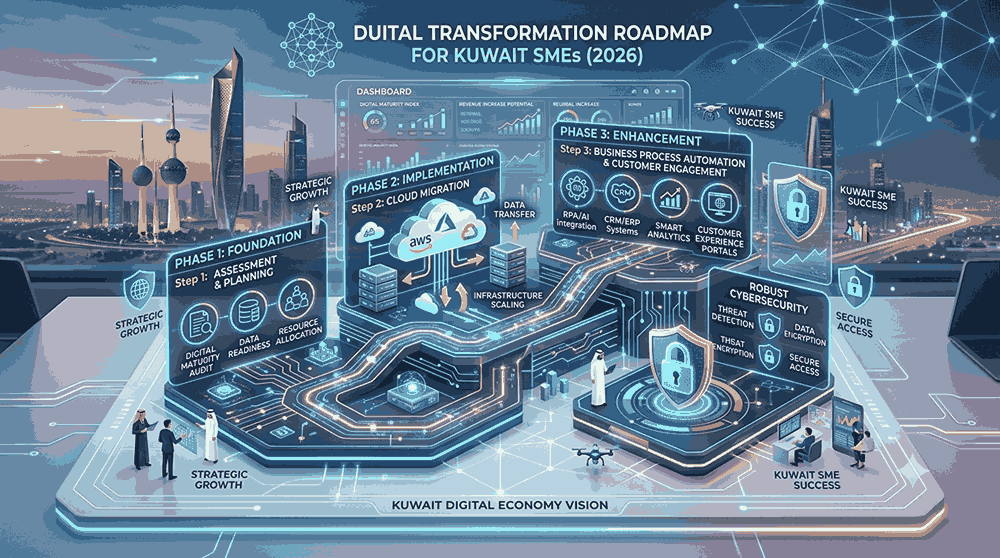
Digital transformation is going to be key for companies wanting to stay competitive in an ever more interconnected marketplace. For small and medium-sized enterprises (SMEs), adopting technology wisely will really make all the difference to their productivity, reduce costs, and create far superior customer experiences. An appropriately planned digital transformation roadmap for SMEs in Kuwait will help organizations identify priorities, manage their investments well, and integrate new technologies into the organization.
Assess Your Current Digital Maturity
Before making a move towards new technology, SMEs need to understand their true digital capacities. Consider what software your company is using, its IT system, its processes, its communication channels, and its cybersecurity policies.
Find out where the same routine tasks are being performed manually, what outdated systems exist within the company, and what ineffective work processes and technological gaps exist. With such an assessment, you will be able to track your progress, but you will also prevent your company from overspending on things it doesn't need.
Define Clear Business Goals
Technology needs to be an enabler of your organizational goals, not an option because all your competitors have it. Start by identifying the problems that technology needs to solve for you.
Your priorities may include:
- Automating mundane, repetitive administrative tasks
- Reducing your operational costs
- Improving your customer service
- Increasing employee productivity
- Finding new sales opportunities
- Making faster decisions
Select the Right Technologies
Once your business priorities have been set, figure out which technologies will have the most impact. For an organization, it might be cloud computing, a CRM or ERP platform, artificial intelligence, automation, data analytics, an e-commerce system, or even cybersecurity tools.
A really effective digital transformation in Kuwait needs to concentrate on those technologies that can scale and will be compatible with all your future business needs. Small to medium enterprises should think about the initial costs of implementation, how well different components integrate together, their usability, security, and ultimately the long-term value, all before actually investing in new technologies.
Create a Phased Implementation Plan
Trying to modernize every part of your business all at once will cause unnecessary disruption. Instead, divide the digital transformation roadmap for SMEs in Kuwait into some clearly defined stages.
Stage 1: Pinpoint and seal off key infrastructure and cybersecurity vulnerabilities.
Stage 2: Automate your number-one process priorities. Also, enhance your digital interaction with customers.
Stage 3: Start working on advanced analytics, AI, and fully integrated digital systems.
Each stage should have its own budget, a particular time frame, the team members involved, and clear key performance indicators (KPIs) that one will be able to measure against. This staged approach will also let SMEs show off their results before making bigger investments.
Prepare Employees for Change
Technology itself can't bring about a truly successful transformation. Employees need the knowledge and confidence so that they really use new systems well. Offer actual, hands-on training and tell them just how those new tools are going to make their everyday jobs better. Get your employees' comments and get them involved in the transition process.
Strengthen Cybersecurity
As ever more business activities are moved online, cybersecurity will have to be seen as an integral part of the changeover plan. SMEs should set up secure access controls, carry out regular backups, provide employees with security training, install monitoring systems, and hold periodic security reviews.
Choose the Right Technology Partner
Companies without a big internal IT team could really benefit from teaming up with experienced tech specialists. Dependable digital transformation solutions in Kuwait will help out small and medium-sized enterprises (SMEs) define their requirements, make the right decision about platforms, integrate various systems, all under one roof, and provide ongoing technical support continuously.
Your ideal partner should be very familiar with your company's particular industry, goals, spending budget, technological environment, and all those local specifics that are important to you.
Track Results and Continuously Improve
Digital transformation forms part of an ongoing process, rather than a solitary project itself. Companies should actually keep track of indicators regularly, like operational costs, productivity levels, customer satisfaction, employee acceptance of the new system, conversion rates, and how well systems are performing.
Small and medium-sized enterprises (SMEs) moving their workloads to the cloud might also discover it beneficial to be helped out by a reliable cloud consulting company in Kuwait, so as to ensure that their cloud infrastructure will remain secure, scalable, and continually meet the ever changing demands of their business.
Conclusion
Developing an effective digital transformation roadmap for SMEs in Kuwait will involve linking business objectives to the right technology, preparing your staff, making sure security is in place, and continually monitoring progress. By taking a phased approach that is both measurable and really centered around the business, SMEs will be able to make wiser investments in technology, build up the strength of their operational resilience, and create a far more stable platform for sustainable development.
Tags : Digital Transformation