How Social Media Technology Is Transforming Content Creation and Discovery
By amarahayes 01-10-2026 2
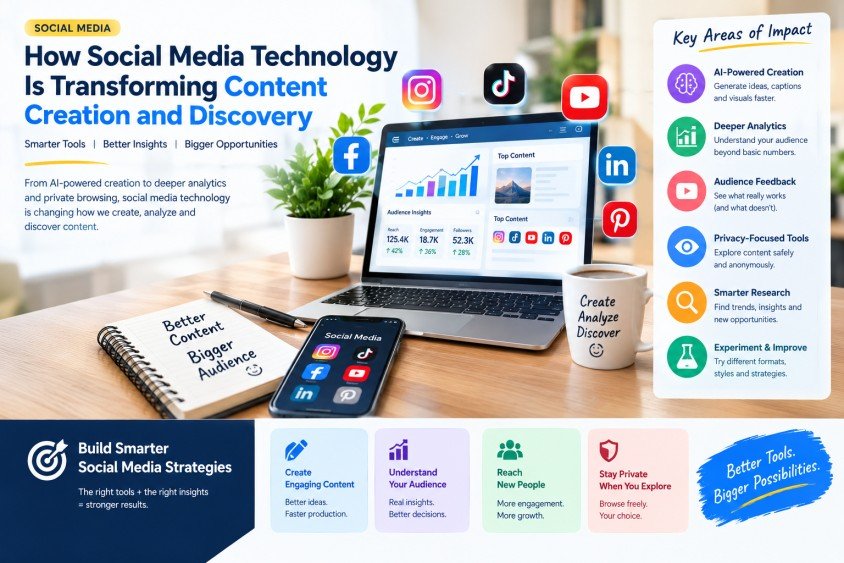
Social media has grown far beyond a place for casual conversations and status updates. Today, it serves as a major digital environment where businesses connect with customers, creators build communities, and users discover products, ideas, trends, and entertainment.
With an enormous amount of content being published every day, however, getting attention has become increasingly difficult. Simply posting consistently is no longer enough. Brands and creators need to understand what their audiences want, measure how people respond, and continuously improve their approach.
Modern social media tools are helping make that process more efficient. From AI-powered content creation to audience analytics and privacy-focused discovery, technology is changing how people create, evaluate, and interact with social content.
Why Social Media Strategy Now Requires Better Tools
Social media marketing was once relatively straightforward for many businesses. Publishing regular updates and responding to followers could be enough to maintain an online presence.
Today, audiences have more choices and expect content that is useful, relevant, and engaging. Businesses therefore need to answer questions such as:
- Which topics attract the most attention?
- What formats encourage meaningful interaction?
- When are audiences most active?
- Which campaigns produce useful results?
- What causes people to ignore or leave content?
Without reliable information, marketers may end up making decisions based entirely on assumptions.
Social media tools provide data and automation that can make these decisions more informed while reducing the amount of repetitive manual work involved.
AI Is Speeding Up the Creative Process
Artificial intelligence has become one of the most noticeable developments in social media marketing. Tasks that previously required substantial time—such as drafting captions, brainstorming concepts, creating visuals, and preparing advertising variations—can now be supported by AI-powered platforms.
With AI-powered tools like Predis.ai, marketers can now create social media posts more efficiently and spend more time focusing on strategy and audience engagement.
This doesn't mean that human creativity is becoming unnecessary. Instead, AI can handle parts of the production process so marketers can devote more attention to campaign planning, brand positioning, audience research, and creative direction.
For businesses running paid social campaigns, faster creative production can also make it easier to test multiple concepts and identify which approaches generate stronger engagement.
Looking Beyond Basic Engagement Numbers
Likes, comments, shares, and views are useful indicators, but they don't always explain why people react to content in a particular way.
A post might attract a large number of views while generating limited engagement. Another piece of content may receive fewer views but create more meaningful discussions or conversions.
Understanding these differences requires marketers and creators to look deeper into audience behavior.
Feedback analysis can reveal patterns that basic engagement figures don't immediately show. Creators can use those insights to identify topics that connect with viewers, recognize weak points in their content, and make better decisions about future posts.
New Ways to Understand Viewer Feedback
Video content has become one of the most important formats across social platforms. As competition increases, creators need to understand not only how many people watch their videos but also how audiences respond to them.
Additional feedback signals can sometimes reveal whether viewers found a video useful, confusing, repetitive, or otherwise unappealing.
Tools designed to surface information around negative engagement can therefore provide another layer of context. A YouTube video dislike viewer, for example, can help creators examine dislike-related signals that may contribute to a broader understanding of audience response.
This information shouldn't be viewed in isolation. It becomes more useful when combined with watch time, comments, retention, shares, and other performance indicators.
Privacy Is Also Changing How People Discover Content
As social media usage grows, privacy has become an increasingly important consideration for internet users.
Not everyone wants every interaction to be visible or directly associated with their account. Some users may want to research public content, monitor trends, or explore updates without actively engaging with the original profile.
Privacy-oriented browsing tools can provide different ways to access publicly available social content while reducing direct interaction.
For instance, an Instagram story viewer can allow users to explore publicly available stories without directly interacting with the account in the conventional way. This can be useful for trend research, content monitoring, or casual browsing where privacy is a priority.
Users should still understand the privacy rules and terms associated with the platforms and tools they choose.
Better Content Research Leads to Better Campaigns
Successful social media campaigns usually begin before the first post is published. Research helps marketers understand their audience, competitors, industry trends, and the types of content that are already performing well.
Businesses can research:
- Competitor campaigns
- Audience interests
- Popular content formats
- Emerging trends
- Customer questions
- Comments and feedback
- High-performing topics
This information can help transform a generic content plan into one that reflects real audience interests.
For example, a travel company may discover that its audience responds more strongly to destination guides and real customer experiences than to conventional promotional posts. That insight can then influence the company's future content strategy.
Companies such as Aero Connect Nepal can similarly use audience and content research to understand which Himalayan travel experiences and stories are most relevant to modern travelers.
The more closely content reflects audience interests, the easier it becomes to create posts that feel useful rather than repetitive.
Why Experimentation Matters in Social Media Marketing
There is no universal content formula that works for every business or audience. A strategy that performs well for one brand may produce very different results for another.
Testing different approaches helps marketers identify what actually works for their specific audience.
Businesses can experiment with:
- Image styles
- Video formats
- Caption lengths
- Posting frequency
- Publishing times
- Calls to action
- Advertising messages
- Content themes
The objective isn't to change everything at once. Testing individual variables makes it easier to understand which changes are contributing to better results.
Over time, repeated experimentation can reveal patterns that help marketers make more confident content decisions.
Social Media Technology Is Becoming Part of Everyday Marketing
The continued development of social media technology is making platforms more intelligent, automated, and personalized.
Creators can use AI to accelerate production while retaining control over their creative direction. Businesses can use analytics to better understand customer behavior. Users can benefit from tools that make content discovery more flexible and privacy-conscious.
These technologies are most valuable when they support human decision-making rather than attempting to replace it. A tool can generate ideas or surface data, but marketers still need to understand their audience and decide how that information should influence the brand's strategy.
Final Thoughts
Social media success now involves much more than maintaining a regular posting schedule. Brands and creators need to understand audience behavior, produce relevant content, test different approaches, and use technology to improve the process.
AI-powered creation tools can reduce repetitive production work, analytics can provide deeper insight into audience behavior, and privacy-focused tools can offer alternative ways to discover public content.
As social platforms continue to evolve, the strongest strategies will combine technology with human creativity and thoughtful decision-making. Businesses and creators that continually learn from their audiences can use these tools to build more relevant, engaging, and effective social media experiences.
Tags : .....