Laparoscopic surgery is one of the clearest examples of how modern medicine demands precision under unusual conditions. Unlike open procedures, it asks the surgeon to work through long instruments, rely on a screen for visual guidance, and perform delicate movements with limited direct tactile feedback. That combination makes training especially challenging. It is not enough to understand anatomy or memorize procedural steps. A learner also has to develop coordination, depth perception, timing, and control in an environment that feels very different from natural hand movement. This is exactly why advanced laparoscopic simulation has become such an important part of surgical education.
Traditional teaching methods can introduce the basics, but they often leave a gap between theory and real procedural confidence. A student may understand what needs to be done and still struggle with how to do it smoothly. The problem is not knowledge alone. It is the physical language of minimally invasive surgery. Hands must learn new patterns. Eyes must adapt to indirect visualization. Small errors in force or angle can create major consequences. Because of that, laparoscopic training works best when learners are given a space where they can repeat difficult tasks safely and often.
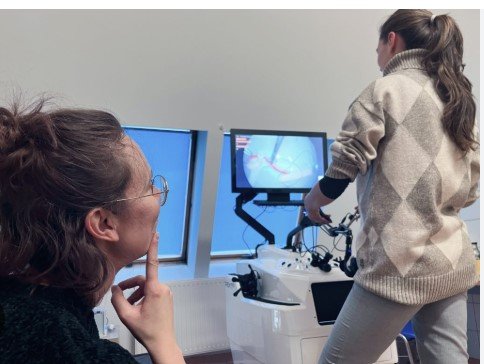
A realistic simulator helps create that space. Instead of waiting for limited clinical opportunities, the trainee can begin building technical confidence in a controlled setting. This matters because laparoscopic skill is deeply practical. It develops through repetition, correction, and gradual refinement. The learner needs time to become comfortable with instrument handling, camera orientation, targeting, and movement efficiency. A good simulation platform supports this process by making practice feel more lifelike and less abstract.
One of the most valuable elements in modern laparoscopic training is realistic feedback. In minimally invasive surgery, the surgeon loses much of the direct tactile sense available in open procedures. That means even basic tasks can feel unfamiliar at first. A simulator that recreates tissue resistance and instrument response more convincingly can make a major difference in training quality. It teaches the learner not only where to move, but how much force to apply and how to remain controlled under subtle resistance. This kind of realism improves judgment as much as dexterity.
Another major advantage of simulation is that it allows technique to be practiced as part of a larger workflow rather than as isolated hand exercises. Early training tools were often useful for simple coordination drills, but modern systems can go much further. They can include guided scenarios, structured modules, visual tips, performance statistics, and exam modes that make learning more organized. Instead of repeating random tasks, learners can move through a progression. They can identify weaknesses, review results, and develop consistency over time. That turns training into something measurable rather than purely subjective.
This structured approach is especially important in surgery because technical skill is only part of readiness. A future surgeon also needs to develop procedural thinking. That includes staying oriented, choosing the right sequence of actions, understanding how one movement affects the next, and keeping attention focused throughout a simulated case. Scenario-based training supports these habits much better than simple mechanical repetition. It helps learners connect movement with decision-making, which is much closer to the reality of the operating room.
Visual quality also plays a significant role. Laparoscopic surgery depends heavily on what the surgeon sees on screen, so training systems benefit from detailed graphics, realistic anatomy, and a strong visual learning environment. When the anatomy looks more convincing and the setting feels closer to real minimally invasive work, the learner is more likely to develop useful habits. The training stops feeling like a technical toy and starts functioning like a true educational bridge between classroom knowledge and procedural experience.
Mobility and accessibility matter as well. In many institutions, training equipment has to serve different spaces, different groups, and different schedules. A simulator that is easier to transport or adjust can be integrated into teaching more often, which means learners get more consistent exposure. That may seem like a practical detail, but it has real educational consequences. Skills improve faster when training is available regularly rather than occasionally. A flexible system makes that much easier.
Another reason advanced laparoscopic simulation is so useful is that it supports both learners and instructors. Students benefit from repetition, realism, and guided progression, while educators benefit from tools that help them organize teaching, monitor progress, and assess performance. When a system includes training modes, exam modes, analytics, and educational content, it becomes easier to build structured sessions around it. Instructors can demonstrate, evaluate, and debrief more effectively. That makes the simulator part of a broader teaching strategy rather than just a standalone device.
For the learner, one of the biggest benefits is confidence. Confidence in surgery should not come from guesswork or from one successful attempt. It should come from repeated practice under realistic conditions. When a trainee spends enough time working through simulated laparoscopic tasks, movements begin to feel more natural. Instrument handling becomes steadier. Visual orientation improves. The learner becomes less overwhelmed by the unusual mechanics of minimally invasive work and more focused on the logic of the procedure itself. That shift is extremely important. It means the first real clinical experiences are built on a foundation rather than uncertainty.
At the same time, simulation does not replace live surgical education. Its role is different. It prepares learners so that real operative experience becomes more productive. A student or resident who has already practiced key skills in a realistic environment will usually gain more from time in the operating room. They are able to pay attention to higher-level details because the basic mechanics are no longer completely new. In that sense, simulation increases the value of real clinical exposure rather than competing with it.
What makes laparoscopic training especially suited to simulation is the nature of the skill itself. This is a field where repetition matters, where hand movements must be retrained, and where visual-spatial coordination develops over time. A well-designed simulator supports all of these needs. It makes technical growth safer, more efficient, and more structured. It reduces unnecessary pressure during the early stages of learning while still demanding precision and discipline.
In the end, the strongest laparoscopic training systems are the ones that move beyond simple drills and create an environment where learners can build real procedural readiness. Realistic feedback, guided scenarios, quality visuals, structured assessment, and accessible design all contribute to that goal. Together, they help narrow the distance between first practice and real surgery. And in a field where precision matters so much, that kind of preparation can make a meaningful difference.
Tags : .....