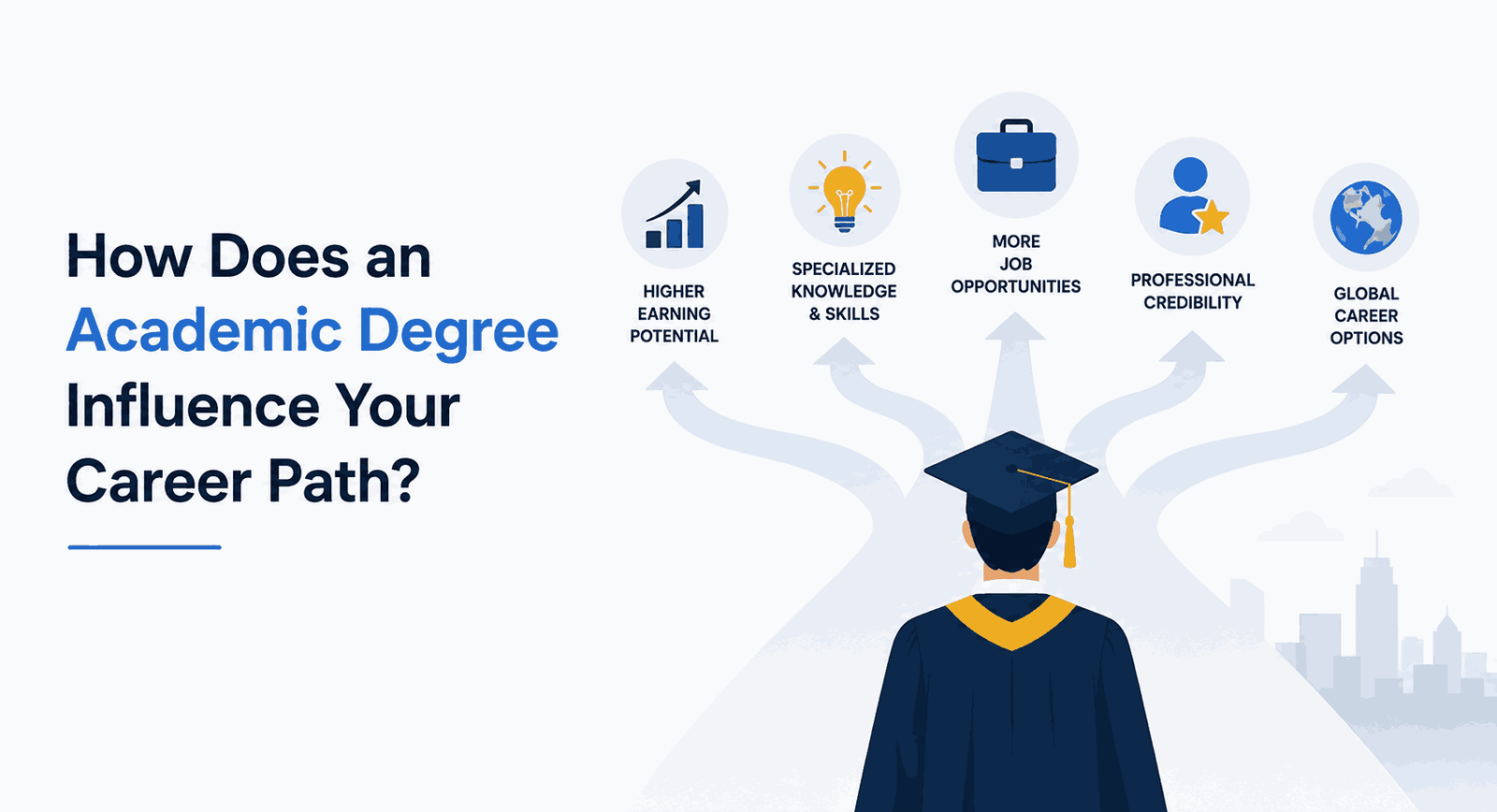
An academic degree can influence your career in several ways. It may affect the skills you develop and the professional opportunities available after graduation. It is a basic requirement for some professions. Whereas for others, it provides useful knowledge and transferable skills that can be applied across different industries.
However, a degree is not a guarantee of career success. Employers also consider experience, practical abilities, communication skills and a candidate's willingness to keep learning. Keep reading to learn about the real value of a degree and how you can use it alongside these other qualities.
How Does a Degree Influence Your Career Path?
The subject you choose at university can have a direct connection with your first career. A student studying engineering may pursue an engineering role, while someone studying accounting may work towards a career in finance.
Some degrees offer considerably more flexibility. Graduates with subjects such as English, history, psychology, sociology or business can enter a range of industries depending on their interests and additional experience.
Your degree for education does not have to determine what you do for the rest of your working life. It can simply provide the first direction in your professional journey.
The choices you make after graduation, including gaining experience and developing new skills, can gradually change that direction.
Here is how a degree plays a role in your academic career.
- University Can Build Transferable Skills
The university can also help students develop skills that remain useful as they move between jobs or industries.
- Depending on the course, students may learn how to research information, assess sources, solve problems and present ideas clearly.
- They also learn to manage deadlines and organise their workload.
These abilities can become valuable in many different careers.
For example, a history graduate may not become a historian. However, research writing and analytical skills developed during the degree could be useful in publishing, communications, education, public administration or marketing.
This is one reason employers may look beyond the title of a degree when assessing a graduate.
- Your Qualification Can Affect Career Progression
A degree may also influence progression once you enter employment.
- Some organisations have graduate development programmes designed specifically for degree holders.
- Others may expect employees to have certain academic qualifications before moving into managerial positions.
Professional progression can also depend on additional qualifications. A graduate may begin in an entry-level position and later complete industry-specific training to qualify for a more senior role.
The degree is therefore often only the beginning, as what happens afterwards can have a significant impact on career development.
- A Degree May Influence Earning Potential
Academic qualifications can sometimes be linked with higher earning potential, particularly when they provide access to professional roles.
However, this relationship is not automatic, as salary can depend on the industry, location, employer, level of responsibility and amount of experience a person has gained.
Some graduates enter highly competitive sectors where starting salaries are modest, while experienced workers without degrees can earn significantly more in certain industries.
It is more useful to consider whether your degree provides access to the type of work and progression opportunities you want instead of viewing it as a direct route to a specific salary.
- A Degree Can Help You Meet Job Requirements
Certain careers have specific educational requirements.
- Medicine, dentistry, architecture and some areas of law, engineering and education require candidates to complete recognised academic and professional training before they can enter the profession.
- In other industries, a degree may not be legally required but can still appear in graduate job descriptions.
Employers may use academic qualifications as an initial way to identify candidates who have demonstrated the ability to complete higher education.
A degree can therefore help recent graduates with limited experience meet the initial requirements for professional opportunities.
This is why a lot of busy law students never let anything come in between their degree completion and choose to go for law assignment writing service when needed.
- Further Study Can Change Your Career Direction
An undergraduate degree does not necessarily mark the end of academic development.
Many graduates continue with master's degrees, postgraduate certificates, professional qualifications or research programmes. Further study can allow someone to move towards a new area.
- For instance, a business graduate might decide to specialise in finance, human resources or marketing through postgraduate study.
- Whereas a science graduate could pursue advanced research in a particular field.
- Your University Experience Can Build Professional Connections
An academic degree can also introduce you to people who may become part of your professional network.
- Lecturers can provide guidance about industries.
- Classmates may eventually become colleagues.
- University societies, careers fairs, guest lectures and work placements can also introduce students to employers and professionals.
These relationships do not always produce immediate results, but connections made during university could become useful several years later when someone hears about an opportunity.
Networking is therefore another part of the wider career value of higher education.
- Work Experience Still Matters
A degree can help you reach the starting line, but employers often want evidence that you can apply your knowledge in practical situations.
Internships, placements, part-time jobs, volunteering and university projects can all help build this evidence.
This is why students should think about employability while studying rather than waiting until graduation. Gaining practical experience can show employers that you understand how your knowledge works outside the classroom.
A lot of students also take online assignment writing help when they are doing internships to ensure smooth completion of their degree.
How to Make Your Degree More Valuable
Students can increase the long-term value of their degree by actively connecting academic study with career development.
Consider how your university experience can prepare you for the workplace instead of focusing on final grades.
Here is how you can do it:
- Relevant experience can make a difference, whether that comes from an internship or a part-time role.
- Career fairs are worth attending. Conversations with people already working in the field can give you a better idea of what the job involves.
- Build skills depending on your career plans; this could mean learning industry software or developing technical knowledge.
- Creating a portfolio can be useful if you are working towards careers in writing and design.
- Keep track of the work you are proud of, such as strong university projects and research work.
These activities can help turn academic knowledge into evidence of practical ability.
FAQS
- Is your academic degree capable of influencing your choice of job opportunities?
Yes. Some jobs require certain degrees or certifications, but some companies only mention degrees among the list of requirements for graduate positions.
- Will obtaining a degree ensure success in your career?
No. Obtaining a degree opens up many doors; however, the success of one’s career will depend upon experience and practical skills.
- Is it possible to make a career in a field different from that of your degree?
Yes. There are many graduates who choose to work in a completely different area than what they learned during their studies with the help of transferable skills and proper training.
Key Takeaways
Having a degree will shape your career in terms of opportunities open to you and expertise acquired. In some professions, having a degree is mandatory, while in others it forms the base from which experience and a variety of career paths can be pursued.
It is important to see a degree as only the beginning of your career path, not as something that will determine your future career roadmap, because experience, career development, networking, and skills also come into play.
Tags : degree for education