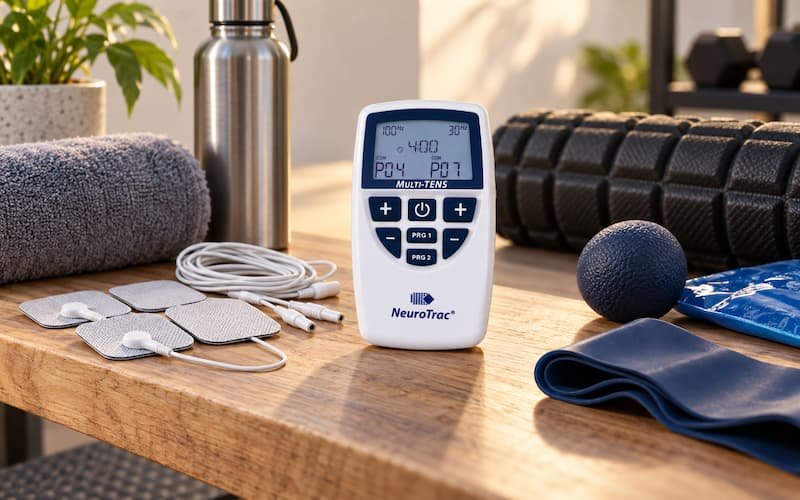
Persistent pain can affect movement, sleep, concentration, work, and everyday activities, making effective symptom management an important part of a person's overall care plan. Because pain may be in various areas and may fluctuate with time, the treatment may frequently require flexibility and individualization. Dual Channel TENS for Persistent Pain may be regarded as a part of a more comprehensive approach to pain-management. Transcutaneous electrical nerve stimulation (TENS) refers to mild electrical impulses that are produced with the help of electrodes attached to skin. TENS can be used to control the symptoms of pain and enable the person to engage in daily or rehabilitation activities depending on the state of the person and the recommendations of a professional.
A Dual channel TENS machine has two channels of stimulation which can be independently controlled, unlike a single-channel system. This may come in handy when two distinct treatment areas require stimulation or when a medical practitioner would like to employ other settings to two distinct stimulation circuits. TENS is typically a non-invasive treatment method, which however must be employed properly and incorporated into a proper course of care. Knowledge on how dual-channel stimulation can be used to facilitate treatment planning will enable the user to make informed decisions on pain management.
What Is Dual Channel TENS?
TENS is an electrical therapy method, which involves the use of electrodes placed on the skin to provide a controlled electrical stimulation. The device is able to stimulate parameters including intensity and programme settings which can be changed to suit the requirements of equipment and treatment.
A two-channel device is a device that has two stimulation circuits. This implies that when it is necessary to place electrodes on certain treatment areas, they can be attached to both channels. All channels can be adjusted separately on appropriate equipment, which offers further possibilities when treating.
The precise position of the electrode, strength, programme and duration of the treatment must be as always guided by professional advice and instructions of the manufacturer.
How Can It Support Persistent Pain Management?
Chronic pain is an area or a combination of areas that are constant and may change with movement, activity or time of the day. This renders personalized treatment planning to be particularly significant.
Dual Channel TENS for Persistent Pain could aid treatment planning as it enables the delivery of stimulation in two channels in cases when it is clinically justified. An illustration is that an individual can have more than one area of treatment that is appropriate to them. Instead of using a single stimulation circuit, a dual-channel system can offer more possibilities to organize the treatment session.
But, two channels do not always imply that it will be more effective in treatment. Dual-channel functionality is mainly aimed at being flexible. The areas of electrode placement and the stimulation should be determined based on the symptoms and treatment objectives of the individual.
Supporting Individual Treatment Goals
Treatment should be linked to realistic goals to manage pain. These objectives could be the enhancement of comfort moving around, exercise attendance, rise in the level of activity, or simplifying some of the daily activities.
Persistent Pain Dual Channel TENS may be part of a treatment plan, as long as TENS is thought to be appropriate in the case. A health worker can evaluate:
The place and character of the pain.
Symptom-enhancing activities and symptoms-reducing activities.
Treatment objectives of the person.
Appropriate electrode positions
Suitable stimulation settings
The response to treatment
Whether TENS should be combined with other therapies
This strategy assists in making sure that electrical stimulation is applied as a component of an organized strategy instead of the exclusive way of controlling chronic pain.
Treating More Than One Appropriate Area
One practical feature of dual-channel TENS is the ability to connect two stimulation circuits. This can come in handy when an individual has symptoms that are in different regions that can be treated by TENS.
As an illustration, a medical practitioner can prescribe stimulation to two distinct areas in the same session. The two channels can also be used in alternative treatment where one channel is used to treat the other depending on the symptoms exhibited by the person.
One should not presume that it is always necessary to stimulate several areas. Individualized treatment and the electrodes must be placed in those locations which are deemed suitable to use TENS.
Monitoring Treatment Response
Persistent pain can change over time, so treatment plans may need regular review. An individual might react differently to stimulation based on the different physical activities, fatigue, sleep or alterations in the underlying condition.
Persistent Pain using Dual Channel TENS can be assessed based on the changes of symptoms as well as functional improvements. Monitoring the levels of pain, activities, the time they are using TENS, and perceived benefits could assist in determining whether TENS is helping to enhance the overall plan.
When stimulation is painful, irritating, or producing strange sensations and/or no significant benefit, reconsideration of the treatment is required instead of merely turning up the intensity.
Combining TENS With Rehabilitation
The TENS can be applied in combination with other methods based on the cause of pain. These may comprise prescribed physical therapy, physical exercises, strengthening, mobility training, activity modification, and education.
Others may find it easier to engage in proper rehabilitation activities with the help of temporary relief of their symptoms. TENS is to be considered as a potential supportive tool as opposed to a substitute to treatment which is aimed at the underlying condition.
Professional advice may be necessary to decide when and how stimulation is to be included in a broader rehabilitation programme.
Safety Considerations
TENS should be used according to the manufacturer's instructions and appropriate professional guidance. Persons are advised to consult with a professional prior to using electrical stimulation when they have an implanted electronic device, have diminished sensation, have serious skin issues or otherwise have a factor that can influence the safe use.
Electrodes are not to be put in places where they are not supposed to be stimulated and skin which is irritated or damaged should normally be avoided. It is also recommended that users should not exceed the recommended periods of treatment and use unnecessarily high levels of stimulation.
Conclusion
Persistent Pain Dual Channel TENS may provide a valuable range of flexibility in the case when TENS is a part of a personalized pain-management plan. Two stimulation channels can be used to treat more than one of the areas or have more control over a session organization. There should always be the aim of aligning the stimulation to the symptoms of the individual, their comfort, functional requirements, and treatment goals.
Frequent observation is necessary to find out whether TENS is giving significant assistance. Dual Channel TENS for Persistent Pain can be applied in combination with rehabilitation and other suggested measures, however, it cannot be simply viewed as an alternative to the holistic approach to pain management. Dual-channel stimulation can be regarded as a part of a systematic approach to the management of persistent pain with the help of proper electrode placement, with appropriate professional guidance, and close monitoring.
Tags : medical device medical equipment