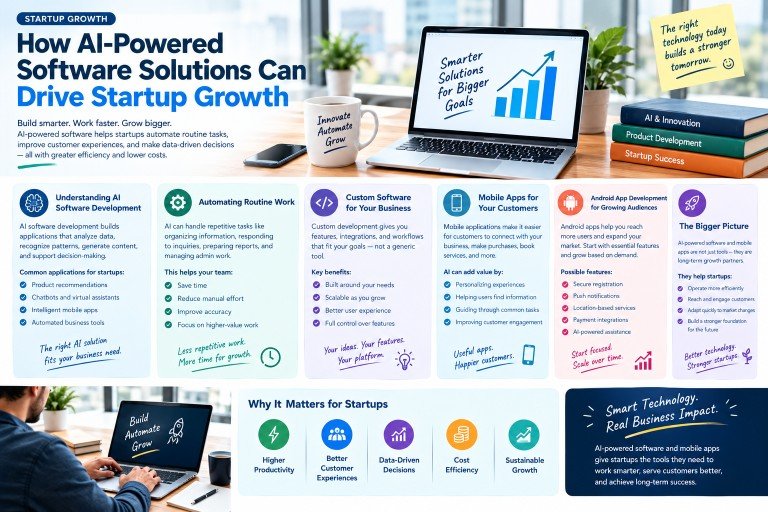
Launching a startup is exciting, but building sustainable growth requires careful planning, efficient operations, and the ability to adapt quickly. Early-stage businesses often work with limited budgets and small teams while trying to develop products, attract customers, and compete with established companies.
AI software development offers startups new ways to address these challenges. From automating routine activities to improving customer experiences and analyzing business data, artificial intelligence can help businesses work more efficiently and make informed decisions.
Partnering with an AI software development company can help startups identify useful AI applications, build practical digital solutions, and adapt their technology as their business needs evolve.
Understanding AI Software Development for Early-Stage Businesses
AI software development involves building applications that use artificial intelligence to perform tasks such as analyzing information, recognizing patterns, generating content, and supporting decision-making.
Startups can apply these capabilities in different ways. An online retailer might use AI to recommend products, while a service-based business could introduce a chatbot to answer common customer questions. Other businesses may develop intelligent mobile applications or automated tools for managing sales and operations.
The key is to select technology based on a genuine business need. AI is most useful when it addresses a specific challenge, improves an existing process, or delivers a better experience for customers.
Automating Routine Work to Improve Productivity
Time is particularly valuable for startups because small teams often manage several responsibilities simultaneously. Employees may spend hours organizing information, responding to repetitive inquiries, preparing reports, and handling administrative tasks.
AI-powered systems can automate many of these activities. For example, software can categorize incoming messages, summarize documents, extract information from business records, and generate reports from available data.
By reducing repetitive work, automation gives teams more time to focus on product improvements, customer relationships, sales, and other activities that contribute directly to business development.
Creating Software Around Specific Business Requirements
Off-the-shelf software does not always meet the needs of a growing startup. A company may require specialized features, integrations, or workflows that generic applications cannot provide.
Custom app development allows businesses to create software based on their objectives, target audience, and operational requirements. Startups can determine which features are essential, how users will interact with the application, and which third-party systems need to be connected.
For example, a food delivery platform may require customer ordering, restaurant dashboards, payment processing, delivery tracking, and automated notifications. A financial technology startup would need a different set of capabilities.
Building around specific requirements helps businesses develop a product that fits their operations rather than forcing their processes to match a generic tool.
Understanding the Value of Custom Mobile App Development
Custom mobile app development means designing and building an application specifically for a business or its intended users. This includes planning the interface, functionality, backend architecture, integrations, and overall user experience.
For startups, this approach provides flexibility during the early stages of product development. Instead of investing immediately in a large application, a business can launch a minimum viable product (MVP) containing only the most important features.
Feedback from early users can then guide future updates. This helps startups prioritize improvements based on actual customer needs instead of spending resources on features that may never be used.
Reaching Customers Through Mobile Applications
Mobile applications can provide a convenient way for customers to interact with a startup. Depending on the business model, an app may support purchases, appointment bookings, service requests, payments, account management, and customer communication.
A mobile app development service can help businesses create applications for industries such as retail, education, healthcare, finance, fitness, travel, and entertainment.
AI can make these experiences more personalized. Applications may use intelligent assistants to help users find information, recommend relevant products, or guide customers through common tasks.
The most effective features are those that make the application easier to use and provide clear value to its audience.
Developing Android Applications for Startup Audiences
Android app development can help startups reach customers who use Android devices. The appropriate features depend on the intended audience, the product's purpose, and the startup's available resources.
Depending on its requirements, an Android application may include:
- Secure registration and account management
- Push notifications
- Location-based functionality
- Payment integrations
- In-app messaging
- Search and filtering tools
- AI-powered customer assistance
- Personalized content or product recommendations
- Connections to external services
Startups can launch with a focused set of features and expand the application as customer demand increases. This staged approach helps control initial development costs while keeping room for future improvements.
Improving Customer Support With Artificial Intelligence
As a startup attracts more customers, managing support requests can become increasingly difficult. A small team that once handled inquiries manually may struggle to respond quickly as demand grows.
AI chatbots can assist by answering frequently asked questions about products, pricing, orders, bookings, and basic account issues. When a request involves a complicated problem or requires human judgment, the system can direct it to a support representative.
This combination of automation and human assistance can improve response times without removing the personal support customers may need.
Businesses should also monitor chatbot accuracy and provide a clear way for users to reach a human when automated responses are insufficient.
Using Customer Data to Make Better Decisions
Understanding customer preferences helps startups improve their products and marketing strategies. AI tools can analyze available information, including website interactions, purchasing patterns, and customer feedback, to identify trends.
For instance, a business may discover which products attract the most interest, where users abandon a checkout process, or which customer groups are more likely to complete a purchase.
These insights can inform decisions about product features, pricing, customer engagement, and marketing campaigns. However, startups should handle customer information responsibly and ensure their data practices comply with applicable privacy requirements.
Accelerating Development and MVP Testing
Startups often need to validate ideas quickly before committing substantial resources to a new product. Modern AI-assisted development tools can support this process by helping developers generate initial code, create prototypes, produce test cases, and automate certain repetitive tasks.
These tools can make parts of development more efficient, but they do not eliminate the need for technical expertise. AI-generated code still requires review, testing, security checks, and optimization before it is suitable for production use.
Combining AI-assisted workflows with experienced developers can help startups move from an idea to a testable product while maintaining attention to reliability and software quality.
Managing the Full Software Development Lifecycle
Building an application involves more than writing code. Startups may also need business analysis, interface design, backend development, API integrations, quality assurance, deployment, maintenance, and ongoing improvements.
Professional software development services can help coordinate these activities throughout the product lifecycle. An experienced development partner can also help determine which features belong in the initial release and which can be introduced after the product has been tested.
A clearly defined development plan helps reduce unnecessary complexity, manage resources, and keep the project aligned with business objectives.
Scaling Operations Without Increasing Costs at the Same Rate
Growth often brings additional customer inquiries, larger datasets, and more complex operational demands. Without efficient processes, a startup may need to increase its workforce and operating expenses simply to keep up.
AI and automation can help businesses manage increasing workloads. Automated support tools can respond to routine questions, analytics systems can process growing volumes of information, and workflow automation can reduce repetitive manual tasks.
These capabilities do not replace every human role. Instead, they can help existing teams work more effectively while allowing employees to concentrate on tasks that require creativity, judgment, and relationship-building.
Building an Effective AI Strategy for a Startup
Startups do not need to adopt every available AI technology at once. A practical strategy begins with a clearly defined problem and a realistic assessment of whether AI can improve the outcome.
A useful process includes:
- Identify a business challenge: Determine which task, customer issue, or operational bottleneck needs attention.
- Choose a focused solution: Select an AI capability that directly addresses the problem.
- Build a minimum viable product: Start with essential functionality instead of developing an unnecessarily complex platform.
- Test with real users: Collect feedback and measure whether the solution delivers meaningful improvements.
- Refine and expand: Improve the product based on results and introduce additional features when there is a clear business case.
For example, a startup could begin with a mobile application that includes one AI-powered support feature rather than launching a large platform with dozens of untested capabilities.
This approach helps control risk, validate demand, and direct investment toward features that provide measurable value.
Final Thoughts: Making AI Work for Sustainable Startup Growth
AI software development can help startups improve productivity, automate repetitive work, understand customer behavior, and create more useful digital products. When applied strategically, it can also help small teams manage growing workloads without adding unnecessary operational complexity.
Whether a business needs custom applications, Android development, intelligent automation, or a complete software solution, the priority should be solving a real problem for its customers.
By choosing appropriate technology, launching focused MVPs, evaluating results, and improving products over time, startups can build a flexible digital foundation for future growth. The goal is not to use AI everywhere, but to apply it where it makes the business more efficient, competitive, and valuable to its users.
Tags : .....