Enterprise software has had one fundamental design assumption for four decades: humans are the operators.
Every application in the category was built around an interface. Someone logs in, inputs data, reviews outputs, and decides what to do next. The software made human work faster and more organized. It never replaced the human in the loop.
That assumption is now being systematically dismantled.
Forrester's 2026 Enterprise Software Predictions report captures the shift precisely: the industry is moving from a user-centric design philosophy to a worker and process-centric one. The new paradigm centers on digitizing entire business processes and reimagining entire workflows, not just optimizing individual tasks.
AI employees are the mechanism driving that shift. Understanding what they are, why they represent a structural change rather than a feature upgrade, and where the implementation gap is widest tells you more about where enterprise software is heading than any product announcement will.
The Adoption Reality in 2026
The data on enterprise AI adoption in 2026 captures a market in transition rather than consensus.
91% of businesses report using AI in at least one capacity in 2026, a dramatic acceleration from 78% in 2024 and 55% in 2023. Worker access to AI rose by 50% in 2025, and the number of companies with more than 40% of AI projects in production is set to double within six months.
But the ROI picture tells a different story. Only 29% see significant ROI from generative AI, despite individual productivity gains of 5x for high-performing users. Two-thirds of organizations report productivity and efficiency gains from AI adoption, but just 20% are already growing revenue through AI, compared to 74% that are hoping to do so in the future.
The gap between adoption and transformation is real and well-documented. What it reflects is not a failure of the technology. It is a failure of implementation architecture. Most organizations have deployed AI at the individual task level: a chatbot here, a summarization tool there, a copilot bolted onto an existing application. Individual productivity goes up. Business outcomes do not follow, because the processes connecting individual work to business results are still human-dependent and manually operated.
That is the problem AI employees are designed to solve.
What Changes When Software Has Agency
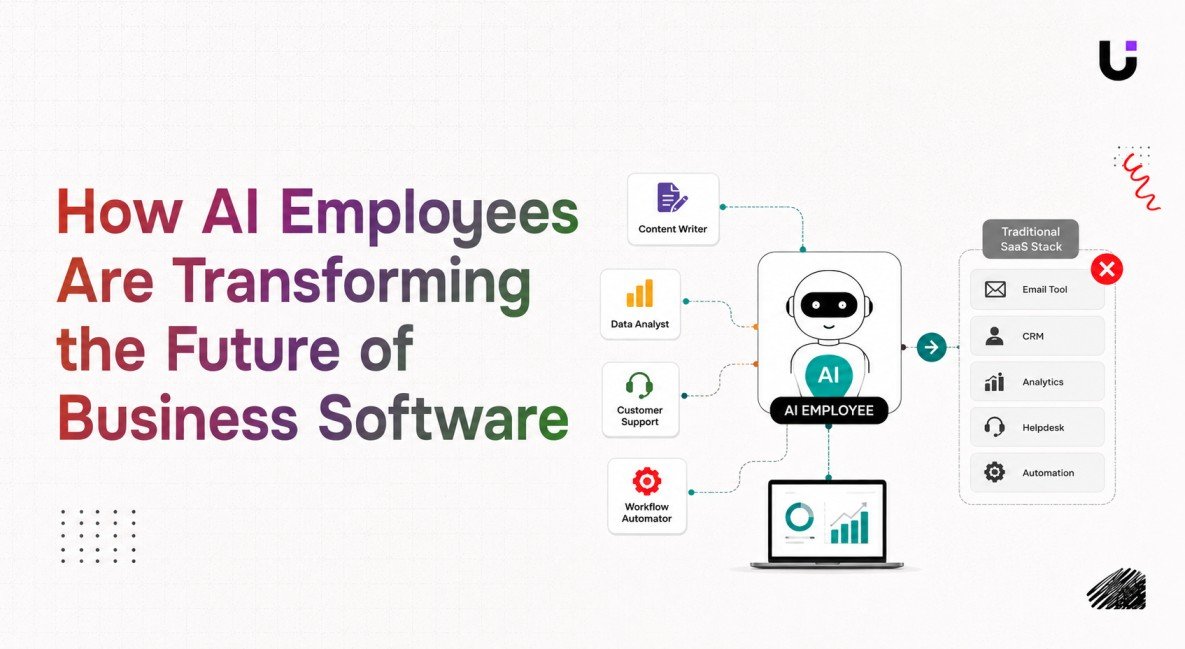
The traditional enterprise software model created a loop: human inputs data, software processes it, human reads the output, human decides what to do, human inputs the next action. Every step that required judgment remained with the human. The software was a tool that accelerated execution of human decisions.
AI employees change the loop. They receive a goal. They determine what steps are needed. They act across multiple systems. They evaluate the results. They adapt when circumstances change. The loop no longer requires a human at every rotation.
Forrester frames this as AI agents becoming employees, changing business models, operations, and workplace culture. The enterprise software landscape is undergoing a fundamental shift, moving from a user-centric design philosophy to a worker and process-centric one.
That shift has concrete implications. An enterprise workflow automation system built on AI employees does not require a human to initiate each step in a workflow, monitor its progress, handle exceptions, or trigger the next stage. The workflow runs. Exceptions get flagged to humans when they genuinely require human judgment. Everything else resolves autonomously.
For growing businesses operating without large operations teams, this is not an incremental improvement. It is the removal of a structural constraint that previously limited how much coordinated work the organization could handle.
The Functions Being Transformed First
The enterprise workflow automation use cases seeing the earliest and most measurable returns share a common profile. They involve work that is high-volume, time-sensitive, rule-adjacent, and dependent on consistent execution across many instances simultaneously.
Sales operations
Lead qualification, scoring, follow-up sequencing, and routing are tasks that require responsiveness, personalization, and consistency at a scale that outpaces what any manual team can sustain. An AI employee handles every lead from the moment it shows intent to the moment it is ready for a human conversation, without the variability that comes from individual reps managing their own queues at different levels of attentiveness.
Financial operations
Companies reported an average 11.5% increase in net productivity over the past 12 months, driven partly by AI adoption. In finance specifically, the gains come from removing the manual cycle of invoice generation, payment monitoring, reminder dispatch, and collections escalation. An AI employee that handles this entire function continuously costs a fraction of what a human team costs to achieve the same throughput.
Project and delivery operations
The failure mode for most project management is not poor planning. It is poor monitoring. Plans exist. Exceptions emerge. Nobody catches them early enough because monitoring requires continuous attention that humans do not have capacity for across multiple simultaneous workstreams. An AI employee that monitors task velocity, workload distribution, and dependency risk continuously surfaces exceptions when they are still recoverable rather than when they have already affected delivery.
Contract and agreement operations
The delay between a closed deal and a signed contract is a gap where momentum dissipates, scope drifts, and the business operates without protection it should have in place. An AI employee that generates, routes, and tracks contracts automatically, with downstream triggers on signature, closes that gap without adding headcount.
The Enterprise Workflow Automation Gap
The organizations capturing the most value from AI employees are not those running the most agents. They are those running the most coordinated ones.
The five failure modes documented in Writer's 2026 Enterprise AI Adoption report stem from the absence of systems designed to scale what is working. Organizations have super-users delivering extraordinary results, but no mechanisms to spread those practices enterprise-wide.
The same structural problem appears in enterprise workflow automation deployments. Individual agents that perform well in isolation still leave the handoffs between functions as manual steps. A sales agent qualifies a lead. Somebody still triggers the project. Somebody else generates the invoice. The automation covers the task. The process remains human-dependent at every boundary.
The organizations closing that gap are building shared data layers across their agent deployments so the output of one agent becomes the input for the next without human intermediation. When a lead closes, the project preparation starts. When a contract signs, the invoice generates. When a milestone completes, the billing cycle triggers.
WorksBuddy is built around this model, running specialized AI employees across sales, marketing, projects, invoicing, contracts, automation, and content, with a shared context layer connecting all seven in real time. It represents one architecture for what coordinated enterprise workflow automation looks like when the agents are designed to interoperate rather than retrofitted to do so.
The Governance Layer That Most Implementations Skip
Gartner's strategic predictions warn that atrophy of critical-thinking skills due to AI use will push 50% of organizations to require AI-free skills assessments by 2026. The governance challenge is not theoretical.
67% of executives believe their company has already suffered a data breach due to unapproved AI tools. The speed of adoption is outpacing the development of the oversight frameworks needed to make that adoption sustainable.
For enterprise workflow automation specifically, governance means defining what each AI employee is authorized to do autonomously and what requires a human decision. It means building audit trails that satisfy compliance requirements. It means identifying the escalation conditions that should always surface to a human rather than resolve automatically. And it means measuring outcomes continuously so the performance of each agent is visible and improvable rather than assumed.
86% of businesses expect AI to transform operations by 2030. The ones that will be ahead of that transformation are the ones that built governance into their deployments from the start rather than trying to retrofit it after problems emerge.
What This Means for Business Software Buyers
Just 34% of organizations are truly reimagining the business with AI. Another third are redesigning key processes around it. The remaining third are adding AI features to existing processes and measuring the results as if the processes themselves were sound.
The distinction matters for anyone evaluating enterprise software in 2026. The relevant question is no longer which tool has the best interface or the most integrations. It is which system can own a business function end to end, adapt when circumstances change, and coordinate with the other systems managing adjacent functions.
That is the design question driving the next generation of enterprise workflow automation. The answer will look different from one organization to the next. But the direction is consistent: less human-in-the-loop for repetitive work, better human judgment applied to the decisions that actually require it, and systems that run the business rather than systems that help humans run it.
AI employees are not a category of feature. They are a new model for how business software is deployed, measured, and valued. The organizations treating them that way are the ones already seeing the results that the other 70% are still hoping for.