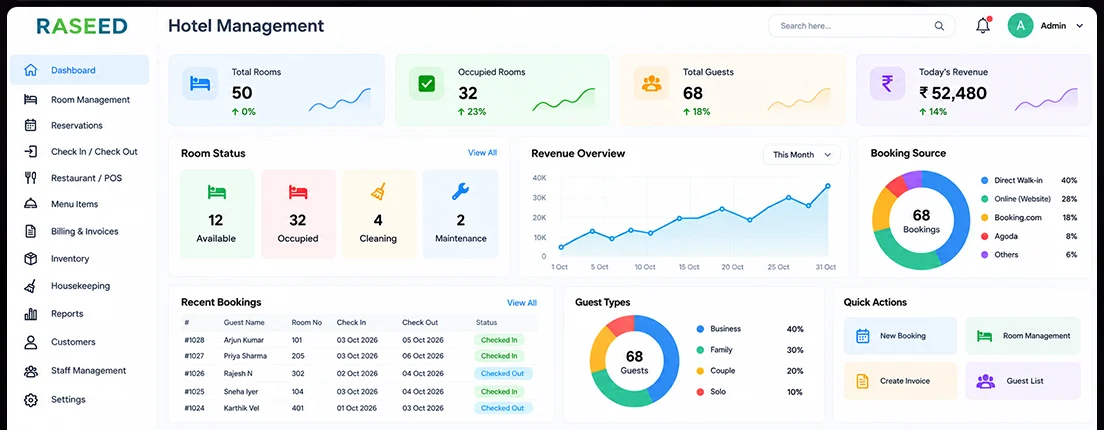
India's hospitality sector is moving toward connected hotel operations, where reservations, guest payments, room-service charges and tax records increasingly need to work together. As hotels prepare for 2027, the priority is not simply adopting new technology. It is eliminating the gaps between the front desk, restaurant, housekeeping and finance teams.
These gaps become expensive during peak check-in and checkout periods. A restaurant charge that never reaches the guest's room account can mean lost revenue. A manually calculated room tariff tax can produce an incorrect invoice. A delayed OTA payout reconciliation can leave managers uncertain about the actual revenue earned from a booking.
GST changes introduced in September 2025 have also made accommodation tariff configuration particularly important. The applicable GST treatment depends on factors including the value of accommodation and the relevant service category. Meanwhile, e-invoicing requirements apply to eligible businesses and transactions, making accurate digital records increasingly important.
For hotel owners, resort managers and boutique-stay operators, the direction for 2027 is clear: Hotel Billing Software must do more than generate invoices. It must help connect guest services, financial controls and day-to-day operations.

What Hotel Operators Should Prepare for in 2027
Four capabilities deserve particular attention as properties review their technology investments.
- Tariff-based GST configuration: Hotels need to configure room rates and tax treatment accurately. Under the GST structure introduced in September 2025, accommodation valued at ₹7,500 or less per unit per day is generally taxed at 5% without input tax credit, while accommodation above that threshold generally falls under the 18% category. Hotels should verify the latest applicable rules before configuring their systems.
- Unified room service billing: Restaurant meals, laundry and other chargeable services should be recorded against the correct guest account. A consolidated folio reduces manual calculations and makes checkout easier to manage.
- Reliable digital invoicing: Hotels should maintain compliant invoice numbering, accurate service descriptions and appropriate tax records. Eligible businesses must also meet applicable GST e-invoicing requirements. Under the current framework, businesses with aggregate annual turnover of ₹10 crore or more must report e-invoices within 30 days of the invoice date.
- Connected payments and night audits: UPI, QR payments, cards and cash transactions should reconcile against the right invoices. Night audit reporting should help managers identify missing charges, outstanding balances and discrepancies before closing the day's accounts.
The wider principle is straightforward: accurate billing depends on connected operational data, not just a tax calculator or a faster printer.
Why Cloud-Native Hotel Systems Will Matter More
Traditional desktop billing systems can be adequate for properties with simple requirements. However, problems arise when different departments maintain separate records or when multiple terminals cannot reliably share updated information.
Consider a guest staying at a resort for three nights. Reception manages the reservation, the restaurant records meals, housekeeping handles amenities, and the finance team reconciles payments. If each department uses a separate system or paper register, staff may need to reconstruct the guest's account at checkout.
A connected system can reduce this friction by making guest records and charge information accessible across authorized workflows.
This is where front desk billing software increasingly overlaps with property-management functionality. Hotels evaluating a hotel PMS alternative should assess whether the solution supports their actual operational requirements—not simply whether it can print an invoice.
Cloud-native architecture can help synchronize information across devices, provide managers with remote visibility and simplify reporting. But cloud adoption is not an automatic guarantee of efficiency. Reliable integrations, data security, staff training and contingency procedures for connectivity failures remain essential.
OTA reconciliation is another important consideration. An industry guide published by AxisRooms in March 2026 described OTA commissions commonly ranging from 15% to 30%, depending on the platform and arrangement. These charges can materially affect net revenue, making it important for hotels to reconcile commissions, deductions and payouts accurately.
For 2027, the strategic opportunity is to connect booking information with billing and reconciliation, so managers can better understand what each reservation actually earns.
What Hotel Owners Should Do Before 2027
Hotel operators do not need to replace every system at once. A structured review can identify the changes most likely to improve billing accuracy and guest experience.
1. Map the guest journey from booking to checkout
Document the entire workflow:
Reservation → Check-in → Room service → Payment → Checkout → Night audit
Identify where staff re-enter information, where additional charges get missed and where invoices need manual correction. A capable hotel check-in/check-out software workflow should reduce duplication and give reception staff a clear view of each guest's account.
2. Consolidate billing and tax configuration
Review how room tariffs, restaurant orders and additional services appear on the final guest invoice. Check that the system supports the applicable GST rules, controlled invoice numbering and relevant reporting requirements.
For properties assessing cloud-based options, Raseed hotel billing software is worth evaluating for its published hotel workflows covering reservations, room inventory, check-in/check-out, guest-account service charges, restaurant POS integration and reporting.
The key is to validate that the features, integrations and tax configurations meet your property's actual requirements before implementation.
3. Connect departmental reporting
Reception, restaurant operations and housekeeping should have clear processes for recording transactions and updating relevant information. Assess whether the software can support housekeeping and amenity inventory tracking, consolidated guest accounts and dependable night audit reporting.
For resorts offering packages or extended stays, also review staycation & room tariff tax billing to ensure that bundled services and additional charges are recorded and taxed correctly.
The goal is to make financial reconciliation a routine, data-supported process instead of a last-minute exercise.
Expert Verdict: The Next 12–18 Months
Through 2027, hotel technology is likely to move further toward contactless checkout, digital invoice delivery through WhatsApp, integrated payment collection and better connections between room status, service charges and inventory.
AI-assisted reporting may help managers identify unusual transactions and understand demand patterns, but tax calculations will still require accurate configuration and compliance checks.
The hotels best prepared for this shift will be those that connect reservations, room service, billing, payments and reporting without creating unnecessary complexity for staff.
Hotel Billing Software is evolving into a core operational control system. Hotels that prioritize accurate records and connected workflows will be better positioned to improve checkout efficiency, manage revenue and deliver a smoother guest experience in 2027.
Tags : .....