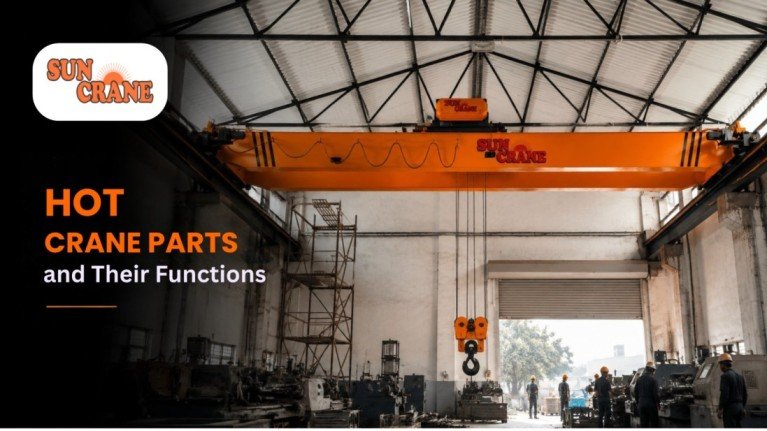
HOT Crane Parts and Their Functions: A Complete Guide for Industrial Users
By Kinjal Thakor 13-06-2026 44
If you work around a HOT crane daily, you already know how it operates. But knowing how it operates and knowing what each part actually does, those are two different things.
When a component fails or starts behaving differently, the person who understands the function of each part responds faster and more accurately. That is the real value of this guide.
Below is a clear breakdown of every major HOT crane part, its function, and what to watch for in actual operation.
What Is a HOT Crane?
HOT stands for Hand Operated Travelling Crane. It is an overhead bridge crane where the operator performs all three motions manually, lifting the load, moving the trolley across the bridge (cross travel), and moving the bridge along the runway (long travel).
There are no electric motors in a standard HOT crane. All motion is driven by pulling hand chains or physically pushing the trolley or bridge. This makes HOT cranes ideal for workshops, warehouses, maintenance areas, and hazardous environments like oil and gas facilities where spark-free operation is required. Standard HOT cranes handle loads from 500 kg up to 10 tonnes, with spans up to 12 meters.
HOT Crane Parts List at a Glance
HOT Crane Parts and Their Functions: Explained
1. Bridge Girder: The Load-Bearing Backbone
Function: Carries the entire weight of the trolley, hoist, and suspended load across the full bay width.
In a standard HOT crane, this is a single I-beam. The trolley runs along its bottom flange. Any permanent deflection or visible sag is a sign of structural fatigue and needs immediate attention.
2. End Carriage Assembly: Connecting Bridge to Runway
Function: Houses the travel wheels and connects the bridge structure to the runway rails, allowing longitudinal crane movement.
The LT drive mechanism is built into the end carriage. They also absorb significant impact loads during end-of-travel stops, a frequently overlooked wear point.
3. Runway Rail: The Travel Path
Function: Provides the fixed path along which the crane bridge travels from one end of the bay to the other.
Unlike EOT cranes, runway rails in HOT cranes carry no electrical conductors. Their only job is structural guidance. Misaligned rails increase wheel flange wear and make long travel noticeably harder for the operator.
4. Trolley Frame: Moving the Load Laterally
Function: Carries the chain pulley block across the bridge girder, handling all cross travel, moving the load left or right within the bay.
The trolley is either push type or geared type. A geared trolley uses a hand chain mechanism for more controlled movement, better suited for heavier loads or longer spans.
5. Chain Pulley Block: The Hoist Unit
Function: Responsible for all vertical movement, lifting the load up and lowering it down. It is the most critical assembly in the HOT crane.
Inside the block, a gear train multiplies the operator's hand chain input into enough lifting force. If the chain pulley block fails, the crane cannot lift. Period.
6. Hand Chain: Operator's Control Input
Function: The operator pulls this closed-loop chain to activate the hoist, one side lifts, the other side lowers.
The hand chain does not carry the load. It only transmits operator force into the mechanism. Worn or kinked links increase effort and can jam inside the chain wheel.
7. Load Chain: The Actual Load Carrier
Function: Directly carries the full weight of the suspended load during every lift cycle, the component under maximum stress in the entire crane.
Any wear, elongation, cracking, or corrosion in the load chain is a direct safety risk. This is one part that must never be used beyond its wear limit.
8. Hand Chain Wheel: Converting Pull to Rotation
Function: The sprocket that engages with the hand chain and drives the internal gear train, which winds the load chain.
Worn teeth cause the hand chain to skip or slip under load, meaning the operator loses control of load movement. Inspect during every periodic maintenance check.
9. Hook and Hook Block: Load Attachment Point
Function: The physical connection between the crane and the load, sling, shackle, or lifting beam attaches here.
The hook rotates freely inside the hook block, letting the suspended load align naturally without twisting the load chain. The safety latch closes the throat to prevent accidental load release.
Note: Points 10–12 (LT Manual Drive Assembly, Reduction Gearbox, and Drive Shaft with Pillow Blocks) apply only to HOT cranes with a geared long travel mechanism. In push-type HOT cranes, the operator moves the bridge manually by pushing, these components are not part of that configuration.
10. LT Manual Drive Assembly: Powering Long Travel
Function: Moves the crane bridge along the runway when the operator pulls the LT hand chain, making long travel practical under load.
Without this assembly, the operator would have to physically push the loaded bridge. The hand chain input goes through the reduction gearbox, then via drive shaft to the travel wheels.
11. Reduction Gearbox (LT): Making Travel Manageable
Function: Steps down the hand chain input speed and multiplies torque, making it physically possible to move a loaded crane bridge manually.
Check oil level and lubrication condition regularly. Unusual noise from the gearbox during travel is an early sign of internal wear.
12. Drive Shaft and Pillow Blocks: Motion Transmission
Function: The drive shaft carries gearbox rotation to the travel wheels on both sides. Pillow block bearings support the shaft at intervals, keeping it aligned and reducing friction.
A dry pillow block creates resistance in the drive system, making long travel noticeably harder. Grease at every maintenance interval without fail.
13. Travel Wheels: Supporting and Guiding Movement
Function: Support the crane on runway rails and keep it tracked during long travel. Wheel flanges prevent lateral drift.
In flameproof HOT cranes for hazardous areas, HTB or bronze-lined wheels are used to eliminate spark risk during rail contact.
14. Buffer / End Stop: Controlling End-of-Travel Impact
Function: Absorbs the kinetic energy of the moving crane when it reaches the permitted end of travel, protecting both the crane and the runway structure.
Even at manual travel speeds, repeated hard contact without buffers causes cumulative structural stress over time.
15. Hook Safety Latch: Preventing Accidental Load Release
Function: A spring-loaded finger that closes the hook throat, preventing the load sling or shackle from slipping out during lifting or travel.
Small component, critical function. A latch that does not spring back to closed position must be replaced before the crane returns to service.
What to Keep as On-Site Spares
The parts most prone to wear are: load chain, hand chain, hook safety latch, hand chain wheel, and travel wheel flanges. Keep these in stock.
When ordering, always confirm:
• Chain pulley block capacity and model
• Chain size, grade, and rated load
• Rail profile for travel wheel compatibility
HOT crane components are not universally interchangeable across brands. Two blocks of the same capacity from different manufacturers may use different chain sizes. Always verify before ordering.
Final Thoughts
A HOT crane is mechanically simple, but simple does not mean there is nothing to understand. Every part plays a defined role in safe, reliable operation.
When maintenance engineers and plant managers understand what each component does, decisions come faster, troubleshooting is more accurate, spare parts ordering is correct, and operational surprises are fewer.
At Sun Crane, we design and supply HOT cranes for industrial facilities across India. If you need guidance on any HOT crane component or want help building a proper spare parts list for your application, our technical team is available to assist.
Frequently Asked Questions
1. What are the main parts of a HOT crane?
A HOT crane consists of a bridge girder, end carriage assemblies, runway rails, a trolley frame, a chain pulley block (which includes the hand chain, load chain, hand chain wheel, and hook), a Long Travel manual drive assembly with reduction gearbox, drive shaft, pillow blocks, travel wheels, and safety components like buffers and hook safety latches.
2. What is the difference between the hand chain and the load chain in a HOT crane?
The hand chain is pulled by the operator to activate the hoist. The load chain is the component that actually carries the suspended weight. Both are inside or attached to the chain pulley block, but they serve completely different functions.
3. How often should HOT crane parts be inspected?
For regular workshop use, a visual inspection before each shift is recommended. A detailed mechanical inspection covering chain condition, hook wear, wheel flanges, gearbox lubrication, and pillow block bearings should be done at least quarterly. Follow the OEM maintenance schedule for your specific crane model.
4. What is the maximum capacity of a standard HOT crane?
Most standard HOT crane configurations support up to 10 tonnes, with spans up to 12 meters. Higher capacities are available in custom configurations depending on manufacturer specifications and application requirements.
5 . Can a HOT crane be used in hazardous or explosion-proof environments?
Yes. HOT cranes are well-suited for hazardous environments because they have no electrical components. Flamepoof variants use HTB or bronze-lined travel wheels, bronze-coated hooks, and bronze-coated hand chains to eliminate any risk of spark generation during operation.
Tags : .....