Guest Posting for SEO: A Practical Approach to Building Quality Backlinks
By Stella Morgan 26-09-2026 3
Building sustainable search visibility requires more than publishing content on your own website. For many businesses, earning mentions and links from relevant third-party websites can also support their broader SEO and digital marketing efforts. One strategy that has remained widely used for this purpose is guest posting.
Guest posting involves creating an original article for another website and contributing useful information to its audience. Depending on the publisher's guidelines, the contributor may receive a relevant backlink to their own website. Beyond the link itself, guest contributions can introduce a brand to new readers, strengthen industry relationships, and create additional referral traffic.
However, successful guest posting isn't simply about publishing as many articles as possible. The real value comes from choosing relevant websites, producing genuinely useful content, and making sure links fit naturally within the context of each article.
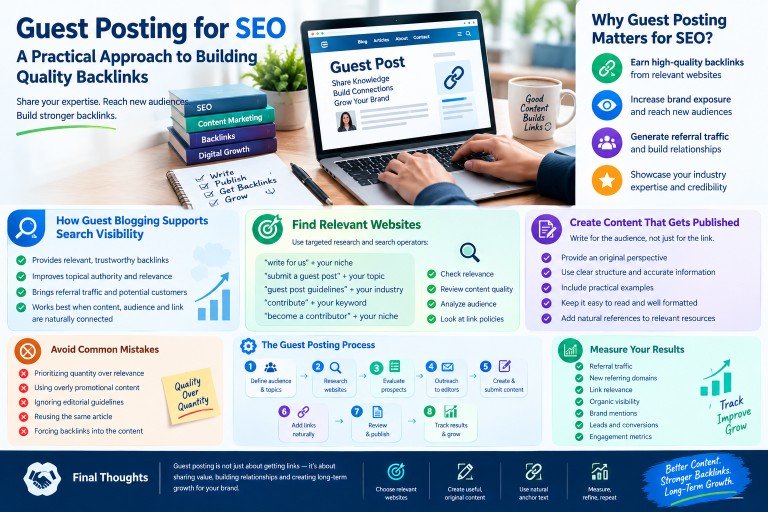
What Makes Guest Posting Valuable for SEO?
Guest blogging gives businesses an opportunity to contribute expertise to websites that already have an established audience. When the publication is relevant to the contributor's industry, the article can provide value to both the host site and the contributor.
One of the main reasons marketers use guest posting is to earn high-quality backlinks from relevant websites. A well-placed link can help readers discover additional resources while also contributing to a site's overall backlink profile.
Guest posting can also support several other objectives, including:
- Increasing brand exposure
- Reaching new audiences
- Generating referral visitors
- Building relationships with publishers
- Demonstrating industry expertise
- Supporting broader content marketing campaigns
The quality and relevance of the publishing website matter considerably. A large number of unrelated or low-value links generally isn't a substitute for a smaller number of meaningful placements.
How Guest Blogging Can Support Search Visibility
Backlinks are one component of how search engines evaluate websites. Links from relevant and trustworthy sources can provide useful signals about the relationships between websites and topics.
For example, a software company contributing an in-depth article to a respected technology publication may gain more relevant exposure than if the same company published an unrelated article on a general website with little connection to its industry.
Guest posting can therefore work best when the content, publisher, audience, and linked page all make sense together.
Referral traffic is another potential benefit. Readers who discover a contributor through a useful article may follow a contextual link to learn more. These visitors can become newsletter subscribers, leads, customers, or returning readers depending on the website and offer.
Finding Relevant Websites for Guest Contributions
Finding suitable publishing opportunities requires targeted research. Rather than contacting random websites, create a list of publications that are connected to your niche and have an audience that could benefit from your expertise.
Search operators can help identify potential opportunities. Examples include:
- “write for us” + your niche
- “submit a guest post” + your topic
- “guest post guidelines” + your industry
- “contribute” + your keyword
- “become a contributor” + your niche
Competitor backlink research can also reveal websites that have previously published contributions from businesses in your industry.
Once potential websites have been identified, review each one before beginning outreach. Check the site's topical relevance, content quality, publishing standards, audience, and existing backlink patterns.
What to Look for Before Choosing a Publishing Site
Not every website that accepts guest articles is automatically a good opportunity. A proper evaluation can help prevent wasted outreach and poor-quality placements.
Consider the following factors:
Topical Relevance
The website should have a clear relationship with your subject or target audience. A contextual connection makes the article more useful and gives the backlink a logical purpose.
Content Standards
Look through recently published articles. Check whether the content is original, well-written, properly edited, and genuinely useful to readers.
Audience Quality
A website with an active and relevant readership can provide value beyond SEO. Readers should have a genuine reason to be interested in your topic or product.
Link Policies
Understand whether the publication allows contextual links, author-bio links, or specific types of promotional references. Always follow its stated editorial requirements.
Existing Content Quality
A website filled with unrelated promotional articles may not provide the same value as a publication with a consistent editorial focus.
Creating Guest Posts That Editors Want to Publish
A strong guest post should be written primarily for the host website's readers. If the article exists only to place a backlink, it is unlikely to provide meaningful long-term value.
Before writing, study the publication's existing content. Identify topics that have already performed well and look for related subjects that haven't been covered thoroughly.
A useful guest article should generally include:
- An original perspective
- Clear and logical structure
- Accurate information
- Practical examples
- Readable formatting
- Helpful takeaways
- Natural references to supporting resources
Avoid rewriting an article that already exists elsewhere. Publishers are more likely to value content that brings something genuinely new to their audience.
Using Anchor Text Naturally
Anchor text should help readers understand what they will find after clicking a link. It should fit naturally into the sentence rather than appearing forced or overly optimized.
For example, if an article discusses different SEO resources, a relevant descriptive phrase can lead readers to a detailed guide on that subject.
Using the same commercial keyword repeatedly across a backlink profile can make the overall strategy look unnatural. A balanced approach may include branded anchors, descriptive phrases, partial matches, and natural contextual references where appropriate.
Most importantly, the linked page should genuinely support the statement being made in the article.
Common Guest Posting Mistakes to Avoid
Several mistakes can reduce the effectiveness of a guest posting campaign.
Prioritizing Quantity Over Relevance
Publishing dozens of articles on unrelated websites may create activity without creating meaningful value. Relevance should be considered before volume.
Using Overly Promotional Content
Guest articles should educate or help readers rather than read like advertisements. Excessive promotion can make content difficult for publishers to accept.
Ignoring Editorial Guidelines
Every publication has its own requirements. Ignoring word counts, formatting rules, linking policies, or topic restrictions can lead to unnecessary rejection.
Reusing the Same Article
Submitting nearly identical content to multiple publications reduces originality. Each contribution should be created specifically for its intended audience.
Forcing Backlinks Into the Content
A link should support the surrounding information. If it doesn't naturally fit the paragraph, it may be better to leave it out.
Building a Sustainable Guest Posting Process
Guest posting becomes easier to manage when it is treated as an ongoing process instead of a series of isolated placements.
Start by defining your target industries and audience. Then build a prospect list, evaluate websites, organize outreach, create customized content, and track published placements.
A simple workflow can look like this:
- Define your target audience and topics.
- Research relevant publishing websites.
- Evaluate each prospect for relevance and quality.
- Contact editors or website owners.
- Agree on the topic and editorial requirements.
- Create original content for the publication.
- Add relevant links naturally.
- Review the published article.
- Track the placement and referral activity.
Keeping records of publishers, topics, URLs, anchor text, publication dates, and campaign results can also make future outreach more organized.
Measuring the Results of Guest Posting
SEO results can take time, so guest posting shouldn't be evaluated solely by immediate ranking changes.
Useful metrics include:
- Referral traffic
- New referring domains
- Link relevance
- Organic visibility
- Brand mentions
- Engagement from referred visitors
- Leads generated through referral traffic
- Quality and consistency of published placements
Looking at these metrics together provides a more complete picture of whether the campaign is contributing to your overall marketing strategy.
Final Thoughts on Guest Posting for SEO
Guest posting can be a useful part of a broader SEO and content marketing strategy when it is approached with quality and relevance in mind.
The strongest campaigns focus on websites that are genuinely connected to the target audience, while the content itself provides information that readers would find valuable even without the backlink.
Instead of chasing the highest possible number of placements, focus on creating useful articles, building relationships with reputable publishers, maintaining natural linking practices, and measuring the results over time. This approach makes guest posting a more sustainable part of long-term digital marketing rather than simply a tactic for acquiring links.
Tags : .....